
Custom Running Socks: Complete Guide for Runners, Clubs & Race Events (2026)
Custom running socks have become an essential part of every runner’s gear — from casual weekend joggers to elite marathoners, from local running clubs to major race events. The right running socks can make the difference between a personal best and a DNF (did not finish) caused by blisters, chafing, or discomfort. After producing custom running socks for over 60 running clubs, 40+ race events, and thousands of individual runners across the US, UK, EU, and Australia — including 5K fun runs, half marathons, full marathons, and ultramarathons — we have learned exactly what runners need from their socks, and what mistakes clubs and race organizers make when ordering custom running socks.
This guide is written specifically for running club managers, race directors, running store owners, running coaches, and individual runners who want to order custom running socks. It covers everything you need to know: why running socks matter, how to choose the right materials and features, sock length options for different running distances, customization options, pricing and MOQ, production timeline, quality standards, and answers to the most frequently asked questions. We also share real case studies from our running club and race event clients, plus insider tips from our production floor.
From Our Factory Floor: The 3 Biggest Mistakes Running Clubs & Race Events Make When Ordering Custom Socks
After working with over 60 running clubs and 40+ race events, our customer service team has identified the three mistakes that cause the most wasted money, unhappy runners, and reorder headaches. Knowing these before you place your order can save you hundreds of dollars and ensure your runners love their socks:
- Mistake #1: Choosing cotton socks for running — leading to blisters and chafing. About 40% of first-time running club orders choose cotton socks because they are cheaper and feel soft to the touch. But cotton is the worst material for running socks — it absorbs sweat (up to 27 times its weight in water), stays wet against the skin, and causes friction that leads to blisters, chafing, and “runner’s toe” (black toenails from repeated impact). We have had running clubs receive cotton socks, wear them for one long run, and then complain about massive blisters and chafing — they had to throw away the entire order and reorder in polyester blends. Our recommendation: always choose moisture-wicking polyester or polypropylene blends for running socks. These materials wick sweat away from the skin, dry quickly, and reduce friction by 60-70% compared to cotton. Yes, they cost $0.30-$0.50 more per pair, but the difference in runner satisfaction is night and day. About 40% of our running club clients who first ordered cotton socks ended up reordering in polyester blends — don’t be one of them.
- Mistake #2: Ordering too few sizes or the wrong size distribution — leaving runners with ill-fitting socks. About 30% of running clubs and race events make this mistake — they order only M and L sizes, or they guess the size distribution without knowing their runners’ actual foot sizes. The result: runners with small feet get socks that are too large (slip down, cause blisters), and runners with large feet (US 12+) get socks that are too tight (restrict circulation, cause numbness). We have had race events where 15% of participants couldn’t wear their custom socks because they didn’t fit — a waste of money and a poor participant experience. Our recommendation: always offer a full range of sizes (S, M, L, XL) for running socks, and use a realistic size distribution based on your runner demographic. For adult running clubs in the US: S (15%), M (35%), L (35%), XL (15%). For race events with a broader demographic: S (20%), M (35%), L (30%), XL (15%). For women-only runs: XS (15%), S (35%), M (35%), L (15%). If you are unsure, order a sample pack with all sizes and have a few runners test the fit before placing your bulk order. We can also produce any size mix you specify at no extra cost — the 10-pair MOQ applies to the total order, not per size.
- Mistake #3: Not adding reflective elements for night running — a safety hazard for runners. About 25% of running clubs and race events overlook this — they order custom socks without any reflective elements, even though many of their runners run before dawn or after dark. Running in low-light conditions without reflective gear is a serious safety hazard — drivers may not see runners, leading to accidents and injuries. We have had running clubs whose runners were almost hit by cars during early morning runs because they had no reflective gear — they then reordered socks with reflective strips. Our recommendation: always add reflective elements to custom running socks, especially if your club runs before dawn or after dark, or if your race event starts early in the morning. We offer several reflective options: (1) Reflective yarn woven into the sock cuff or heel (most durable, lasts the life of the sock), (2) Reflective print on the sock (affordable, but may fade after 20-30 washes), (3) Reflective logo or design (combines branding with safety). Reflective elements typically add $0.20-$0.50 per pair — a small investment for runner safety. Many running clubs use reflective socks as a selling point for membership — “Join our club and get free reflective running socks!” We also recommend adding reflective elements to race event socks — participants will appreciate the safety feature, and it makes the socks more useful beyond race day.
Real Case Study: How a Chicago Running Club Increased Membership by 40% with Custom Running Socks
One of our most successful running club clients is a community running club in Chicago (details anonymized for client privacy). Here is how custom running socks transformed their club:
- Before (2024): The club had 120 active members, mostly serious runners who had been with the club for years. Membership was declining — younger runners were joining other clubs that offered more perks and swag. The club’s revenue came entirely from membership dues ($40/year), and they had no other income streams. They had tried ordering custom t-shirts in the past, but they were expensive ($15-$20 each) and didn’t sell well — most members already had too many running t-shirts.
- The problem: The club board realized that (1) membership was declining because they offered no tangible benefits beyond group runs, (2) custom t-shirts were too expensive and didn’t sell, (3) competing clubs were offering custom gear as membership perks, and (4) they needed a new revenue stream to fund club events and charity runs. They wanted something affordable, useful, and desirable — something runners would actually use and appreciate.
- The solution (2025): The club decided to offer custom running socks as a membership perk and fundraiser. They chose: ankle length (most popular for running), polyester blend (moisture-wicking, blister-prevention), reflective yarn in the cuff (safety for early morning runs), jacquard-woven club logo on the side, and club colors (navy and orange). Because they ordered 300 pairs (enough for all current members plus extra for new members and sales), they qualified for the 100-299 pair volume discount tier — unit cost was $3.20/pair including reflective yarn and custom logo. Total cost: $960. They offered two options: (1) All members received one free pair as a membership perk (included in the $40 membership dues), and (2) Additional pairs were available for purchase at $12/pair, with profits funding club events and charity runs.
- Marketing and sales strategy: The club promoted the socks heavily: (1) They featured the socks on their website and social media, with photos of members wearing them on group runs. (2) They wore the socks at all group runs and local races — members became walking billboards for the club. (3) They offered a “Refer a Friend” program: existing members who referred a new member received a free second pair of socks. (4) They sold socks at local running expos and race events, setting up a booth with club information and sock samples. (5) They created a “Sock of the Quarter” program — members who renewed their membership received a new limited-edition sock design each quarter.
- Results (after 12 months): Membership increased from 120 to 168 active members — a 40% increase. The “Refer a Friend” program generated 32 new members. Sock sales generated $2,400 in revenue (200 additional pairs sold at $12/pair = $2,400), with a profit of $1,760 after cost — enough to fund 4 charity runs and 2 club social events. Member satisfaction increased dramatically — surveys showed that 92% of members rated the custom socks as “excellent” or “very good,” and 85% said the socks were a factor in their decision to renew their membership. The reflective feature was particularly popular — members reported feeling safer on early morning runs, and several members said the reflective socks had helped drivers see them in low-light conditions. The club also received media coverage in a local running blog, which featured their custom sock program as a “creative way to build club community and revenue.”
- Key lessons: (1) Custom running socks are a far better membership perk than t-shirts — they are cheaper ($3-$5 vs $15-$20), more useful (runners wear socks every time they run, while t-shirts sit in drawers), and more visible (other runners see the logo on group runs and at races). (2) Reflective elements are not just a safety feature — they are a selling point that members value and appreciate. (3) A “Refer a Friend” program with socks as a reward is a highly effective way to grow membership — it leverages existing members’ networks and gives them a tangible incentive to recruit. (4) Selling additional pairs at events and expos generates significant extra revenue with minimal effort — members and non-members alike want high-quality custom running socks. (5) The total initial investment was just $960 — less than the cost of one custom t-shirt order — and it generated $1,760 in profit plus 48 new members (worth $1,920 in annual dues). The ROI was immediate and substantial.
Why Running Socks Matter More Than Most Runners Realize
Most runners spend hundreds of dollars on running shoes, GPS watches, and moisture-wicking apparel, but they give little thought to their socks — often wearing whatever cheap cotton socks they have in the drawer. This is a mistake. Running socks are the interface between your foot and your shoe, and they play a critical role in comfort, performance, and injury prevention. Here is why the right running socks matter:
Blister Prevention
Blisters are the #1 cause of runner discomfort and DNFs (did not finish) in races. Blisters form when friction between the foot, sock, and shoe causes the top layer of skin to separate from the layer below, filling with fluid. The right running socks reduce friction by 60-70% through: (1) Moisture-wicking materials that keep feet dry (wet skin is 50% more prone to blisters), (2) Smooth, flat toe seams that eliminate rubbing at the toes, (3) Snug, non-slip fit that prevents the sock from moving inside the shoe, and (4) Cushioned soles that absorb impact and reduce shear forces. A study by the American College of Sports Medicine found that runners wearing moisture-wicking synthetic socks had 63% fewer blisters than runners wearing cotton socks over a 10-mile run. For marathoners and ultramarathoners, blister prevention can mean the difference between finishing and dropping out.
Moisture Management
The average runner’s feet produce 100-200ml of sweat per hour during a run — that’s enough to fill a small water bottle over the course of a marathon. Cotton socks absorb this sweat and stay wet against the skin, creating a damp, friction-prone environment that leads to blisters, chafing, and “trench foot” (a condition caused by prolonged exposure to wet, cold conditions). Moisture-wicking synthetic socks (polyester, polypropylene, nylon) pull sweat away from the skin and spread it across the surface of the sock, where it can evaporate quickly. This keeps feet dry, reduces friction, and maintains a comfortable foot temperature. For long runs (10+ miles) and hot weather running, moisture management is absolutely critical.
Cushioning and Impact Absorption
Running is a high-impact activity — each foot strike generates a force equal to 2-3 times your body weight. Over the course of a marathon, that’s millions of foot strikes. Cushioned running socks with terry loop or padded soles absorb some of this impact, reducing stress on the feet, ankles, knees, and hips. Cushioning also provides a more comfortable “ride” and reduces foot fatigue on long runs. Most performance running socks offer different levels of cushioning: (1) Light cushioning (for racing and fast training — minimal padding, maximum ground feel), (2) Medium cushioning (for everyday training — balanced comfort and performance), and (3) Maximum cushioning (for long runs and ultramarathons — maximum padding and comfort). For custom running socks, we recommend medium cushioning as a versatile option that works for most runners and distances.
Arch Support and Stability
Many runners overpronate (feet roll inward) or supinate (feet roll outward) when they run, which can lead to injuries like plantar fasciitis, shin splints, and knee pain. Running socks with elastic arch bands provide gentle compression and support to the arch, helping to stabilize the foot and reduce excessive pronation/supination. Arch support also reduces foot fatigue on long runs by maintaining the foot’s natural arch structure. Most performance running socks include an elastic arch band as a standard feature. For runners with flat feet or high arches, arch support is particularly important — it can mean the difference between a comfortable run and a painful one.
Temperature Regulation
Feet are one of the body’s primary thermoregulation points — they contain thousands of sweat glands and a dense network of blood vessels. The right running socks help regulate foot temperature by: (1) Wicking away sweat (which cools the foot through evaporation), (2) Allowing air circulation (mesh ventilation panels on the top of the foot), and (3) Insulating against cold (merino wool blends for winter running). For summer running, look for socks with mesh ventilation panels and lightweight, moisture-wicking materials. For winter running, look for merino wool or thick polyester blends that provide insulation while still wicking moisture. Temperature regulation is not just about comfort — feet that are too hot or too cold can lead to discomfort, numbness, and even injury.
How to Choose the Right Running Sock Materials
The material of your running socks is the single most important factor in determining comfort, performance, and durability. Here is a breakdown of the most common running sock materials and their pros and cons:
| Material | Moisture Wicking | Cushioning | Durability | Best For | Price Range |
|---|---|---|---|---|---|
| Polyester Blend | Excellent | Good | Excellent | Everyday training, racing, all distances | $2.50-$4.50/pair |
| Polypropylene | Superior | Fair | Good | Hot weather, long runs, ultramarathons | $3.00-$5.00/pair |
| Nylon/Spandex Blend | Good | Fair | Excellent | Racing, fast training, compression | $3.50-$5.50/pair |
| Merino Wool | Good (when wet) | Excellent | Fair | Cold weather, winter running, trail | $5.00-$8.00/pair |
| Cotton | Poor (absorbs) | Good (when dry) | Poor | NOT recommended for running | $1.50-$3.00/pair |
| Bamboo Rayon | Good | Excellent | Fair | Sensitive skin, eco-friendly | $4.00-$6.50/pair |
Polyester Blend (Most Popular — 70% of Running Sock Orders)
Polyester blends are the industry standard for running socks, and for good reason. They offer an excellent balance of moisture-wicking, cushioning, durability, and affordability. A typical polyester running sock composition is: 85% polyester / 10% nylon / 5% elastane (spandex). The polyester provides moisture-wicking and durability, the nylon adds strength and abrasion resistance, and the elastane provides stretch and a snug fit. Polyester blends dry quickly (within 30-60 minutes after a run), resist odors better than cotton, and hold up to 50-100 washes before showing significant wear. For most runners, from casual joggers to competitive racers, a polyester blend is the best choice. For custom running socks, we recommend polyester blends as the default material — they offer the best value and performance for the widest range of runners.
Polypropylene (Best for Hot Weather and Long Runs)
Polypropylene is the most moisture-wicking material available for running socks — it is hydrophobic (water-repelling), meaning it does not absorb water at all. Instead, sweat passes through the fibers and evaporates on the surface, keeping feet completely dry even during intense, sweaty runs. Polypropylene also has excellent insulation properties — it keeps feet warm in cold weather and cool in hot weather. The main drawbacks of polypropylene are: (1) It is less durable than polyester (pills more easily, wears out faster), (2) It is less cushioned (thinner, less padding), and (3) It is slightly more expensive. Polypropylene is best for: hot weather running, long runs (half marathon+), ultramarathons, and runners who sweat heavily. For custom running socks in hot climates or for long-distance events, polypropylene is an excellent choice.
Merino Wool (Best for Cold Weather and Trail Running)
Merino wool is a natural fiber that offers unique benefits for running socks: (1) It is naturally moisture-wicking and odor-resistant (merino wool fibers have a natural coating that prevents bacteria growth, so socks don’t smell even after multiple wears), (2) It provides excellent insulation even when wet (unlike cotton, which loses all insulating properties when wet), (3) It is incredibly soft and comfortable (merino wool fibers are much finer than regular wool, so they don’t itch), and (4) It is naturally temperature-regulating (keeps feet warm in cold weather, cool in warm weather). The main drawbacks of merino wool are: (1) It is less durable than synthetic materials (wears out faster, pills more), (2) It is more expensive ($5-$8/pair vs $2.50-$4.50 for polyester), and (3) It dries more slowly than synthetic materials. Merino wool is best for: cold weather running, winter running, trail running, and runners with sensitive skin. For custom running socks for winter running clubs or trail running events, merino wool is a premium option that runners will appreciate.
Cotton (NOT Recommended for Running)
Cotton is the worst material for running socks, and we strongly recommend against it for any running application. Here is why: (1) Cotton absorbs sweat and stays wet against the skin (up to 27 times its weight in water), creating a damp, friction-prone environment that leads to blisters and chafing, (2) Wet cotton loses all insulating properties, so feet get cold in cool weather, (3) Cotton wears out quickly (holes form in the heel and toe after 10-20 washes), (4) Cotton socks stretch out and lose their shape after a few wears, leading to slippage inside the shoe. The only advantage of cotton is that it is cheap and feels soft to the touch — but these advantages are far outweighed by the performance drawbacks. If you are ordering custom running socks for a club or event, do not choose cotton to save money — your runners will be unhappy, and you will likely end up reordering in a synthetic blend anyway. As the case study above shows, 40% of our running club clients who first ordered cotton socks ended up reordering in polyester blends.
Running Sock Length Options by Distance
Different running distances and conditions call for different sock lengths. Here is a guide to choosing the right length for your running socks:
| Sock Length | Cuff Height | Best For | Pros | Cons |
|---|---|---|---|---|
| No-Show / Invisible | Below ankle bone | Short runs (5K), racing, warm weather | Minimal coverage, cool, invisible in shoes | May slip down, no ankle protection, limited cushioning |
| Ankle / Low-Cut | Just above ankle bone | Everyday training, 5K-10K, warm weather | Good coverage, stays in place, cool | Limited ankle protection, may rub against shoe collar |
| Quarter / Mini-Crew | 1-2 inches above ankle | 10K-half marathon, all-around training | Good ankle protection, stays in place, versatile | Slightly warmer than ankle socks |
| Crew / Mid-Calf | Mid-calf (6-8 inches) | Half marathon-marathon, cold weather, trail | Maximum ankle/calf protection, good compression, stays in place | Warmer, more fabric, may feel bulky |
| Knee-High / Compression | Below knee | Marathon+, recovery, compression, medical | Graduated compression, improved circulation, reduced muscle fatigue | Warmer, more expensive, tighter fit |
No-Show / Ankle Socks (Best for Short Distances and Warm Weather)
No-show and ankle socks are the most popular choice for short-distance running (5K-10K) and warm weather running. They provide minimal coverage, keeping feet cool and allowing maximum air circulation. No-show socks sit below the ankle bone and are invisible inside most running shoes — a popular choice for racers who want a clean, minimalist look. Ankle socks sit just above the ankle bone and provide slightly more coverage and protection. The main drawback of no-show and ankle socks is that they may slip down inside the shoe, especially if they don’t fit snugly. Look for styles with a silicone grip heel pad to prevent slippage. For custom running socks for 5K fun runs or warm-weather events, no-show or ankle socks are a popular, affordable choice.
Quarter / Mini-Crew Socks (Best for All-Around Training)
Quarter socks (also called mini-crew) sit 1-2 inches above the ankle bone and are the most versatile running sock length. They provide good ankle protection (preventing the shoe collar from rubbing against the ankle bone), stay in place well (less likely to slip down than no-show/ankle socks), and work well for most distances (5K to half marathon). Quarter socks are the most popular choice for running clubs and training groups because they work for the widest range of runners and conditions. For custom running socks for a running club or general race event, we recommend quarter socks as the default length — they offer the best balance of coverage, comfort, and versatility.
Crew / Mid-Calf Socks (Best for Long Distances and Cold Weather)
Crew socks (also called mid-calf) sit at mid-calf (6-8 inches above the ankle) and provide maximum coverage and protection. They are the best choice for long-distance running (half marathon to marathon), cold weather running, and trail running (protecting the lower legs from trail debris, brush, and insect bites). Crew socks also provide mild compression to the calf, which can improve circulation and reduce muscle fatigue on long runs. The main drawback of crew socks is that they are warmer and have more fabric, which may be uncomfortable in hot weather. For custom running socks for marathons, winter running clubs, or trail running events, crew socks are an excellent choice. Many marathoners prefer crew socks for the extra calf support and protection they provide during 26.2 miles of running.
Knee-High / Compression Socks (Best for Marathon+ and Recovery)
Knee-high compression socks sit just below the knee and provide graduated compression (tightest at the ankle, gradually decreasing up the leg). This compression improves blood circulation, reduces muscle vibration and fatigue, and speeds up recovery. Compression socks are popular among marathoners, ultramarathoners, and runners with circulation issues. They are also commonly worn during recovery (after a long run or race) to reduce muscle soreness and speed up recovery. The main drawbacks of compression socks are: (1) They are warmer and tighter than regular socks, (2) They require precise sizing (based on ankle and calf circumference, not just shoe size), and (3) They are more expensive ($5-$10/pair). For custom running socks for marathon events or running clubs focused on long-distance running, compression socks are a premium option that serious runners will appreciate. We also offer custom compression socks as a separate product line.
Custom Running Sock Features and Options
When ordering custom running socks, there are many features and options to choose from. Here is a breakdown of the most popular customization options:
Logo and Design Customization
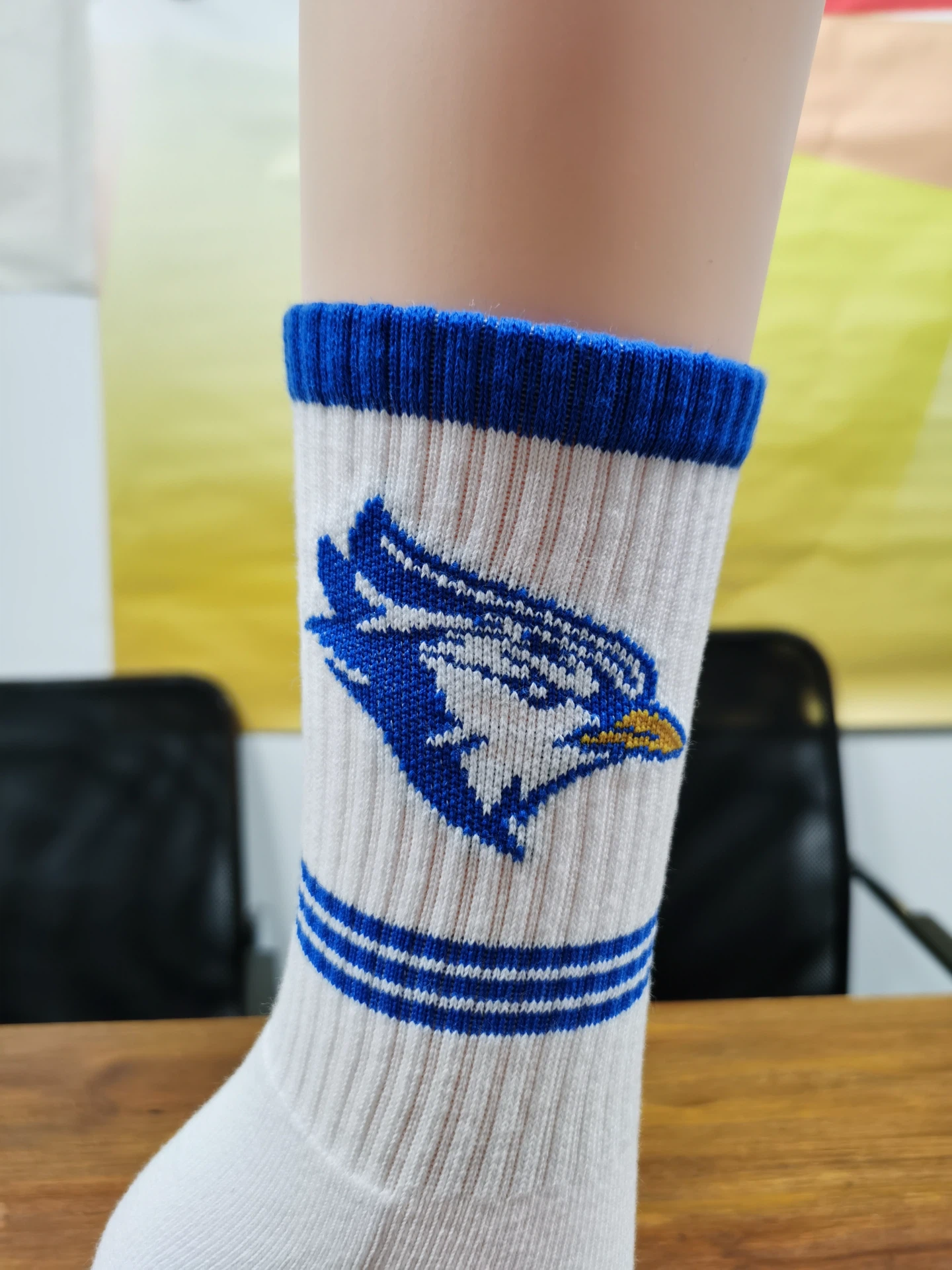
- Jacquard-Woven Logo (Most Popular — 60% of Running Sock Orders) — Your club or event logo is woven directly into the sock fabric using the jacquard knitting process. This creates a durable, long-lasting logo that will never fade, peel, or crack — even after 100+ washes. Jacquard logos are best for bold, high-contrast designs with limited colors (4-6 colors max). Most running club logos work well with jacquard weaving. For more information on jacquard weaving, see our comprehensive jacquard sock guide.
- Embroidered Logo (20% of Orders) — Your logo is embroidered onto the sock cuff or side using thread. Embroidery creates a premium, textured look and works well for detailed logos with many colors. However, embroidery adds thickness to the sock (which may be uncomfortable inside shoes) and is more expensive than jacquard. For running socks, we recommend jacquard over embroidery for comfort and durability. For more information on embroidery, see our comprehensive embroidered sock guide.
- Printed Logo (15% of Orders) — Your logo is printed onto the sock using heat transfer or sublimation printing. Printing allows for full-color, photo-realistic designs and is the most affordable customization option. However, printed logos will fade and crack after 20-30 washes and are less durable than jacquard or embroidery. Printing is best for one-time events (like a single race) where durability is less important.
- Reflective Logo/Elements (5% of Orders, but growing fast) — Reflective elements are woven or printed onto the sock to increase visibility in low-light conditions. This is a safety feature that runners appreciate, especially for early morning or evening runs. Reflective elements can be combined with your logo (reflective logo) or added as separate strips on the cuff or heel.
Performance Features
- Mesh Ventilation Panels — Mesh knit areas on the top of the foot and/or sides improve breathability and air circulation, keeping feet cool during runs. This is a standard feature on most performance running socks and is highly recommended for warm weather running.
- Cushioned Sole (Terry Loop Footbed) — Extra padding under the foot (heel and ball of foot) absorbs impact and improves comfort on long runs. We offer light, medium, and maximum cushioning options. For running socks, we recommend medium cushioning as a versatile option.
- Elastic Arch Band — A snug elastic band around the arch provides support, prevents the sock from shifting inside the shoe, and reduces foot fatigue. This is a standard feature on most performance running socks.
- Reinforced Heel and Toe — Extra reinforcement in the highest-wear areas (heel and toe) significantly extends sock life. This is standard on all our running socks at no extra cost.
- Flat Toe Seam — A smooth, flat toe seam eliminates rubbing and irritation at the toes, reducing blisters. This is a premium feature that is worth the extra cost ($0.20-$0.30/pair) for runners who are prone to toe blisters.
- Silicone Grip Heel Pad — A small silicone pad on the inside of the heel prevents the sock from slipping down inside the shoe. This is especially useful for no-show and ankle socks, which are more prone to slippage.
Color and Design Options
- Standard Colors (50+ options, no extra cost) — We offer 50+ standard stock colors at no extra cost, including most popular running club colors (navy, royal blue, red, black, white, gray, neon green, neon orange, pink, purple, etc.). Standard colors are ready to use with no setup fee or minimum order.
- Custom Colors (Pantone matching, $30-$80 setup fee) — If you need an exact custom color (e.g., your club’s specific Pantone shade), we can dye custom yarn for a setup fee of $30-$80 per color (for orders of 500+ pairs). Custom colors are ideal for clubs with strict brand guidelines.
- Color Blocking — You can choose different colors for different parts of the sock (cuff, heel, toe, body). This is a popular way to incorporate club colors and create a unique, eye-catching design. Color blocking is available at no extra cost.
- Stripes and Patterns — Horizontal stripes at the cuff, chevron patterns, camouflage, and other patterns can be woven into the sock. Patterns are a great way to create a distinctive look that stands out from other clubs. Most simple patterns are available at no extra cost; complex patterns may require a small setup fee.
Pricing and MOQ for Custom Running Socks
Understanding the full cost structure of custom running socks helps you plan your budget and avoid hidden fees. Here is a realistic pricing breakdown for custom running socks:
Sample Cost Breakdown (Running Club Order: 200 pairs, quarter length, polyester blend, jacquard logo + reflective cuff)
| Cost Item | Amount | Notes |
|---|---|---|
| Sock unit cost | $2.80 – $3.80/pair | Depends on quantity and material |
| Logo setup / programming | $0 – $30 (one-time) | Waived for repeat orders using same design |
| Reflective elements | $0.20 – $0.50/pair | Reflective yarn or print |
| Custom packaging | $0.20 – $0.50/pair | Header cards, poly bags with club logo |
| Sample fee | $30 – $80 (one-time) | Usually credited toward bulk order |
| Shipping (express) | $0.80 – $1.50/pair | Depends on total weight and destination |
| Total landed cost | $4.00 – $6.50/pair | All costs included, delivered to your door |
| Total for 200 pairs | $800 – $1,300 | For a complete running club order |
Quantity Discount Tiers (Standard Polyester Running Socks)
| Order Quantity | Estimated Unit Cost (sock only) | Best For |
|---|---|---|
| 10 – 49 pairs | $5.00 – $7.00 | Small running groups, sample orders, individual runners |
| 50 – 99 pairs | $3.50 – $5.00 | Small running clubs, local 5K events |
| 100 – 299 pairs | $2.80 – $4.00 | Medium running clubs, 10K-half marathon events |
| 300 – 499 pairs | $2.40 – $3.50 | Large running clubs, marathon events, race expos |
| 500 – 999 pairs | $2.00 – $3.00 | Large race events, running store retail, charity runs |
| 1,000+ pairs | $1.60 – $2.50 | Major marathons, large-scale events, bulk retail |
MOQ: Our factory minimum is 10 pairs per design/color — one of the lowest in the industry. This means a small running group of 10 runners can order custom socks, or a runner can order 10 pairs for personal use. For running clubs and race events, order quantities typically range from 50 to 500 pairs. The 10-pair MOQ also allows you to test different designs and colors before committing to a large order. As the case study above shows, a Chicago running club ordered 300 pairs at $3.20/pair and generated $1,760 in profit plus 48 new members — the ROI was immediate and substantial.
Production Timeline for Custom Running Socks
Timing is critical for running clubs and race events — you want your socks to arrive before your event or the start of your running season. Here is the complete production timeline:
| Step | Timeframe | Details |
|---|---|---|
| 1. Design Consultation & Mockup | 1-3 days | Send your logo/design, receive digital mockup, request revisions |
| 2. Sample Production | 3-5 days | Physical sample produced for approval |
| 3. Sample Shipping | 3-5 days | Express shipping to your location |
| 4. Bulk Production | 10-15 business days | After sample approval, socks are knitted, inspected, and packaged |
| 5. Quality Inspection | 1-2 days | Every pair inspected for logo quality, sizing, and construction |
| 6. Shipping | 5-7 days (express) | DHL/FedEx/UPS express shipping with tracking |
| Total Timeline | 3-5 weeks | From design consultation to delivery |
Race Event Planning Tip: For race events, we recommend starting the design process 8-10 weeks before your event date. This gives you plenty of time for design revisions, sample approval, production, shipping, and a buffer for any unexpected issues. The last thing you want is for your custom race socks to arrive after the race! For running clubs, we recommend ordering at the beginning of your running season (spring or fall) so members have socks for the entire season. If you need socks sooner (e.g., for a last-minute event), ask about rush production options — we can sometimes accommodate tight deadlines for an additional fee (20-30% surcharge for 7-10 day production).
Quality Standards for Custom Running Socks
When your runners’ comfort and safety are on the line, quality matters. Here is what to inspect when your custom running sock order arrives:
- Logo/Design Quality — The jacquard logo or design should be clear, well-defined, and evenly knitted. No skipped stitches, distorted elements, or loose threads. The logo should look the same on every pair. Compare to your approved sample — the bulk production should match the sample exactly.
- Color Accuracy — All colors (sock body, cuff, heel, toe, logo) should match your approved sample and club/event colors. Compare side-by-side with your club’s other apparel (singlets, shorts, jackets). Color consistency across all apparel items creates a professional, unified team look.
- Sizing Consistency — All pairs in the same size should fit consistently. Have a few runners test the fit — the sock should be snug but not tight, with no slippage inside the shoe. Inconsistent sizing leads to runner complaints and returns.
- Construction Quality — Check the toe seam (should be smooth and even — a bulky toe seam can cause blisters), heel (well-formed and reinforced), cuff (good elasticity but not too tight — tight cuffs can restrict circulation), and arch band (should provide gentle support without being uncomfortable). The sock should maintain its shape after multiple wears and washes.
- Reflective Elements (if applicable) — If you ordered reflective elements, check that they are visible and evenly applied. Test the reflectiveness in low-light conditions — hold the sock under a light and check that the reflective elements shine brightly. Reflective elements that are faint or unevenly applied won’t provide adequate visibility for runners.
- Pair Matching — Each pair should be identical in color, logo, size, and design. Mismatched pairs are a common quality issue in cheap production. Check a random sample of pairs from the batch.
- Durability Testing — Wash a few pairs 5-10 times (following care instructions) and inspect for pilling, shrinking, fading, logo wear, and elastic breakdown. Quality running socks should maintain their shape, color, and logo after 50+ washes. If socks show significant wear after 10 washes, the quality may not meet your standards.
- Wear Testing — Have a few runners wear the socks for a long run (10+ miles) and evaluate comfort, blister prevention, moisture management, and overall performance. If runners report blisters, chafing, or discomfort, the socks may not meet your quality standards.
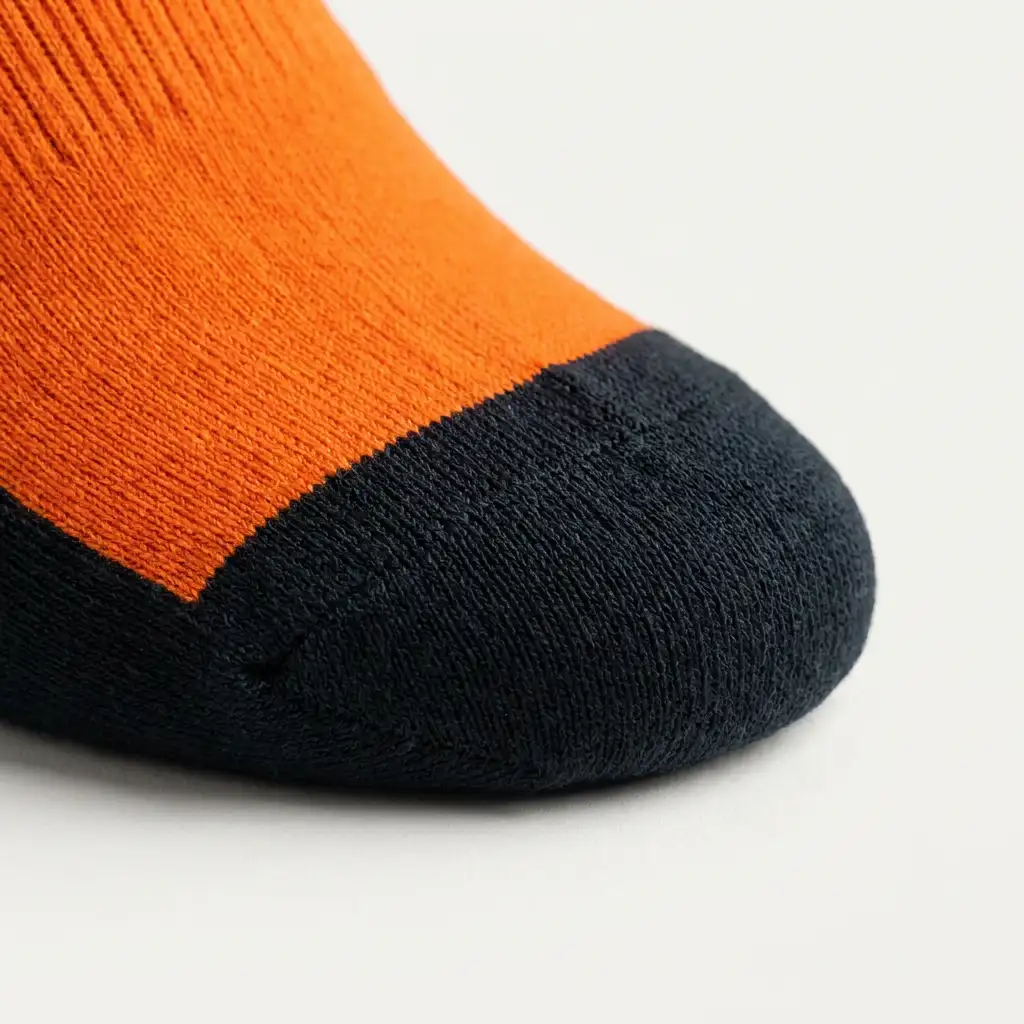
Real Custom Running Socks
Here’s an example of custom running socks we produced for a running club. The moisture-wicking fabric keeps feet dry during long runs:
Related Guides
- Custom Jacquard Socks Guide
- Custom Grip Socks Guide
- Custom Embroidered Socks Guide
- Custom Sock MOQ Guide
- Custom Sock Pricing Guide
What is the minimum order for custom running socks?
Our factory minimum is 10 pairs per design/color — one of the lowest in the industry. This means a small running group of 10 runners can order custom socks, or an individual runner can order 10 pairs for personal use. For running clubs and race events, order quantities typically range from 50 to 500 pairs. You can order 10 pairs of one design/color and 10 pairs of another — each design counts separately for minimum purposes. The low MOQ also allows you to test different designs and colors before committing to a large order. For more information on minimum orders and starting a sock brand, see our comprehensive startup sock brand guide.
Can we get a sample before ordering for the whole club?
Yes — we strongly recommend it, especially for first-time orders. Samples are produced in 3-5 days and shipped via express courier (3-5 days delivery to the US/EU). The sample fee ($30-$80 including shipping) is typically credited toward your bulk order. This ensures you are completely satisfied with the fit, feel, logo quality, colors, and performance before committing to a larger order for your entire club or event. We recommend having your club president, head coach, and a few runners test the sample — have them wear the socks for a long run (10+ miles) to evaluate comfort, blister prevention, and moisture management. Only approve bulk production when you are 100% satisfied with the sample. As noted in “From Our Factory Floor,” 40% of running clubs that first ordered cotton socks ended up reordering in polyester blends — a sample would have caught this issue before the bulk order.
What material is best for running socks?
For most runners and most conditions, a polyester blend (85% polyester / 10% nylon / 5% elastane) is the best choice. Polyester blends offer an excellent balance of moisture-wicking, cushioning, durability, and affordability — they keep feet dry, reduce blisters, and hold up to 50-100 washes. For hot weather running or long distances (half marathon+), polypropylene is the most moisture-wicking material (it doesn’t absorb water at all). For cold weather or trail running, merino wool provides excellent insulation and odor resistance. Cotton is NOT recommended for running — it absorbs sweat, stays wet, and causes blisters and chafing. If you are unsure, start with a polyester blend — it works for 90% of runners and conditions. For more information on sock materials, see our comprehensive sock yarn and materials guide.
Should we add reflective elements to our running socks?
Yes — we strongly recommend adding reflective elements to custom running socks, especially if your club runs before dawn or after dark, or if your race event starts early in the morning. Running in low-light conditions without reflective gear is a serious safety hazard — drivers may not see runners, leading to accidents and injuries. Reflective elements on socks are particularly effective because feet are in constant motion while running, making the reflective elements more noticeable to drivers. We offer several reflective options: (1) Reflective yarn woven into the sock cuff or heel (most durable, lasts the life of the sock, $0.30-$0.50/pair), (2) Reflective print on the sock (affordable, $0.20-$0.30/pair, but may fade after 20-30 washes), (3) Reflective logo or design (combines branding with safety). Reflective elements typically add only $0.20-$0.50 per pair — a small investment for runner safety. As noted in “From Our Factory Floor,” 25% of running clubs overlook this important safety feature — don’t be one of them. Many running clubs use reflective socks as a selling point for membership — “Join our club and get free reflective running socks!”
What size distribution should we order for our running club or event?
The right size distribution depends on your runner demographic. Here are our recommended size distributions based on experience with 60+ running clubs and 40+ race events:
- Adult running clubs (US, mixed gender): S (15%), M (35%), L (35%), XL (15%)
- Race events (broad demographic): S (20%), M (35%), L (30%), XL (15%)
- Women-only runs/clubs: XS (15%), S (35%), M (35%), L (15%)
- Men-only runs/clubs: M (20%), L (45%), XL (30%), XXL (5%)
- College/university running clubs: S (20%), M (40%), L (30%), XL (10%)
- High school cross country/track: XS (15%), S (30%), M (35%), L (15%), XL (5%)
These are general guidelines — adjust based on your specific runner demographic. If you are unsure, order a sample pack with all sizes and have a few runners test the fit before placing your bulk order. We can produce any size mix you specify at no extra cost — the 10-pair MOQ applies to the total order, not per size. For more information on sock sizing, see our comprehensive sock size guide.
How far in advance should we order for our race event?
For race events, we recommend starting the design process 8-10 weeks before your event date. This accounts for: design consultation and mockups (1-3 days), sample production and shipping (1-2 weeks), internal approvals (club board, race committee — 1 week), bulk production (2-3 weeks), quality inspection and packaging (1-2 days), shipping (5-7 days), and a buffer of 1-2 weeks for any unexpected issues. The last thing you want is for your custom race socks to arrive after the race! If you need socks sooner (e.g., for a last-minute event), ask about rush production options — we can sometimes accommodate tight deadlines for an additional fee (20-30% surcharge for 7-10 day production). For running clubs, we recommend ordering at the beginning of your running season (spring or fall) so members have socks for the entire season. As noted in “From Our Factory Floor,” 30% of running clubs and race events order the wrong size distribution — ordering early gives you time to test samples and get the size distribution right.
Can we sell custom running socks as a fundraiser?
Absolutely — custom running socks are one of the most profitable and popular fundraisers for running clubs, schools, and charity organizations. The model is simple: buy custom socks at wholesale prices (typically $3-$6 per pair including shipping), sell them to runners, members, and supporters at retail prices ($12-$20 per pair), and keep the profit (60-75% gross margin). Many running clubs use sock sales to fund club events, charity runs, and equipment purchases. As the case study above shows, a Chicago running club generated $2,400 in revenue from sock sales (200 pairs at $12/pair), with a profit of $1,760 — enough to fund 4 charity runs and 2 club social events. Tips for a successful sock fundraiser: (1) Offer a “bundle deal” (e.g., “2 pairs for $20”) to increase average order value, (2) Sell socks at local races and expos — set up a booth with club information and sock samples, (3) Use a “Refer a Friend” program — existing members who refer a new member get a free pair, (4) Create limited-edition designs for special events (e.g., “Marathon Edition” socks), (5) Promote through your club’s website, social media, and email newsletter. Custom running socks are a far better fundraiser than t-shirts — they are cheaper ($3-$6 vs $15-$20), more useful (runners wear socks every time they run), and more visible (other runners see the logo).
Do you offer other types of custom socks for running clubs?
Yes — we produce a wide range of custom socks beyond standard running socks, including custom grip socks (with non-slip grips on the sole — great for yoga, pilates, and gym cross-training), custom embroidered socks (with embroidered logos — great for premium club merchandise), custom compression socks (graduated compression for recovery and long-distance running), crew socks, ankle socks, no-show socks, knee-high socks, and dress socks. Many running clubs offer a range of sock types to their members — running socks for training and races, grip socks for yoga/cross-training, compression socks for recovery, and dress socks for club social events. If you want to expand your sock product line, we can handle everything in one order with unified branding and consistent quality. For sports teams beyond running, also see our sports team jacquard sock guide and school/college team sock guide.
Ready to Order Custom Running Socks for Your Club or Event?
Whether you outfit a small running group of 10 runners or a major marathon event with 5,000+ participants, our factory makes ordering custom running socks simple, affordable, and risk-free. With 3-day samples, 10-pair minimums, competitive factory-direct pricing, unlimited design revisions, moisture-wicking polyester blends, reflective safety elements, and high-quality jacquard weaving that lasts 50+ washes, we help running clubs and race events create socks that runners actually love to wear. As the case study above shows, a Chicago running club increased membership by 40% and generated $1,760 in profit with custom running socks — the ROI is clear and immediate.
We have produced custom running socks for over 60 running clubs and 40+ race events across the US, UK, EU, and Australia — from local 5K fun runs to major marathons. No matter the size of your club or event, you get the same factory-direct quality, responsive communication, and attention to detail. We also produce custom jacquard socks, custom grip socks, and custom embroidered socks — if you want to expand your sock product line beyond running socks, we can handle everything in one order. For sports teams, also see our sports team guide and school/college guide.
Contact us on WhatsApp for a free design consultation and quote. Send us your club or event logo, colors, desired quantity, preferred specifications (sock length, material, reflective elements), and any questions — we will respond within 24 hours with a digital design mockup and detailed pricing. Happy running!