
How to Start a Custom Sock Brand with Low Minimums: Complete Guide for Startups (2026)
Starting a custom sock brand has never been more accessible — but for many first-time founders, designers, and creators, the biggest barrier to entry is the high minimum order quantity (MOQ) required by most sock manufacturers. Traditional sock factories often require 500, 1,000, or even 5,000 pairs per design — a massive upfront investment for a startup that hasn’t yet validated its product, found its audience, or generated its first sale. This leaves many promising sock brands stuck before they even start: they can’t afford to order 1,000 pairs, but they can’t sell socks they don’t have. After helping over 80 startup sock brands launch their first collections — from solo creators testing a single design to established influencers launching full product lines — we have learned exactly what works for startup sock brands, and what mistakes cost founders money and time.
This guide is written specifically for startup founders, independent designers, influencers, creative entrepreneurs, and small business owners who want to launch a custom sock brand without risking tens of thousands of dollars on a large initial order. It covers everything you need to know: why low minimums matter for startups, how to choose the right manufacturing partner, the full process of designing and launching your first sock collection, budget planning for a low-MOQ launch, marketing and sales strategies for a new sock brand, quality control, scaling your business, and answers to the most frequently asked questions from first-time sock brand founders. We also share real case studies from startup brands we have worked with and insider tips from our production floor.
From Our Factory Floor: The 3 Biggest Mistakes Startup Sock Brands Make
After working with over 80 startup sock brands, our customer service team has identified the three mistakes that cause the most wasted money, delayed launches, and founder frustration. Knowing these before you start can save you thousands of dollars and months of time:
- Mistake #1: Ordering too many pairs of an unproven design, tying up all your cash in inventory. About 45% of first-time founders make this mistake — they get excited about their design, order 500-1,000 pairs to get a lower per-unit price, and then discover that the design doesn’t sell as well as they hoped. They are stuck with hundreds of pairs of unsellable socks and no cash left to pivot or try new designs. The #1 reason startups fail is running out of cash — and tying up all your capital in unproven inventory is one of the fastest ways to run out of cash. Our recommendation: start with 10-50 pairs per design, even if the per-unit price is higher. Use the savings to invest in marketing and customer acquisition. Once you have proven that a design sells (at least 50-100 pairs sold at full price), then you can increase your order quantity to get volume discounts. As the case study below shows, a startup founder who started with just 30 pairs per design was able to validate her best-selling design, reinvest profits into larger orders, and build a $50K/year sock brand in 12 months — without ever risking more than $500 on a single design.
- Mistake #2: Skipping samples to save time and money, leading to quality issues that damage your brand reputation. About 30% of first-time founders want to skip the sample step, thinking “I trust the factory, just make them” or “I don’t have time for samples, I need to launch ASAP.” But a $50 sample is the best insurance policy you can buy — it lets you verify the quality, color accuracy, design reproduction, fit, and comfort before committing to a bulk order. We have had founders receive bulk orders from other factories where the colors were wrong, the design was unrecognizable, or the quality was poor — all problems that would have been caught with a sample. For a new brand, your first batch of products is your first impression — one bad batch can lead to negative reviews, returns, and damaged reputation that takes months to recover from. Our recommendation: always order samples before bulk production, even if it adds 1-2 weeks to your timeline. Evaluate every sample thoroughly — wear them for a full day, wash them multiple times, show them to potential customers for feedback. Only approve bulk production when you are 100% satisfied with the sample. We require samples for all new startup clients — a $50 sample can save you from ordering 200 pairs of socks with a design that looks nothing like what you envisioned.
- Mistake #3: Spending all your budget on inventory and leaving nothing for marketing, leading to a great product that nobody knows about. About 25% of first-time founders make this mistake — they spend 80-90% of their startup budget on inventory, packaging, and product development, leaving only 10-20% for marketing and customer acquisition. They launch with a great product, but nobody knows it exists — and they have no budget left to tell people about it. Having a great product is only half the battle — you also need customers to find and buy it. For a startup sock brand, marketing is often the difference between success and failure. Our recommendation: never spend more than 50% of your total startup budget on inventory. The other 50% should go to marketing, branding, and operations. With low MOQs, you can keep inventory costs low and allocate more budget to customer acquisition — the most important factor in startup success. For example, a $3,000 startup budget might only get you 500 pairs of socks from a high-MOQ factory (with nothing left for marketing), but with a low-MOQ factory, that same $3,000 could cover 150 pairs of inventory ($600) plus $2,400 for marketing — a far more effective allocation of resources. As the case study below shows, a startup founder who allocated 60% of her budget to marketing and only 40% to inventory was able to generate $15K in sales in her first 3 months — while a founder who spent 80% on inventory and 20% on marketing generated only $2K in sales in the same period.
Real Case Study: How a Solo Founder Launched a $50K/Year Sock Brand with Just $1,500 Startup Budget
One of our most successful startup clients is a solo founder in California who launched a sustainable sock brand targeting eco-conscious millennials (details anonymized for client privacy). Here is how she built her brand from scratch:
- Background: The founder was a graphic designer working full-time at a tech company. She had always wanted to start her own brand, and she chose socks because she loved the product and saw a gap in the market for sustainable, design-forward socks at an accessible price point. Her total startup budget was $1,500 — saved from her day job. She had no prior e-commerce experience, no existing audience, and no investors.
- Phase 1: Validation (Months 1-2, $500 spent): She started by defining her niche: sustainable, design-forward socks for eco-conscious millennials. She designed 3 initial designs using her graphic design skills — all featuring nature-inspired patterns and made from organic cotton and recycled polyester. She ordered samples of all 3 designs ($150 total including shipping). When the samples arrived, she wore them for a week, washed them multiple times, and showed them to 20 friends and colleagues for feedback. Based on feedback, she made small adjustments to one design and eliminated another (the feedback was consistently negative). She then placed her first bulk order: 30 pairs of Design A and 30 pairs of Design B (60 pairs total at $5/pair = $300 including shipping). She allocated the remaining $50 of her Phase 1 budget to basic packaging (custom header cards printed locally) and her Shopify domain.
- Phase 2: Launch and Marketing (Months 3-4, $600 spent): She set up a basic Shopify store ($39/month) and launched with her 60 pairs of inventory. She allocated $600 to marketing: $200 for micro-influencer collaborations (she sent free socks to 15 micro-influencers in the sustainability/fashion niche, 1K-10K followers each), $200 for Instagram/Facebook ads (she tested multiple ad creatives and audiences with a $5-$10/day budget), and $200 for content creation (she invested in a basic lighting setup and took high-quality product photos herself). Her launch was modest — she sold 25 pairs in the first month at $18/pair = $450 in revenue. But more importantly, she gathered valuable data: Design A was selling 3x faster than Design B, her Instagram ads were generating sales at a $12 CAC (customer acquisition cost), and her micro-influencer collaborations were generating the highest engagement.
- Phase 3: Scale and Reinvest (Months 5-12, $400 remaining + all profits reinvested): Based on her launch data, she made several key decisions: (1) She doubled down on Design A, placing a reorder of 100 pairs (qualifying for a volume discount that reduced her per-unit cost from $5 to $3.80). (2) She increased her ad budget to $20/day, focusing on the audiences and creatives that were performing best. (3) She launched 2 new designs based on customer feedback and trend research. (4) She started an email list, offering 10% off for signups — by month 6, she had 500 email subscribers, and email was generating 30% of her sales. (5) She expanded to TikTok, posting daily content about her brand journey and design process — one video went viral (100K views) and generated $2,000 in sales in a single week.
- Results (after 12 months): Total revenue: $52,000. Total profit (after all expenses including inventory, marketing, Shopify, packaging, and shipping): $18,200. She had 8 active designs, 2,500+ email subscribers, 15K+ Instagram followers, and 8K+ TikTok followers. Her average order value was $32 (up from $18 at launch, thanks to bundle pricing), and her repeat purchase rate was 22%. She was able to quit her day job in month 10 and work on the brand full-time. Her total initial investment was $1,500 — she never invested any additional personal funds, reinvesting all profits back into the business.
- Key lessons: (1) Start small — 30 pairs per design was enough to validate demand without risking too much capital. (2) Allocate more budget to marketing than inventory — her 60/40 marketing/inventory split was critical to generating sales. (3) Use data to make decisions — she didn’t guess what customers wanted; she tested, measured, and doubled down on what worked. (4) Reinvest profits — every dollar of profit went back into the business, fueling rapid growth. (5) Low MOQs made it all possible — with a 500-pair minimum, she never could have started with just $1,500. The 10-pair minimum allowed her to test multiple designs, iterate quickly, and build a profitable brand without risking her life savings.
Why Low Minimum Order Quantities (MOQ) Matter for Startups
For a startup, cash is king — and tying up all your capital in 1,000 pairs of unproven socks is one of the riskiest moves you can make. Here is why low MOQs are critical for startup success:
1. Reduce Financial Risk
The #1 reason startups fail is running out of cash. Ordering 1,000 pairs of socks at $4 per pair costs $4,000 — before shipping, packaging, marketing, and other startup costs. If your design doesn’t sell, you are stuck with 1,000 pairs of unsellable socks and no cash left to pivot. With a 10-pair minimum, your initial investment is $40-$80 — a fraction of the risk. You can test multiple designs, colors, and styles for the cost of one large order from a high-MOQ factory. If a design doesn’t sell, you are only out $50, not $5,000. This allows you to experiment, iterate, and find winning designs without going broke. As the case study above shows, a startup founder who started with just 30 pairs per design was able to build a $50K/year brand without ever risking more than $500 on a single design.
2. Validate Your Product Before Scaling
The lean startup methodology — build, measure, learn — applies perfectly to sock brands. With low MOQs, you can launch a small batch of socks, test them with real customers, gather feedback, measure sales performance, and then scale the designs that work. This is far more effective than guessing what customers will want, ordering 1,000 pairs of your best guess, and hoping for the best. Many successful sock brands started with a 10-50 pair test batch, found a winning design, and then scaled to 500-1,000 pairs once they had proven demand. Low MOQs allow you to be data-driven rather than guess-driven.
3. Offer More Variety and Faster Innovation
With a 1,000-pair MOQ, you are limited to 1-2 designs per order — you can’t afford to offer variety because each design requires a massive investment. With a 10-pair MOQ, you can offer 10, 20, or even 50 different designs for the same total investment. More variety means more opportunities to connect with different customer segments, more reasons for customers to buy multiple pairs, and more content for social media and marketing. Low MOQs also allow you to respond quickly to trends — if a new color, pattern, or design becomes popular, you can have a new design in production within days, not months. This agility is a massive competitive advantage for startups competing against large, slow-moving sock brands.
4. Preserve Cash Flow for Marketing
Having a great product is only half the battle — you also need customers to find and buy it. For a startup sock brand, marketing is often the difference between success and failure. If you spend all your money on inventory, you have nothing left for Instagram ads, influencer collaborations, pop-up events, content creation, or other customer acquisition activities. With low MOQs, you spend a fraction of your budget on inventory, leaving the majority of your capital for marketing and sales. A $5,000 startup budget might only get you 1,000 pairs of socks from a high-MOQ factory (with nothing left for marketing), but with a low-MOQ factory, that same $5,000 could cover 200 pairs of inventory ($1,000) plus $4,000 for marketing — a far more effective allocation of resources. As the case study above shows, a startup founder who allocated 60% of her budget to marketing and only 40% to inventory was able to generate $15K in sales in her first 3 months.
5. Test Different Markets and Niches
With low MOQs, you can test multiple markets and niches simultaneously. You might launch a line of running socks for athletes, a line of funny socks for gift shoppers, and a line of custom socks for corporate clients — all with small initial orders. Whichever niche performs best, you double down on. This “spray and pray” approach would be prohibitively expensive with high MOQs, but with 10-pair minimums, it is affordable and strategic. Many of the most successful sock brands today started by testing multiple niches and then focusing on the one that gained traction.
How to Choose the Right Manufacturing Partner for Your Startup
Your manufacturing partner is one of the most important decisions you will make as a sock brand founder. The right partner will help you grow; the wrong one will cost you money, time, and customers. Here is what to look for:
Key Criteria for Evaluating Sock Manufacturers
- Low minimum order quantity (MOQ) — This is the #1 criterion for startups. Look for a factory that offers 10-50 pair minimums per design/color. Avoid factories that require 500+ pairs for your first order — they are not set up to serve startups and will not be flexible as you grow.
- Fast sample turnaround — Samples are critical for startups. Look for a factory that can produce samples in 3-7 days, not 3-4 weeks. Fast samples allow you to iterate quickly, test designs, and get to market faster. A factory that takes weeks to produce samples will slow down your entire product development process.
- Responsive communication — As a startup, you will have many questions, frequent changes, and tight deadlines. You need a manufacturing partner that responds to emails and messages within 24 hours, not 2-3 days. Look for a partner that offers WhatsApp, WeChat, or other instant messaging communication — email-only communication is too slow for fast-moving startups.
- Transparent pricing — Avoid factories that give you vague quotes or hide fees. A good manufacturing partner will provide a detailed, itemized quote including unit cost, setup fees, sample fees, packaging costs, and shipping. They should also be upfront about quantity discounts so you can plan your pricing and budget accordingly.
- Quality consistency — Quality is everything for a new brand. One bad batch can destroy your reputation and lead to negative reviews. Look for a factory with rigorous quality control processes, and always order samples before placing bulk orders. Ask for references from other startup brands they have worked with.
- Flexibility and willingness to grow with you — As a startup, your needs will change rapidly. You need a manufacturing partner that can handle small orders now but can also scale to 500, 1,000, or 10,000 pairs as you grow. Look for a partner that has the capacity to scale and is willing to work with you on pricing as your order volumes increase.
- Customization capabilities — Look for a factory that offers a wide range of customization options: jacquard weaving, embroidery, printing/grip, custom colors, custom packaging, custom labels, and more. The more customization options available, the more unique and differentiated your products can be.
- Ethical and sustainable production — Modern consumers care about ethical and sustainable manufacturing. Look for a factory that treats workers fairly, pays living wages, and uses environmentally friendly materials and processes. This is not just good ethics — it is good marketing, as eco-conscious consumers will pay a premium for sustainable products.
Red Flags to Avoid
- High MOQs with no flexibility — If a factory insists on 500+ pairs for your first order and won’t budge, walk away. They are not set up to serve startups.
- Slow response times — If it takes them 3+ days to respond to your initial inquiry, imagine how slow they will be when you have an urgent issue with an order.
- Prices that seem too good to be true — If a factory quotes you $1 per pair when everyone else quotes $3-$5, there is likely a catch: poor quality, hidden fees, or unreliable delivery. You get what you pay for.
- No samples before bulk order — Any reputable factory will offer samples before bulk production. If a factory refuses to provide samples or pressures you to place a bulk order without seeing a sample, run away.
- Poor English communication — If you can’t understand your manufacturing partner and they can’t understand you, you will have endless problems with orders, designs, and shipping. Look for a partner with clear, professional English communication.
- No references or portfolio — A reputable factory should be able to show you examples of their work and provide references from other brands they have manufactured for. If they can’t, they may be inexperienced or a middleman marking up prices.
The Complete Process of Launching Your First Sock Collection
Launching your first custom sock collection involves several key steps. Here is a step-by-step guide to the entire process, from initial concept to first sale:
Step 1: Define Your Brand and Niche (Week 1-2)
Before you design a single sock, you need to define your brand identity and target market. Ask yourself: Who is my ideal customer? What problem am I solving? What makes my socks different from everything else on the market? What is my brand personality — fun, sophisticated, athletic, eco-friendly, luxury? Successful sock brands often start with a clear niche: running socks for marathoners, funny socks for gift shoppers, luxury dress socks for professionals, eco-friendly socks for sustainability advocates, custom socks for corporate clients. The more specific your niche, the easier it is to market your products and connect with customers. Avoid trying to be everything to everyone — focus on a specific audience and dominate that niche first, then expand.
Step 2: Design Your First Collection (Week 2-4)
Once you have defined your brand and niche, it is time to design your first collection. For a startup, we recommend starting with 3-5 designs — enough to offer variety but not so many that you overwhelm yourself or your customers. Your designs should be cohesive and clearly reflect your brand identity. If you are not a designer yourself, you can work with a freelance designer (Upwork, Fiverr, 99designs), use design software (Adobe Illustrator, Procreate, Canva), or collaborate with your manufacturer’s in-house design team. When designing socks, keep in mind the limitations of jacquard weaving: bold, high-contrast designs reproduce best; fine details, small text, and gradients may not reproduce clearly. Your manufacturer should provide design guidance and digital mockups showing exactly how your design will look as a sock. For more information on jacquard design guidelines, see our comprehensive jacquard sock guide.
Step 3: Order Samples (Week 4-5)
Never place a bulk order without first seeing and touching a physical sample. A digital mockup can look great on screen, but the actual sock may feel different, the colors may be slightly off, or the design may not reproduce as expected. Order samples of every design in your collection — yes, even if it costs $30-$80 per sample. This is a small investment compared to the cost of a bad bulk order. When you receive your samples, evaluate them carefully: Is the quality what you expected? Do the colors match your brand? Is the design clear and well-executed? Are the socks comfortable to wear? Do they fit well? Wash them a few times to test durability and color fastness. If anything is not right, request revisions — most manufacturers will make adjustments to the sample at no additional cost (or a small fee). Only approve bulk production when you are 100% satisfied with the sample. We require samples for all new startup clients — a $50 sample can save you from ordering 200 pairs of socks with a design that looks nothing like what you envisioned.
Step 4: Place Your First Bulk Order (Week 5-7)
Once you have approved your samples, it is time to place your first bulk order. For a startup, we recommend starting small — 20-50 pairs per design, for a total of 100-250 pairs. This is enough inventory to launch your store, fulfill initial orders, and test demand, without tying up too much capital. Before placing your order, confirm all details with your manufacturer: designs, colors, sizes, quantities, materials, packaging, shipping method, and total cost. Get everything in writing (email or message) to avoid misunderstandings. Production typically takes 10-20 business days depending on the factory and order size. During production, stay in touch with your manufacturer for updates — but avoid micromanaging, as this can slow down the process.
Step 5: Set Up Your Sales Channels (Week 5-7, concurrent with production)
While your socks are in production, set up your sales channels so you are ready to sell as soon as the inventory arrives. The most common sales channels for startup sock brands include: (1) E-commerce website — Shopify is the most popular platform for new brands, with easy setup, customizable themes, and integrated payment processing. (2) Social media — Instagram and TikTok are essential for sock brands, as they are highly visual platforms. Set up business accounts, start posting content, and build an audience before your products arrive. (3) Online marketplaces — Amazon, Etsy, and eBay can help you reach customers who are already searching for socks. (4) Pop-up shops and local markets — selling in person allows customers to see and feel your socks, and is a great way to get feedback and build a local customer base. (5) Wholesale — selling to local boutiques, gift shops, and specialty stores can provide consistent revenue. For a startup, we recommend focusing on 1-2 sales channels initially (e.g., Shopify + Instagram) and expanding once you have traction.
Step 6: Receive Inventory and Quality Check (Week 7-8)
When your inventory arrives, do a thorough quality check before selling any pairs. Inspect a random sample of pairs from each design: Check the logo/design quality, color accuracy, sizing consistency, construction quality (toe seam, heel, cuff), and packaging. Compare to your approved sample — the bulk production should match the sample exactly. If you find any issues (defects, wrong colors, wrong sizes, poor quality), contact your manufacturer immediately to discuss resolution — most reputable factories will replace defective pairs or offer a refund. Once you are satisfied with the quality, organize your inventory by design and size, and you are ready to launch!
Step 7: Launch and Market (Week 8+)
Launch day is exciting — but it is just the beginning. For a startup sock brand, marketing is an ongoing effort, not a one-time event. Focus on: (1) Content creation — post high-quality photos and videos of your socks on Instagram, TikTok, and Pinterest. Show your socks being worn in real-life situations, not just flat lays. (2) Influencer collaborations — partner with micro-influencers (1,000-100,000 followers) in your niche. Send them free socks in exchange for posts, stories, or reviews. Micro-influencers often have higher engagement rates and more loyal audiences than macro-influencers. (3) Email marketing — build an email list from day one. Offer a discount (e.g., “10% off your first order”) in exchange for email signups. Send regular newsletters with new designs, behind-the-scenes content, and exclusive offers. (4) Paid advertising — Once you have validated your product with organic sales, experiment with Facebook/Instagram ads, Google Ads, or TikTok ads. Start with a small budget ($5-$10/day) and scale what works. (5) Customer engagement — Respond to every comment, message, and review. Build relationships with your customers — happy customers become repeat buyers and brand advocates. (6) Analytics — Track your sales, website traffic, conversion rates, and customer acquisition costs. Use data to make informed decisions about which designs to reorder, which marketing channels to invest in, and how to price your products. As the case study above shows, a data-driven approach to marketing was critical to the founder’s success — she tested, measured, and doubled down on what worked.
Budget Planning for a Low-MOQ Sock Brand Launch
One of the biggest advantages of low MOQs is that you can launch a sock brand on a modest budget. Here is a realistic budget breakdown for a startup sock brand launch:
Minimal Viable Launch Budget: $1,000-$2,000
| Expense Category | Estimated Cost | Notes |
|---|---|---|
| Product samples (3-5 designs) | $150 – $400 | $30-$80 per sample including shipping |
| First bulk order (100-150 pairs) | $400 – $900 | $3-$6 per pair including shipping, 20-30 pairs per design |
| Packaging (custom labels, tags, bags) | $50 – $150 | Custom header cards, poly bags, tissue paper |
| E-commerce platform (Shopify Basic) | $39/month | Most popular platform for new brands |
| Domain name | $10 – $20/year | Your brand website URL |
| Logo and brand design | $0 – $200 | Canva (free) or freelance designer |
| Initial marketing (social media, micro-influencers) | $200 – $500 | Product giveaways, small ad budget, content creation tools |
| Miscellaneous (shipping supplies, business license, etc.) | $100 – $200 | Shipping boxes, labels, tape, business registration |
| Total minimal launch budget | $950 – $2,400 | Enough to launch with 3-5 designs and start selling |
More Robust Launch Budget: $3,000-$5,000
| Expense Category | Estimated Cost | Notes |
|---|---|---|
| Product samples (5-8 designs) | $250 – $640 | More designs = more variety and testing |
| First bulk order (250-400 pairs) | $1,000 – $2,400 | More inventory = more sales potential, volume discounts |
| Premium packaging (custom boxes, tissue, stickers) | $200 – $500 | Premium unboxing experience = higher perceived value |
| Professional brand design (logo, website, branding) | $300 – $800 | Professional designer for a polished brand identity |
| Professional product photography | $200 – $500 | High-quality photos are critical for e-commerce sales |
| Marketing and advertising | $500 – $1,500 | Influencer collaborations, paid ads, content creation |
| E-commerce and tools (6 months) | $250 – $400 | Shopify, email marketing, analytics, apps |
| Miscellaneous and buffer | $300 – $500 | Unexpected expenses, shipping supplies, contingency |
| Total robust launch budget | $3,000 – $7,240 | More designs, more inventory, professional branding, bigger marketing push |
Key budget principle for startups: Never spend more than 50% of your total startup budget on inventory. The other 50% should go to marketing, branding, and operations. Inventory that sits in a warehouse does you no good — you need to invest in getting customers to see and buy your products. With low MOQs, you can keep inventory costs low and allocate more budget to customer acquisition — the most important factor in startup success. As the case study above shows, a startup founder who allocated 60% of her budget to marketing and only 40% to inventory was able to generate $15K in sales in her first 3 months — while a founder who spent 80% on inventory and 20% on marketing generated only $2K in sales in the same period.
Pricing Strategy for Your Sock Brand
Pricing is one of the most important decisions for a sock brand. Price too high and customers won’t buy; price too low and you won’t make a profit. Here is a framework for setting your prices:
Cost-Plus Pricing (Starting Point)
Start by calculating your total landed cost per pair — this includes the sock unit cost, packaging cost, and shipping cost allocated per pair. For a startup ordering 100-200 pairs, your total landed cost is typically $4-$8 per pair. Multiply this by 3-5x to get your retail price: $4 × 4 = $16 per pair. This 3-5x markup (called “keystone” in retail) is standard for consumer products and covers your marketing costs, overhead, and profit margin. Many successful DTC sock brands retail at $14-$24 per pair, with a landed cost of $4-$8 — a 3-5x markup.
Value-Based Pricing (Refinement)
Once you have a cost-plus starting point, refine your price based on the value you deliver to customers. Factors that allow you to charge a premium include: unique designs that customers can’t find elsewhere, high-quality materials (merino wool, organic cotton, bamboo), sustainable and ethical manufacturing, a strong brand story, excellent customer service, and a premium unboxing experience. If your brand offers these value factors, you can price at the higher end ($18-$28 per pair). If you are competing on price and targeting budget-conscious shoppers, price at the lower end ($10-$16 per pair). Research your competitors — what are similar brands charging? What do customers get for that price? Position your brand accordingly.
Bundle and Multi-Pair Pricing
Most successful sock brands use bundle pricing to increase average order value (AOV) and encourage customers to buy more pairs. Common bundle strategies include: (1) “3 pairs for $40” (vs. $16 each = $48) — a 17% discount that encourages buying 3 pairs instead of 1. (2) “Buy 2, get 1 50% off” — encourages buying 3 pairs. (3) Subscription boxes — monthly or quarterly sock subscriptions provide recurring revenue and customer loyalty. (4) Gift sets — packaged sets of 3-5 pairs in a gift box, priced at a premium for the gift market. Bundle pricing typically increases AOV by 30-50% compared to single-pair pricing, which is critical for profitability given the high cost of customer acquisition. As the case study above shows, the founder increased her AOV from $18 to $32 by implementing bundle pricing — a 78% increase that significantly improved profitability.
Marketing and Sales Strategies for a New Sock Brand
Having a great product is necessary but not sufficient — you also need customers to find and buy it. Here are proven marketing strategies for startup sock brands:
Social Media Marketing (Instagram + TikTok)
Socks are a highly visual product, making Instagram and TikTok essential marketing channels. Strategies that work for sock brands include: (1) High-quality product photography — invest in good lighting and styling. Show your socks being worn in real-life situations (at the office, at the gym, on a date, with friends), not just flat lays on a white background. (2) Behind-the-scenes content — show your design process, factory production, packaging, and shipping. Customers love seeing the story behind the product. (3) User-generated content (UGC) — encourage customers to post photos of your socks with a branded hashtag. Repost UGC on your accounts — it is social proof and free content. (4) TikTok trends — participate in relevant TikTok trends with your socks. TikTok has enormous organic reach for new brands, and a single viral video can generate thousands in sales. (5) Reels and Stories — use Instagram Reels for short, engaging videos (unboxing, styling tips, design process). Use Stories for behind-the-scenes, polls, Q&As, and limited-time offers. As the case study above shows, a single viral TikTok video generated $2,000 in sales in one week for the founder.
Influencer and Creator Collaborations
Influencer marketing is one of the most effective ways to launch a new sock brand. Focus on micro-influencers (1,000-100,000 followers) in your niche — they often have higher engagement rates, more loyal audiences, and lower costs than macro-influencers. Strategies include: (1) Product gifting — send free socks to influencers in exchange for posts, stories, or reviews. This is low-cost and low-risk. (2) Affiliate partnerships — offer influencers a commission (10-20%) on every sale they generate. This aligns incentives and is performance-based. (3) Sponsored content — pay influencers for dedicated posts or videos. Start with a small budget and scale what works. (4) Brand ambassadors — build a team of loyal customers who love your brand and promote it in exchange for free products, discounts, or commissions. When selecting influencers, look for those whose audience matches your target market, whose content quality is high, and whose engagement rate is genuine (not just bots).
Email Marketing
Email marketing has the highest ROI of any marketing channel — typically $36-$42 for every $1 spent. For a sock brand, email marketing is essential for: (1) Building a list from day one — offer a lead magnet (e.g., “10% off your first order” or “Free shipping on your first order”) in exchange for email signups. (2) Welcome series — send a series of 3-5 emails to new subscribers introducing your brand, your story, your best-selling products, and a special offer. (3) New product launches — announce new designs to your email list first. Email subscribers are your most loyal customers and often account for 30-50% of launch sales. (4) Abandoned cart recovery — send automated emails to customers who added items to their cart but didn’t purchase. Abandoned cart emails typically recover 10-15% of lost sales. (5) Seasonal campaigns — holiday gift guides, back-to-school, summer collections, etc. (6) Customer loyalty — send exclusive offers, early access, and birthday discounts to repeat customers. Use an email marketing platform like Klaviyo (most popular for e-commerce), Mailchimp, or ConvertKit. As the case study above shows, email marketing generated 30% of the founder’s sales by month 6.
Paid Advertising
Once you have validated your product with organic sales and have a profitable customer acquisition cost (CAC), paid advertising can scale your brand rapidly. Platforms to consider: (1) Facebook/Instagram Ads — the most popular platform for e-commerce brands. Use carousel ads, video ads, and dynamic product ads. Target based on interests, behaviors, and lookalike audiences. (2) TikTok Ads — growing rapidly, especially for younger demographics. TikTok’s algorithm can deliver enormous organic and paid reach for creative, engaging content. (3) Google Ads — target customers who are actively searching for socks (e.g., “funny socks”, “custom socks”, “merino wool socks”). Google Shopping ads are particularly effective for e-commerce. (4) Pinterest Ads — great for visual products and gift shopping. Pinterest users are often in planning/buying mode for gifts, home decor, and fashion. Start with a small daily budget ($5-$20), test multiple ad creatives and audiences, and scale what works. Track your CAC and lifetime value (LTV) carefully — your LTV should be at least 3x your CAC for a healthy business.
Quality Control for Your Sock Brand
Quality is the foundation of a successful sock brand. One bad batch can lead to negative reviews, returns, and damaged reputation. Here is how to maintain quality control:
- Always order samples before bulk production — This is your first and most important quality checkpoint. Never skip this step. Evaluate every sample thoroughly and only approve bulk production when you are 100% satisfied.
- Inspect every bulk order upon arrival — When your inventory arrives, inspect a random sample of at least 5-10% of pairs from each design and size. Check for: design/logo quality, color accuracy, sizing consistency, construction defects (holes, loose threads, uneven seams), and packaging quality. Compare to your approved sample.
- Wash test your products — Wash a few pairs from each batch 5-10 times (following care instructions) and inspect for: pilling, shrinking, fading, logo wear, and shape retention. Quality socks should maintain their appearance and shape after 50+ washes.
- Wear test your products — Wear your own socks for a full day (or multiple days) to evaluate comfort, fit, breathability, and durability. If you wouldn’t wear them yourself, don’t expect customers to buy them.
- Listen to customer feedback — Pay close attention to customer reviews, comments, and messages. If multiple customers complain about the same issue (e.g., “socks shrink after washing”, “logo faded”, “too small”), address it immediately with your manufacturer. Customer feedback is your best quality control tool.
- Maintain a good relationship with your manufacturer — A good manufacturing partner will work with you to resolve quality issues, replace defective pairs, and continuously improve. Communicate clearly, provide feedback, and treat them as a partner, not just a supplier.
Scaling Your Sock Brand Beyond the Startup Phase
Once you have validated your product, found your audience, and are generating consistent sales, it is time to scale. Here is how to grow your sock brand beyond the startup phase:
- Increase order quantities for better pricing — As your sales grow, increase your order quantities to qualify for volume discounts. Moving from 100 pairs to 500 pairs per order can reduce your unit cost by 20-30%, significantly improving your profit margins. Reinvest your profits into larger orders.
- Expand your product line — Once you have proven designs, expand your collection with new colors, patterns, and styles. Add complementary products: no-show socks, knee-high socks, compression socks, sock accessories (sock clips, laundry bags), or apparel (t-shirts, hoodies) with your brand logo. More products = more reasons for customers to buy and higher AOV.
- Enter new sales channels — Expand beyond your DTC website: (1) Wholesale — sell to boutiques, gift shops, department stores, and specialty retailers. Wholesale provides consistent, bulk revenue. (2) Marketplaces — Amazon, Etsy, Zappos, and other online marketplaces can expose your brand to millions of customers. (3) Pop-up shops and trade shows — sell in person at markets, fairs, and trade shows. (4) Corporate and custom orders — offer custom socks for corporate gifts, events, teams, and weddings. Custom B2B orders can be very profitable with high average order values.
- Build a subscription program — Sock subscriptions (monthly, quarterly, seasonal) provide recurring revenue, predictable cash flow, and high customer lifetime value. Many successful sock brands (e.g., Stance, Bombas, Happy Socks) have subscription programs that account for a significant portion of their revenue.
- Invest in brand building — As you scale, invest in professional branding, content creation, and customer experience. A strong brand commands premium prices, builds customer loyalty, and differentiates you from competitors. Tell your brand story consistently across all channels.
- Hire a team — As you grow, you can’t do everything yourself. Hire or outsource: customer service, order fulfillment, social media management, content creation, graphic design, and accounting. Focus your time on the highest-impact activities: product development, brand strategy, and partnerships.
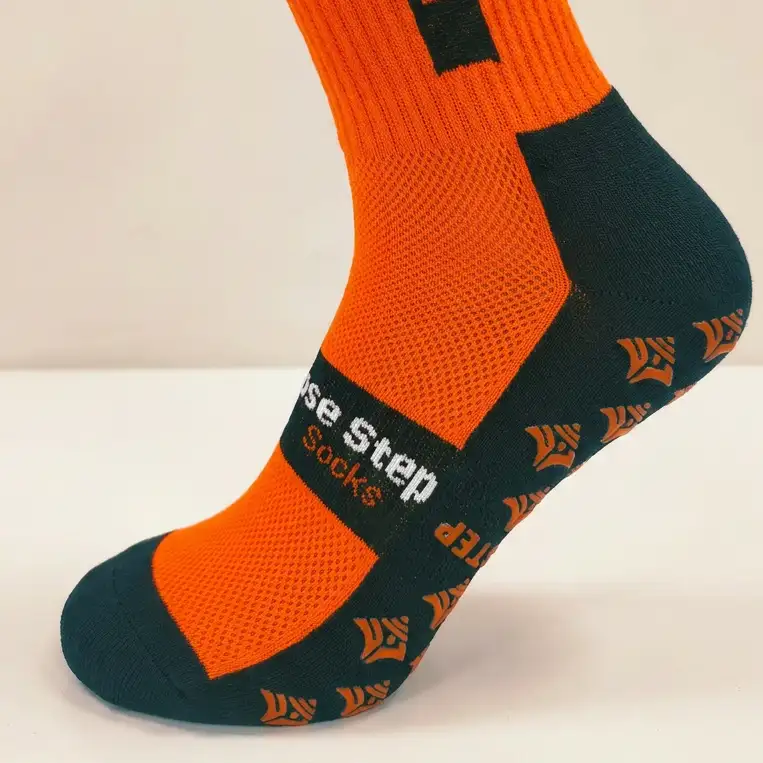
Real Custom Socks from Our Factory
Here’s an example of custom socks we produced for a startup brand. We help new brands create their first sock line with low minimums:
Related Guides
- Custom Jacquard Socks Guide
- Custom Grip Socks Guide
- Custom Embroidered Socks Guide
- Custom Sock MOQ Guide
- Custom Sock Pricing Guide
How much does it cost to start a custom sock brand?
With low minimum order quantities (10 pairs per design), you can start a custom sock brand with as little as $1,000-$2,000. This covers product samples ($150-$400), your first bulk order of 100-150 pairs ($400-$900), basic packaging ($50-$150), e-commerce platform and domain ($50-$100), and initial marketing ($200-$500). For a more robust launch with more designs, more inventory, and professional branding, budget $3,000-$5,000. The key is to start small, validate your product, and reinvest profits into growth — rather than risking a large sum on an unproven product. As the case study above shows, a solo founder launched a $50K/year sock brand with just $1,500 startup budget.
What is the minimum order quantity for custom socks?
Our factory minimum is 10 pairs per design/color — one of the lowest in the industry. This means you can start with just 10 pairs of a single design to test the market, or order 10 pairs each of 5 different designs (50 pairs total) to offer variety. This is dramatically lower than traditional sock factories that often require 500, 1,000, or even 5,000 pairs per design. As your brand grows and your order volumes increase, you will qualify for volume discounts — but you never have to risk a large upfront investment to get started.
How long does it take to get custom socks made?
The total timeline from design consultation to delivery is approximately 3-5 weeks for standard orders. Here is the breakdown: Design consultation and digital mockups (1-3 days), sample production (3-5 days), sample shipping (3-5 days), bulk production (10-15 business days), and shipping (5-7 days express). If you already have a finalized design and don’t need sample revisions, you can compress the timeline to 2-3 weeks. For rush orders, ask about expedited production options — we can sometimes accommodate tight deadlines for an additional fee. For startups, we recommend building in extra time for design revisions and sample approval — it is better to launch 2 weeks late with a perfect product than to launch on time with a product you are not satisfied with.
Do I need to know how to design socks myself?
No — you don’t need any design experience to create custom socks. Our in-house design team can help you create your sock designs from scratch, based on your ideas, brand identity, and target market. All you need to provide is your brand logo (if you have one), your brand colors, and some ideas or references for the style you want. We will create digital mockups showing exactly how your design will look as a sock, and we offer unlimited revisions until you are completely satisfied. If you are a designer yourself, you can also provide your own design files (Adobe Illustrator, PNG, JPG) and we will optimize them for sock production. The key is to communicate your vision clearly — we handle the technical side of translating your vision into a producible sock design.
How should I price my custom socks?
How do I find customers for my sock brand?
Finding customers is the biggest challenge for any new brand. The most effective strategies for startup sock brands are: (1) Social media — Instagram and TikTok are essential for visual products like socks. Post high-quality content daily, use relevant hashtags, engage with your target audience, and participate in trends. (2) Influencer collaborations — partner with micro-influencers (1,000-100,000 followers) in your niche. Send free socks in exchange for posts. Micro-influencers have loyal, engaged audiences and can drive significant sales. (3) Email marketing — build an email list from day one with a lead magnet (discount, free shipping). Email has the highest ROI of any marketing channel. (4) Pop-up shops and local markets — selling in person allows customers to see and feel your socks, and is a great way to get feedback and build a local customer base. (5) Online marketplaces — Amazon, Etsy, and eBay can help you reach customers who are already searching for socks. (6) Paid advertising — once you have validated your product with organic sales, experiment with Facebook/Instagram ads, TikTok ads, and Google Ads. Start small and scale what works. The key is to focus on 1-2 channels initially, master them, and then expand — trying to do everything at once is a common startup mistake. As the case study above shows, the founder focused on Instagram + TikTok + email initially, and then expanded to paid ads once she had validated her product.
What are the most profitable sock niches for startups?
While you can sell socks in any niche, some niches are particularly profitable for startups due to high demand, low competition, and premium pricing potential: (1) Custom/personalized socks — customers pay a premium for socks with their name, face, logo, or custom design. This includes custom socks for corporate gifts, weddings, teams, and events. (2) Performance/athletic socks — runners, gym-goers, and athletes are willing to pay premium prices for high-quality performance socks with specific features (compression, moisture-wicking, arch support). (3) Fun/novelty socks — funny, quirky, and conversation-starting socks are popular as gifts and self-purchases. This niche has strong social media potential. (4) Luxury/dress socks — professionals and style-conscious consumers pay premium prices for high-quality dress socks in unique patterns and colors. (5) Eco-friendly/sustainable socks — environmentally conscious consumers pay a premium for socks made from organic cotton, bamboo, recycled materials, or produced ethically. (6) Medical/health socks — compression socks, diabetic socks, and other health-focused socks have a dedicated customer base and premium pricing. The key is to choose a niche you are passionate about and that has a clear target audience — trying to sell “socks for everyone” is a recipe for failure.
Do you offer other types of custom socks beyond jacquard?
Yes — we produce a wide range of custom socks beyond jacquard team socks, including custom embroidered socks (with embroidered logos and text — great for premium branding and corporate gifts), custom grip socks (with non-slip grips on the sole — great for yoga, pilates, hospitals, and trampoline parks), crew socks, ankle socks, compression socks, and dress socks. Many startup sock brands start with jacquard socks and then expand to embroidered or grip socks as their product line grows. If you want to offer multiple sock types, we can handle everything in one order with unified branding and consistent quality. We also produce custom socks for other industries — if your brand targets specific niches like yoga studios, hospitals, or corporate clients, see our yoga studio grip sock guide, hospital grip sock guide, and corporate gift sock guide for more information.
Ready to Start Your Custom Sock Brand?
Starting a custom sock brand has never been more accessible. With 10-pair minimums, 3-day samples, competitive factory-direct pricing, unlimited design revisions, and high-quality jacquard weaving, embroidery, and printing capabilities, we help startup founders, independent designers, and creative entrepreneurs launch their sock brands without risking tens of thousands of dollars on a large initial order. Whether you are launching your first collection or scaling an established brand, we are here to help you succeed. As the case study above shows, a solo founder with just $1,500 startup budget was able to build a $50K/year sock brand in 12 months — and low minimums made it all possible.
We have helped over 80 startup sock brands launch their first collections — from solo creators testing a single design to established influencers launching full product lines. No matter your budget or experience level, you get the same factory-direct quality, responsive communication, and design support. We also produce custom jacquard socks, custom embroidered socks, and custom grip socks — if you want to expand your product line beyond one sock type, we can handle everything in one order. For specific niches, also see our corporate gift guide, wedding guide, and sports team guide.
Contact us on WhatsApp for a free consultation. Tell us about your brand vision, target market, design ideas, and budget — we will respond within 24 hours with design guidance, sample options, and detailed pricing. Your sock brand journey starts here!