
Non-Slip Grip Socks for Trampoline Parks: Complete Procurement Guide (2026)
Non-slip grip socks are not just an accessory for trampoline parks — they are an essential safety requirement, a hygiene standard, and a significant revenue stream. Every trampoline park, indoor bounce arena, and family entertainment center requires customers to wear grip socks before entering the jumping area. The right grip sock program improves safety, reduces liability, enhances hygiene, increases customer satisfaction, and generates additional revenue through sock sales. The wrong grip socks — slippery, uncomfortable, poorly made — can lead to injuries, customer complaints, and lost revenue. After producing custom grip socks for over 80 trampoline parks and family entertainment centers across the US, Canada, UK, and Australia — from small single-location parks to multi-location chains with 15+ facilities — we have learned exactly what works for trampoline park grip socks, and what mistakes cost parks money and customers.
This guide is written specifically for trampoline park owners, general managers, family entertainment center operators, and indoor playground owners. It covers everything you need to know: why grip socks are essential for your facility, how to choose the right specifications, custom branding options, the full ordering process, budget planning with retail pricing strategies, inventory management, quality standards, and how to avoid the most common procurement mistakes that cost trampoline parks money and customers. We also share real case studies from our trampoline park clients and insider tips from our production floor.
From Our Factory Floor: The 3 Biggest Mistakes Trampoline Parks Make When Procuring Grip Socks
After working with over 80 trampoline parks and family entertainment centers, our customer service team has identified the three mistakes that cause the most financial loss, safety issues, and customer complaints. Knowing these before you place your order can save you thousands of dollars and protect your customers’ safety:
- Mistake #1: Buying the cheapest available socks without testing grip effectiveness. About 40% of new park owners start by searching for the cheapest grip socks on Alibaba or Amazon, thinking “all grip socks are the same.” They are not. Cheap grip socks often use low-quality PVC that becomes slippery when slightly damp (from sweat), has low dot density (fewer than 30 dots per square inch instead of the recommended 50-70), and the grip dots peel off after just 5-10 washes. We have had parks switch to us after a customer slipped and injured themselves wearing cheap grip socks — the resulting insurance claim and legal fees cost them over $15,000, not to mention the reputational damage. Our recommendation: always test samples in your actual facility before placing a bulk order. Have staff and regular customers jump in them, test traction on your trampoline mats (both dry and slightly damp), and wash them 20 times to see how the grip holds up. A $50 sample pack is the best insurance policy you can buy — it can save you from a $15,000 injury claim.
- Mistake #2: Running out of socks due to poor inventory management. About 30% of parks we work with have experienced a sock shortage at some point — usually during a busy weekend or school holiday. Running out of socks is a triple whammy: (1) You lose sock sales revenue (customers who can’t buy socks may leave or jump barefoot); (2) You create safety issues (customers jumping in regular socks or bare feet); (3) You damage customer experience (frustrated customers who came prepared to jump but can’t). The root cause is almost always waiting too long to reorder — parks wait until they have 1-2 weeks of inventory left, then don’t account for production lead times (3-5 weeks) and shipping delays. Our recommendation: maintain at least 4-6 weeks of safety stock at all times, and place a reorder when inventory drops to 2-3 weeks of supply. Track inventory by size and color separately — it is common to run out of medium socks while having plenty of X-large. For parks with predictable demand, consider an annual contract with scheduled monthly deliveries — this locks in a lower price and ensures you never run out.
- Mistake #3: Not offering custom branded socks, leaving revenue and brand exposure on the table. About 25% of small parks still use generic, unbranded grip socks — thinking “custom branding is too expensive” or “customers don’t care about the brand.” This is a missed opportunity on multiple levels: (1) Custom branded socks sell for $1-$2 more per pair than generic socks (customers are willing to pay more for a branded product); (2) Every customer who takes your branded socks home becomes a walking advertisement for your park — they wear them at home, at the gym, to other activities, and post photos on social media; (3) Custom branding creates a sense of professionalism and identity — customers perceive your park as more established and well-managed. The cost difference is minimal: custom logo printing adds just $0.10-$0.40 per pair, and custom branding setup fees are often waived for orders of 500+ pairs. For a park selling 200 pairs per week, custom branding can generate an additional $10,000-$20,000 in annual revenue (from higher retail price) plus invaluable brand exposure. Our recommendation: always order custom branded socks — the ROI is clear and immediate.
Real Case Study: How a Multi-Location Trampoline Park Chain Increased Sock Revenue by 65% with Custom Branded Grip Socks
One of our most successful trampoline park clients is a family entertainment chain with 8 locations across the Midwest US (details anonymized for client privacy). Here is how their grip sock program evolved:
- Before (2024): The chain was using generic, unbranded PVC grip socks purchased from a local distributor at $2.20/pair. They retailed for $4.99/pair. Average sock attach rate was 52% (only 52% of customers purchased socks — the rest brought their own or reused). Annual sock revenue across 8 locations: approximately $280,000. The chain was also experiencing frequent sock shortages at individual locations due to inconsistent inventory management.
- The problem: The general manager noticed that (1) sock attach rate was lower than industry benchmarks (60-65%), (2) customers often complained about the quality of the generic socks (grip peeling off after a few washes, uncomfortable), (3) there was no brand consistency across locations (each location ordered from different suppliers), and (4) the chain was missing out on brand exposure — customers took generic socks home that had no connection to the park.
- The solution (early 2025): The chain switched to custom branded grip socks from our factory. They chose: ankle length, polyester blend, PVC grip with full-sole dot coverage (60 dots/sq inch), custom logo printed on the cuff (chain logo + location-specific color accents), and individual poly bag packaging with a custom header card. They also implemented a standardized inventory management system across all locations, with centralized purchasing and scheduled monthly deliveries. Because they ordered in bulk (8,000 pairs per month across all locations), they qualified for our highest volume discount tier — unit cost dropped to $1.15/pair (including custom branding and packaging), down from $2.20/pair for generic socks.
- Pricing strategy: They increased the retail price from $4.99 to $5.99/pair (customers were willing to pay more for a branded, higher-quality product). They also introduced a family pack ($19.99 for 4 pairs) and a “sock subscription” ($19.99/year for unlimited free sock rentals + 20% off retail sock purchases). Annual pass holders received a free pair of custom branded socks with their pass purchase.
- Results (after 12 months): Sock attach rate increased from 52% to 68% (customers were more willing to buy branded, higher-quality socks). Average retail price increased from $4.99 to $5.79 (including family packs and subscriptions). Annual sock revenue across 8 locations increased to $462,000 — a 65% increase. Gross margin improved from 55% to 72% (lower unit cost + higher retail price). The chain also reported increased brand awareness — customers posted photos of their branded socks on social media, and many new customers mentioned seeing the socks at friends’ homes as their reason for visiting. Sock shortages were eliminated through centralized inventory management and scheduled deliveries.
- Key lesson: Custom branded grip socks are not just a safety requirement — they are a significant revenue driver and brand-building tool. By investing in custom branding, improving quality, and implementing smart pricing and inventory strategies, this chain increased sock revenue by 65% in just 12 months. The total investment in custom branding setup was less than $500 — the ROI was immediate and substantial.
Why Grip Socks Are Essential for Trampoline Parks
Grip socks serve four critical functions for trampoline parks — safety, hygiene, branding, and revenue. Understanding each will help you make better procurement decisions:
1. Safety — The #1 Priority
Trampoline parks are high-activity environments where customers jump, bounce, flip, and land repeatedly. Bare feet or regular socks can slip on trampoline mats, foam pit surfaces, and padded flooring — leading to slips, falls, and injuries. Non-slip grip socks with PVC or silicone dots on the sole provide traction that significantly reduces the risk of slipping. This is not just a customer convenience — it is a liability issue. A customer injury caused by slipping on a trampoline can result in costly insurance claims, lawsuits, and reputational damage. Providing high-quality grip socks is one of the most effective risk management investments a trampoline park can make. Many insurance providers now require or strongly recommend grip sock programs as a condition of coverage. For more information on grip sock technology and safety standards, see our comprehensive grip sock guide.
2. Hygiene — A Clean Facility Is a Successful Facility
Trampoline parks see hundreds of bare feet every day. Foot fungus, athlete’s foot, warts, and other foot conditions can spread through direct contact with trampoline mats and shared surfaces. Requiring customers to wear grip socks creates a hygienic barrier between bare feet and shared surfaces, significantly reducing the spread of foot-borne infections and fungi. This is especially important for facilities that serve children, who are more susceptible to foot infections. A clean, hygienic facility also improves customer satisfaction — parents appreciate facilities that take hygiene seriously, and are more likely to return and recommend your park to friends. Many parks report that implementing a mandatory grip sock policy improved their cleanliness ratings and reduced customer complaints about foot hygiene.
3. Branding — Walking Advertisements
Custom grip socks with your park’s logo and colors turn every customer into a walking advertisement. When customers wear your branded socks — both inside your park and after they take them home — they are promoting your brand to everyone around them. Parents post photos of their kids wearing your socks on social media. Customers wear your socks at home, at the gym, and to other activities — exposing your brand to new potential customers. Custom branded socks also create a sense of professionalism and identity — they signal that your park is established, well-managed, and takes the customer experience seriously. Many parks report that custom branded socks improve their brand perception and increase social media mentions. As the case study above shows, custom branded socks can increase sock attach rate by 15-20% and generate invaluable word-of-mouth marketing.
4. Revenue — A Significant Profit Center
Grip socks are one of the highest-margin products a trampoline park can sell. A pair of custom grip socks typically costs the park $1.50-$3.50 (including shipping), and retails for $4.99-$7.99 per pair — a gross margin of 60-75%. For a park that sees 500 customers per week, with 60% purchasing socks (the other 40% bring their own or reuse), that is 300 pairs sold per week at $5.99 per pair — generating approximately $1,797 in weekly sock revenue, or over $93,000 per year. With a 65% gross margin, that is over $60,000 in annual gross profit from sock sales alone. Many parks also offer annual sock subscriptions, family sock packs, and limited-edition designs to increase sock revenue even further. Grip socks are not just a safety requirement — they are a significant profit center that can meaningfully contribute to your facility’s bottom line. For more information on retail pricing strategies and revenue optimization, see the Budget Planning section below.
How to Choose the Right Grip Socks for Your Trampoline Park
The right specifications depend on your facility size, customer demographics, budget, and branding goals. Here are the key procurement decisions:
Sock Length
| Length | Pros | Cons | Best For |
|---|---|---|---|
| Ankle (most common) | Affordable, comfortable, easy to put on, good for all ages | Less coverage, may slide down for some users | Most trampoline parks, family entertainment centers, all-age facilities |
| Low-cut / no-show | Minimal coverage, cool for hot environments | More likely to slip off, less grip surface area | Adult-focused facilities, fitness trampoline parks |
| Quarter / crew | More coverage, stays on better, more branding space | Slightly more expensive, may be hot for some users | Premium facilities, colder climates, parks that want more branding space |
Our recommendation for most trampoline parks: Ankle length. It is the most popular, most affordable, and works well for customers of all ages (from toddlers to adults). The ankle length provides enough grip surface area on the sole while being comfortable and easy to put on. If you want a more premium feel or more branding space, quarter length is a good upgrade. About 70% of our trampoline park clients choose ankle length, 20% choose quarter/crew, and 10% choose low-cut/no-show.
Material Options
- Polyester / acrylic blend (most common for trampoline parks — 75% of orders) — Excellent moisture-wicking, quick-drying, durable, and affordable. This is the industry standard for trampoline park grip socks. Polyester blends hold up well to repeated use and washing, and the moisture-wicking properties keep feet dry during active jumping. Typical composition: 90% polyester / 8% nylon / 2% elastane.
- Cotton blend (10% of orders) — Soft and comfortable, but absorbs moisture (not ideal for high-sweat trampoline environments). Cotton socks become damp and slippery when wet, which can reduce grip effectiveness. Better for low-activity facilities or cooler environments. Typical composition: 80% cotton / 15% polyester / 5% elastane.
- Terry cloth / terry loop (premium — 8% of orders) — Thick, absorbent, soft, and comfortable. The terry loop footbed provides extra cushioning and absorbs sweat. More expensive but offers a premium feel and better comfort. Popular for high-end trampoline parks and facilities that want to differentiate on customer experience.
- Bamboo viscose blend (eco-friendly / premium — 7% of orders) — Naturally antibacterial, hypoallergenic, ultra-soft, and moisture-wicking. Bamboo socks are incredibly soft and comfortable, and the natural antibacterial properties help reduce foot odor. Slightly more expensive but offers a premium, eco-friendly option. Popular for facilities that market to health-conscious or eco-conscious customers.
Anti-Slip Grip Type: PVC vs. Silicone
| Feature | PVC Grip (Most Common — 80% of trampoline park orders) | Silicone Grip (Premium — 20% of orders) |
|---|---|---|
| Traction on trampoline mats | Excellent | Excellent |
| Traction when slightly damp | Good | Excellent |
| Durability (washes) | 20-50 washes | 50+ washes |
| Flexibility / comfort | Moderate | Very flexible, softer feel |
| Cost | Lower ($1.00-$2.50/pair) | Higher ($1.80-$4.00/pair) |
| Best For | High-volume parks, budget-conscious facilities, disposable/single-use programs | Premium parks, reusable rental programs, facilities that want the best quality |
Our recommendation: For most trampoline parks, PVC grip socks are the standard and most cost-effective choice. They provide excellent traction on trampoline mats, are durable enough for 20-50 washes, and are affordable enough to sell at a high margin. For premium facilities or parks that offer a reusable sock rental program, silicone grip offers better durability and comfort over the long term. Many parks use PVC for retail sales (customers take them home) and silicone for rental programs (reused many times). For more detailed information on PVC vs. silicone grip technology, see our comprehensive grip sock guide.
Grip Pattern and Coverage
The grip pattern affects both traction and comfort. For trampoline parks, we recommend:
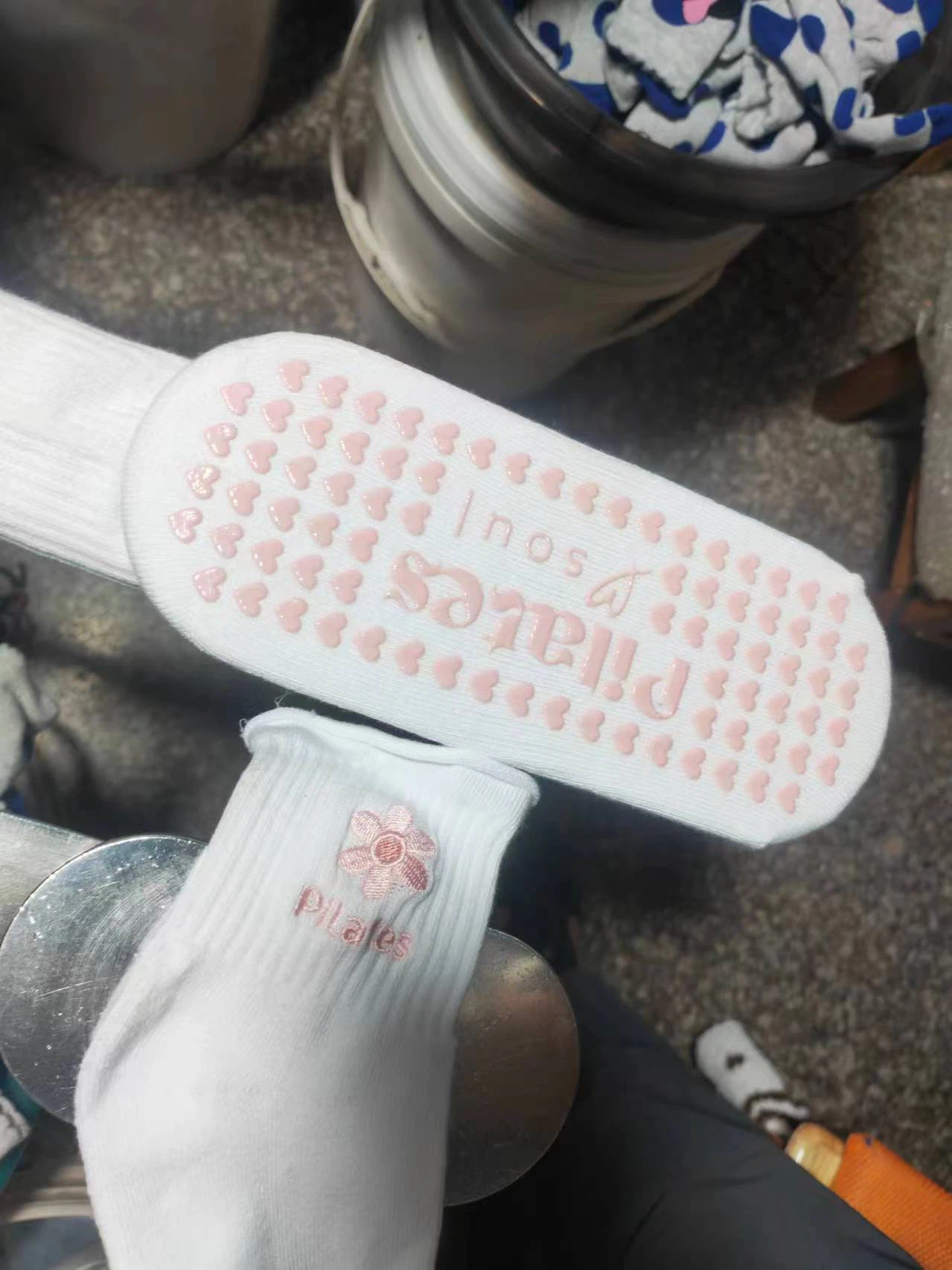
- Full-sole dot coverage (essential for trampoline parks) — The grip dots should cover the entire sole, from heel to toe. Partial grip (only heel or only forefoot) is not sufficient for trampoline use — customers need traction across the entire foot for jumping and landing.
- Dot density — Higher dot density = more traction. We recommend at least 50-70 dots per square inch for trampoline park socks. Lower density may not provide enough traction for high-impact jumping. All our standard trampoline park grip socks use 60+ dots per square inch.
- Dot size — Medium-sized dots (3-5mm diameter) provide the best balance of traction and comfort. Very small dots may not provide enough grip; very large dots can feel uncomfortable underfoot.
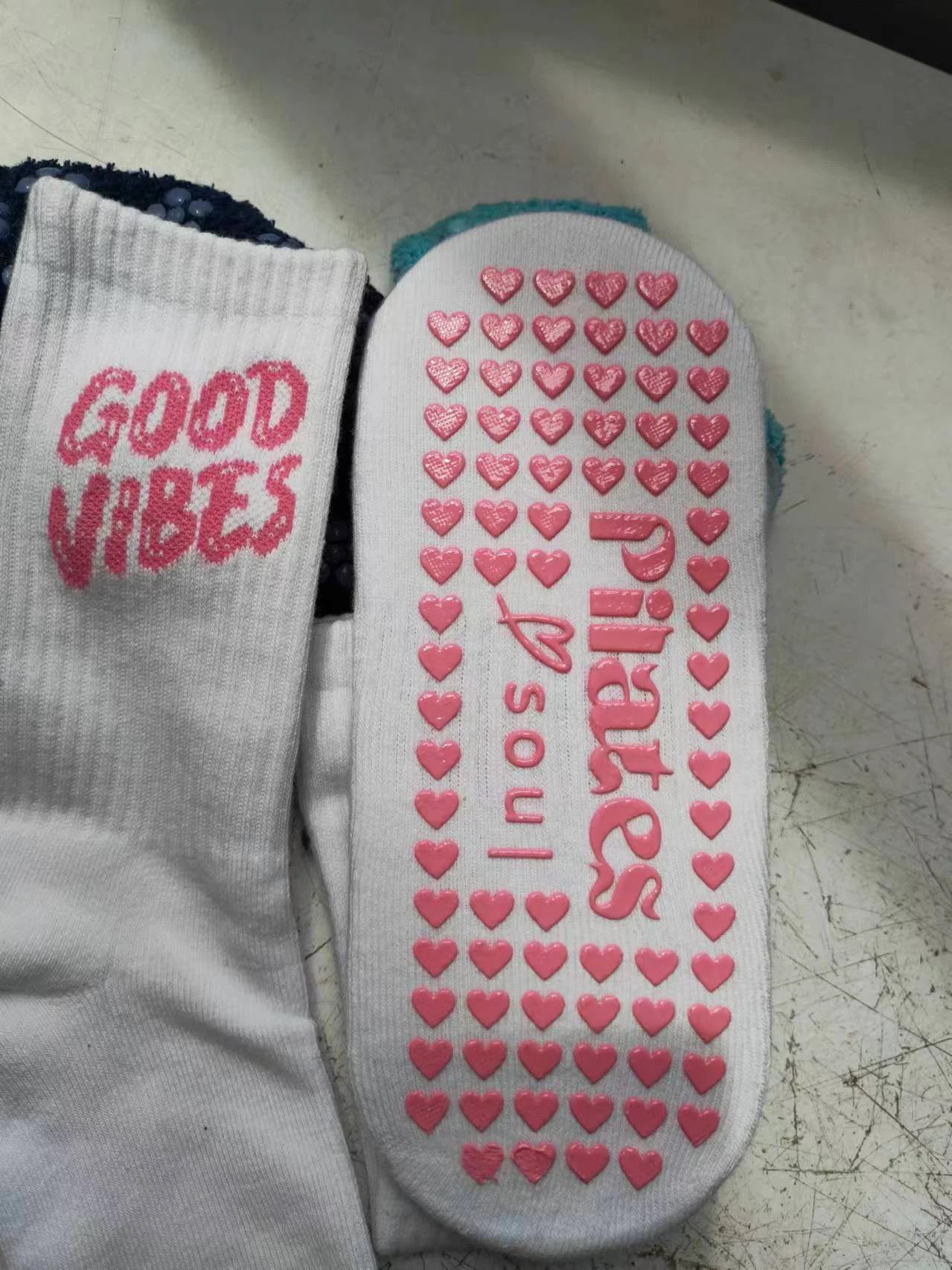
- Custom logo grip pattern (premium option) — Your park’s logo can be used as the grip pattern itself — the logo becomes the anti-slip dots. This is a premium branding option available for orders of 500+ pairs. It creates a unique, branded experience and reinforces your brand every time a customer looks at their feet. About 15% of our trampoline park clients choose custom logo grip patterns for a truly unique branded experience.
Color Options and Branding
Color is an important branding decision for trampoline parks:
- Brand colors (most popular — 50% of orders) — The most popular option. Custom socks in your park’s brand colors with your logo embroidered or printed on the cuff. This creates a cohesive brand experience and makes your socks instantly recognizable.
- Multiple color options (30% of orders) — Many parks offer 2-3 color options (e.g., blue for kids, pink for girls, black for adults) to appeal to different customer preferences. Offering multiple colors can increase sock sales by giving customers a choice.
- Limited-edition / seasonal colors (10% of orders) — Some parks offer limited-edition sock designs for holidays, special events, or promotions. This creates urgency and encourages repeat visits — customers come back to collect the latest design.
- Size-coded colors (10% of orders) — Some parks use different colors for different sizes (e.g., red = small, blue = medium, green = large) to make size management easier for staff. This is especially useful for high-volume parks.
We have 50+ standard stock colors available at no extra cost. Custom dyeing is available for a small setup fee ($30-$80 per color) for orders of 500+ pairs. If you need socks in your exact brand color, send us your color reference (Pantone code, logo file, or fabric swatch) and we will recommend the closest stock color or advise on custom dyeing.
Sock Sales Models: Retail vs. Rental vs. Included
Trampoline parks use three main models for grip socks. Each has pros and cons, and many parks use a combination:
| Model | How It Works | Pros | Cons |
|---|---|---|---|
| Retail sales (most common — 65% of parks) | Customers purchase socks at the front desk for $4.99-$7.99 per pair. Customers keep the socks and can bring them back for future visits. | High margin revenue, customers take home branded socks (free advertising), no laundry/inventory management for reused socks | Some customers resist paying extra for socks, need to manage retail inventory |
| Rental program (20% of parks) | Customers rent socks for $1-$3 per visit. Socks are collected, washed, and reused. Some parks offer free sock rental with admission. | Lower barrier for customers (no purchase required), consistent quality control, can be included in admission price | Requires laundry facilities/infrastructure, socks wear out faster (need frequent replacement), hygiene concerns for some customers |
| Included with admission (15% of parks) | Socks are included in the admission price. Customers receive a new pair with each visit or can reuse their own. | No customer resistance, perceived as “free” (included in price), simplifies front desk operations | Lower margin (cost is absorbed into admission), customers may not value “free” socks as much, need to manage inventory carefully |
Most successful parks use a hybrid model: Socks are available for purchase ($4.99-$6.99 per pair), customers who bring their own grip socks can use them for free, and annual pass holders receive a free pair of custom branded socks with their pass purchase. This maximizes sock revenue while keeping customers happy. Some parks also offer a “sock subscription” — customers pay $19.99/year for unlimited free sock rentals or a new pair every month. This creates recurring revenue and increases customer loyalty. As the case study above shows, a well-executed hybrid model with custom branded socks can increase sock revenue by 50-70% compared to generic socks with a simple retail model.
The Trampoline Park Grip Sock Ordering Process
Understanding the process helps you plan procurement and inventory:
Step 1: Requirements Assessment and Quote (1-3 days)
Provide your facility’s requirements: estimated monthly/annual quantity, sock length, material, grip type (PVC/silicone), colors, custom branding needs (logo on sock, custom grip pattern, custom packaging), and any special requirements (latex-free, antibacterial treatment, size-coded colors). We will provide a detailed quote including unit cost, setup fees, custom branding costs, packaging, and shipping. For facilities with predictable demand, we can provide volume-based annual pricing and scheduled delivery options.
Step 2: Sample Evaluation (3-7 days)
Before placing a bulk order, we strongly recommend evaluating physical samples. Test the socks in your actual facility — have staff and customers jump in them, evaluate traction on your trampoline mats, test comfort and durability, and wash them multiple times to see how the grip holds up. Sample cost is typically $30-$80 (including shipping), and is credited toward your bulk order. For trampoline parks, real-world testing is essential — a sock that feels good in a showroom may not perform well on actual trampoline mats during high-impact jumping. We recommend testing samples for at least 1-2 weeks before making a final decision.
Step 3: Bulk Production (10-20 days)
After you approve the samples and place your order, bulk production begins. For standard colors and specifications, production takes 10-15 business days. Custom colors, custom logo grips, or special materials may add 5-10 days. For large orders (2,000+ pairs), production may take 15-25 days. Inventory tip: Plan your orders well in advance — running out of socks is one of the most common operational issues for trampoline parks. Maintain at least 4-6 weeks of inventory at all times, and place reorders when inventory drops to 2-3 weeks of supply. For parks with predictable demand, consider an annual contract with scheduled monthly deliveries — this ensures you never run out and locks in the lowest possible per-unit price.
Step 4: Quality Inspection and Packaging (2-3 days)
Every pair is inspected for grip quality, color accuracy, sizing, and construction defects. Socks are then packaged according to your specifications — individual poly bags (most common for retail), bulk packs (for rental programs), or custom retail packaging. For parks with size-coded colors, we verify that each color is correctly packaged and labeled to prevent distribution errors at the front desk. We also offer custom header cards and retail packaging with your park logo, website, and social media handles — this reinforces branding and gives customers a way to connect with your park after their visit.
Step 5: Shipping (5-10 days)
For trampoline park orders, we offer multiple shipping options: express air freight (5-7 days), standard air freight (7-10 days), and sea freight (25-35 days) for very large orders. Most parks choose air freight for reliability and tracking. We can ship directly to your facility, to a central warehouse, or to multiple facility locations (for park chains). Total timeline from order to delivery: Approximately 3-5 weeks for standard orders.
Budget Planning and Retail Pricing Strategy
Understanding the full cost structure and setting the right retail price is critical for maximizing sock revenue. Here is a realistic budget breakdown and pricing strategy:
Sample Cost Breakdown (1,000 pairs, ankle length, polyester blend, PVC grip, custom logo, individual packaging)
| Cost Item | Amount | Notes |
|---|---|---|
| Sock unit cost | $1.00 – $1.80/pair | Depends on quantity and material |
| Custom logo (print or embroidery) | $0.10 – $0.40/pair | Printed logo is cheaper; embroidered is more premium |
| Custom grip pattern (logo as grip) | $0.30 – $0.80/pair | Premium option, available for 500+ pairs |
| Individual poly bag packaging | $0.05 – $0.15/pair | Standard for retail; bulk packaging is free |
| Custom retail packaging / header card | $0.20 – $0.50/pair | Premium retail packaging with branding |
| Sample fee | $30 – $80 (one-time) | Usually credited toward bulk order |
| Shipping (air freight) | $0.20 – $0.50/pair | Depends on total weight and destination |
| Total landed cost (standard) | $1.40 – $2.80/pair | All costs included, delivered to your facility |
| Total landed cost (premium with custom grip) | $1.80 – $3.50/pair | Includes custom logo grip pattern and retail packaging |
Quantity Discount Tiers (Standard PVC Grip Socks)
| Order Quantity | Estimated Unit Cost (sock only) | Best For |
|---|---|---|
| 100 – 499 pairs | $2.00 – $3.00 | Small parks, pilot programs, sample orders |
| 500 – 999 pairs | $1.50 – $2.30 | Medium parks, single location |
| 1,000 – 2,999 pairs | $1.10 – $1.80 | Most common trampoline park order size |
| 3,000 – 4,999 pairs | $0.90 – $1.50 | Large parks, high-volume facilities |
| 5,000 – 9,999 pairs | $0.75 – $1.20 | Park chains, multi-location operators |
| 10,000+ pairs | $0.60 – $1.00 | Large chains, annual contracts, group purchasing |
Retail Pricing Strategy
The right retail price maximizes revenue while keeping customers happy. Here is a proven pricing strategy used by successful trampoline parks:
- Standard retail price: $4.99-$6.99 per pair — This is the industry standard. At a landed cost of $1.50-$2.50, this delivers a 60-75% gross margin. Most customers are willing to pay $5-$7 for a pair of quality grip socks — it is perceived as a reasonable cost for a quality product that they can reuse.
- Family pack: $19.99-$24.99 for 4 pairs — Offering a family pack (4 pairs at a slight discount) increases average transaction value. A family of 4 is more likely to buy a $20 family pack than 4 individual pairs at $6 each ($24). The family pack still delivers a healthy margin while encouraging larger purchases.
- Annual pass holder perk: free pair with pass purchase — Including a free pair of custom branded socks with annual pass purchases increases perceived value of the pass and gives pass holders a tangible branded item. The cost of the socks ($1.50-$2.50) is negligible compared to the pass price, and the branded socks serve as walking advertisements.
- Limited-edition socks: $7.99-$9.99 per pair — Offering limited-edition designs (holiday, special events, collaborations) at a premium price creates urgency and encourages repeat visits. Customers who already have standard socks may buy the limited-edition version just to collect it.
- Bring-your-own policy — Allow customers to bring their own grip socks (must have non-slip grips on the sole) for free. This reduces customer resistance while still generating sales from customers who forget or don’t own grip socks. Clearly post your grip sock policy at the front desk and on your website.
Revenue example: A medium-sized trampoline park with 400 customers per week, 65% purchasing socks at $5.99 per pair = 260 pairs/week × $5.99 = $1,557/week in sock revenue = $80,984/year. At a 65% gross margin, that is $52,640 in annual gross profit from sock sales alone. This is pure profit that requires minimal additional labor or overhead — the front desk sells socks as part of the normal check-in process. As the case study above shows, parks that invest in custom branded socks and smart pricing strategies can increase this revenue by 50-70% — generating an additional $40,000-$60,000 in annual gross profit.
Inventory Management and Reordering
Running out of socks is one of the most costly operational mistakes a trampoline park can make — it leads to customer frustration, lost revenue, and potential safety issues (customers jumping in regular socks or bare feet). Here is a proven inventory management strategy:
- Maintain 4-6 weeks of safety stock — Always keep at least 4-6 weeks of inventory on hand. This accounts for production lead times (3-5 weeks), shipping delays, and unexpected demand spikes (school holidays, birthday parties, rainy weekends).
- Reorder when inventory drops to 2-3 weeks of supply — Place a reorder when your inventory reaches 2-3 weeks of supply. This gives the factory 3-5 weeks to produce and ship, so your new order arrives just as your current inventory is running low. Do not wait until you are almost out — production and shipping delays happen.
- Track inventory by size and color — If you offer multiple sizes or colors, track inventory for each SKU separately. It is common to run out of one size (e.g., medium) while having plenty of another (e.g., X-large). Reorder based on the SKU that is running low, not just total inventory.
- Plan for seasonal demand spikes — Trampoline park attendance spikes during school holidays (winter break, spring break, summer), weekends, and rainy days. Increase your inventory before these periods. Many parks sell 2-3x more socks during school holidays than during normal weeks.
- Consider annual contracts for predictable demand — If your park has predictable monthly demand, consider an annual contract with scheduled deliveries. This locks in a lower per-unit price (volume discount) and ensures you never run out. We can schedule monthly, quarterly, or semi-annual deliveries based on your demand pattern. As the case study above shows, an annual contract with centralized purchasing and scheduled deliveries eliminated sock shortages for an 8-location chain and reduced per-unit cost by 48%.
Quality Standards for Trampoline Park Grip Socks
When your customers’ safety is on the line, quality is non-negotiable. Here is what to inspect and require from your supplier:
- Grip effectiveness on actual trampoline mats — The most important quality test. Test samples on your actual trampoline mats, not just on smooth floors. The grip should provide consistent traction during jumping, landing, and walking. Test with both dry and slightly damp feet (sweat can reduce grip effectiveness).
- Grip durability after washing — For retail socks (customers take them home and wash them), the grip should remain effective after at least 20-30 washes. Test samples by washing them 20 times and re-testing grip effectiveness. PVC grips typically last 20-50 washes; silicone grips last 50+ washes.
- Latex-free certification — All grip socks should be latex-free to avoid allergic reactions. Request a latex-free declaration from your supplier. This is especially important for facilities that serve children, who are more likely to have undiagnosed latex allergies. All our grip socks are 100% latex-free — we can provide a latex-free declaration certificate with your order.
- Material safety (OEKO-TEX or equivalent) — Socks should be made from materials that meet textile safety standards. No harmful dyes, chemicals, or heavy metals. This is important for direct skin contact, especially for children.
- Construction quality — Check the toe seam (should be smooth to prevent blisters during active jumping), heel (well-formed and reinforced), and cuff (good elasticity but not too tight — tight cuffs can leave marks and be uncomfortable for children). The sock should maintain its shape after multiple wears and washes.
- Size consistency — All pairs in the same size should fit consistently. Try on multiple pairs from the same batch to verify. Inconsistent sizing leads to customer complaints and returns.
- Color fastness — The sock color should not bleed or fade after washing. Test by washing a pair with white clothing — if the white clothing picks up color, the dye is not colorfast and will stain customers’ skin and clothing.
- Packaging and labeling — Individual packaging should be clean and properly labeled with size. For retail sales, consider adding a header card or label with your park logo, website, and social media handles — this reinforces branding and gives customers a way to connect with your park after their visit.
Real Grip Socks for Trampoline Parks
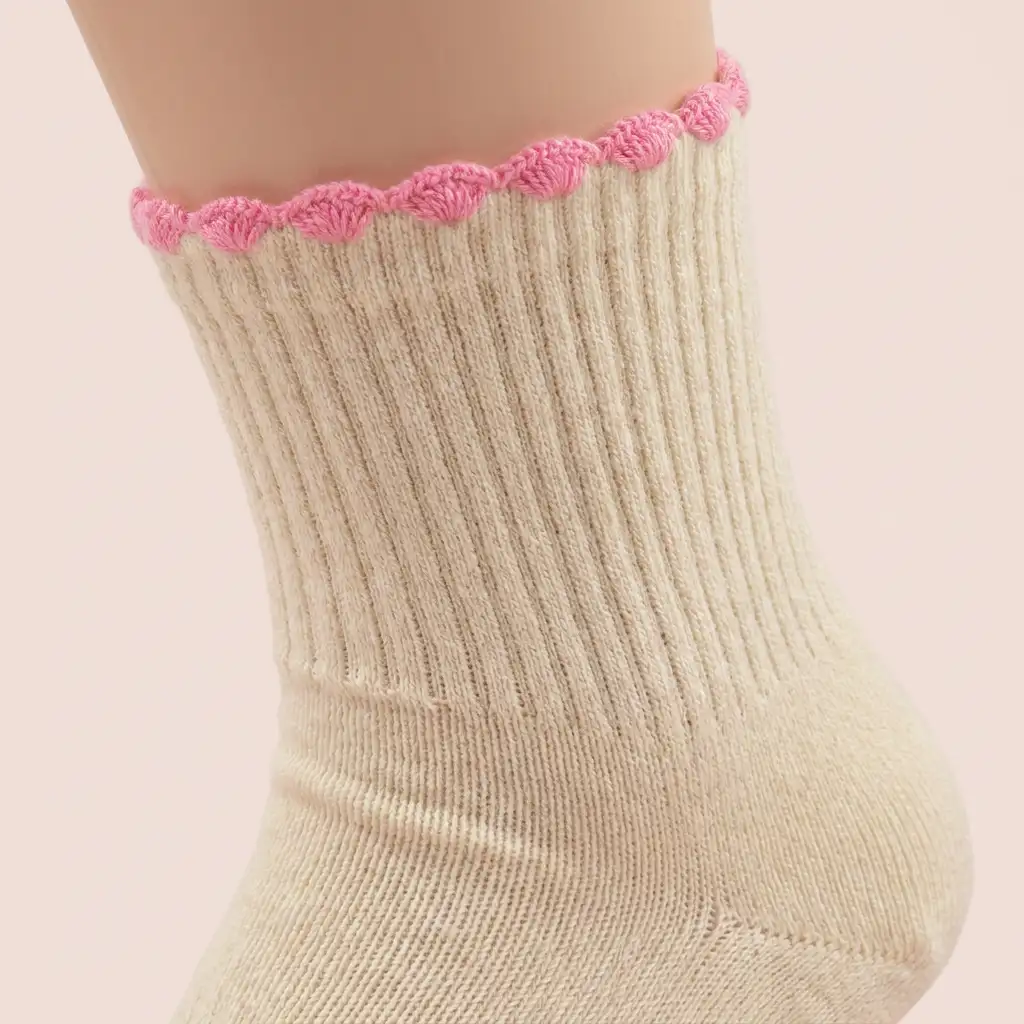
Here’s an example of custom grip socks we produced for a trampoline park. The grip dots are designed for maximum traction on trampoline surfaces:
Related Guides
- Custom Jacquard Socks Guide
- Custom Grip Socks Guide
- Custom Embroidered Socks Guide
- Custom Sock MOQ Guide
- Custom Sock Pricing Guide
Are your grip socks latex-free?
Yes — all our grip socks are 100% latex-free. The anti-slip grip is made from PVC or silicone (your choice), and the elastic in the cuff is made from spandex/elastane — no natural rubber latex is used in any component. We can provide a latex-free declaration certificate with your order for your facility’s safety records. This is important for trampoline parks, where latex allergies in children are a significant safety concern. We also offer OEKO-TEX certified materials for facilities that require the highest level of textile safety.
Can grip socks be washed and reused?
Yes — our grip socks are designed to be washable and reusable. PVC grips typically remain effective for 20-50 washes, and silicone grips for 50+ washes. To maximize lifespan: wash in warm water (40°C / 105°F max), avoid bleach and fabric softener (fabric softener coats the grip dots and reduces traction), and tumble dry on low heat or air dry. Do not iron. For retail sales, customers take socks home and wash them themselves — the grip should remain effective for months of regular use. For rental programs, follow your facility’s standard laundering protocols and inspect socks regularly for wear — replace socks when the grip dots start to wear smooth. For more information on grip sock care and maintenance, see our comprehensive grip sock guide.
What sizes should I order for my trampoline park?
We recommend offering 3-4 sizes to accommodate all customers: Toddler/Small (US shoe size 8-12, ages 2-5), Medium (US shoe size 13-5, ages 6-10 / women’s 5-7), Large (US women’s 7-11 / men’s 6-9), and X-Large (US men’s 9-13). For most parks, the size distribution is approximately: 20% Toddler/Small, 35% Medium, 35% Large, 10% X-Large. If your park primarily serves young children (toddler-focused), increase the Toddler/Small percentage to 35-40%. If your park has a lot of adult customers (fitness trampoline, teen-focused), increase the Large and X-Large percentages. We also offer “one-size-fits-most” options (US women’s 5-11 / men’s 6-12) for parks that want to simplify inventory management — but we recommend offering multiple sizes for better customer fit and satisfaction. Track inventory by size separately — it is common to run out of medium socks while having plenty of X-large.
Can you print or embroider our park logo on the socks?
Yes — we offer several branding options for trampoline parks: (1) Printed logo on the cuff (most affordable, available for 100+ pairs), (2) Embroidered logo on the cuff (more premium, durable, available for 100+ pairs), (3) Custom grip pattern using your park logo (the logo becomes the anti-slip dots — premium option, available for 500+ pairs), (4) Custom printed packaging and header cards with your logo and park information. Custom branding reinforces your park’s identity, turns customers into walking advertisements, and creates a professional, cohesive customer experience. Setup fees apply for custom branding, but per-unit costs are low — typically $0.10-$0.80 per pair depending on the branding option. Send us your logo file (vector format preferred: AI, EPS, SVG) and we will create a digital mockup showing your branding on the sock. As the case study above shows, custom branded socks can increase sock attach rate by 15-20% and generate invaluable word-of-mouth marketing. For more information on custom logo techniques, see our sock logo techniques guide.
What is the minimum order for custom trampoline park grip socks?
Our factory minimum is 100 pairs per color/design for standard trampoline park grip socks. This is lower than many competitors (who often require 500+ pairs), making custom branded socks accessible for small parks and new facilities. For custom branding (logo on sock), the minimum is 100 pairs. For custom grip pattern (logo as the anti-slip dots), the minimum is 500 pairs. For custom dyeing (exact brand color), the minimum is 500 pairs per color. For most parks, order quantities range from 500 to 5,000 pairs per order. We also offer annual contract pricing for parks with predictable monthly demand — contact us to discuss volume-based annual pricing and scheduled deliveries. For small parks just starting out, we recommend an initial order of 200-500 pairs to test custom branded socks — you can always reorder once you see the revenue impact.
How do I handle customers who refuse to buy or wear grip socks?
A mandatory grip sock policy is standard in the trampoline park industry, and most customers understand and accept it. Here are some best practices for handling resistance: (1) Clearly post your grip sock policy at the front desk, on your website, and on your waiver — customers should know about the policy before they arrive. (2) Explain the safety and hygiene benefits — most customers accept the policy when they understand it is for their safety. (3) Offer affordable pricing — $4.99-$5.99 per pair is reasonable and rarely meets significant resistance. (4) Allow customers to bring their own grip socks (must have non-slip grips on the sole) — this reduces resistance from customers who already own grip socks. (5) For customers who still refuse, you may need to enforce the policy as a condition of entry — this is standard industry practice and is typically covered in your liability waiver. If you encounter significant resistance, consider offering a low-cost rental option ($1-$2 per visit) as an alternative to purchase. Many parks find that offering a rental option reduces resistance while still generating revenue.
Can you provide samples for us to test in our facility?
Yes — we strongly recommend real-world testing before placing a bulk order. We can provide sample packs with multiple sizes, colors, materials, and grip types (PVC vs. silicone) for your staff and customers to test in your actual facility. Sample cost is $30-$80 (including express shipping), and is typically credited toward your bulk order. We recommend testing samples for at least 1-2 weeks — have staff jump in them, let regular customers try them, wash them multiple times, and evaluate traction, comfort, and durability. This ensures you select the best product for your specific facility before committing to a large order. We also welcome feedback from your testing — if a sample doesn’t meet your expectations, we can adjust the specifications and provide revised samples until you are completely satisfied. A $50 sample pack is the best insurance policy you can buy — it can save you from ordering thousands of pairs of socks that don’t perform well in your facility.
Do you offer other types of custom socks for our facility?
Yes — we produce a wide range of custom socks beyond grip socks, including custom jacquard socks (with woven-in designs and logos), custom embroidered socks (with embroidered logos and text), crew socks, ankle socks, compression socks, and dress socks. Many trampoline parks use custom jacquard or embroidered socks as premium merchandise (sold in the pro shop or online), as employee uniforms, or as special event giveaways. If you want to expand your sock product line beyond grip socks, we can handle everything in one order with unified branding and consistent quality. We also produce custom grip socks for other industries — if you also operate a yoga studio, fitness center, or hospital, see our yoga studio grip sock guide or hospital grip sock guide for more information.
Ready to Procure Custom Grip Socks for Your Trampoline Park?
Whether you own a single indoor trampoline park or operate a multi-location family entertainment chain, our factory makes procuring high-quality custom grip socks simple, cost-effective, and risk-free. With latex-free materials, PVC and silicone grip options, 50+ standard colors, custom branding (including logo-as-grip patterns), competitive factory-direct pricing, comprehensive quality control, and annual contract options, we help trampoline parks of all sizes improve safety, enhance hygiene, increase brand visibility, and maximize sock revenue. As the case study above shows, parks that invest in custom branded grip socks and smart pricing strategies can increase sock revenue by 50-70% in just 12 months — generating tens of thousands of dollars in additional annual profit.
We have produced custom grip socks for over 80 trampoline parks and family entertainment centers across the US, Canada, UK, and Australia — from small single-location parks to multi-location chains with 15+ facilities. No matter the size of your facility or your budget, you get the same factory-direct quality, responsive communication, and attention to detail. We also produce custom jacquard socks and custom embroidered socks — if you want to expand your sock product line beyond grip socks, we can handle everything in one order. For other industries that use grip socks, see our yoga studio guide, hospital guide, and hotel guide.
Contact us on WhatsApp for a free consultation and quote. Provide your facility type, estimated monthly/annual quantity, preferred specifications (sock length, material, grip type, colors, custom branding), and any questions — we will respond within 24 hours with detailed pricing and sample options. Not sure which specifications are right for your facility? We will send you a free sample pack with multiple options so you can test them in your actual facility before making a decision.