
Non-Slip Grip Socks for Hospitals & Senior Care: Complete Procurement Guide (2026)
Falls are the leading cause of injury-related hospitalizations among older adults, and patient falls in healthcare facilities are a significant safety concern — affecting both patient outcomes and facility liability. Non-slip grip socks (also called hospital socks, anti-skid socks, or fall-prevention socks) are one of the most cost-effective and widely used fall prevention tools in hospitals, nursing homes, assisted living facilities, rehabilitation centers, and home care settings. After producing non-slip grip socks for over 80 healthcare facilities across the US, Canada, UK, and Australia — from small assisted living facilities to large hospital networks — we have learned exactly what works for healthcare procurement, and what mistakes to avoid.
This guide is written specifically for hospital procurement managers, nursing home administrators, assisted living directors, rehabilitation center managers, and home care agency owners. It covers everything you need to know: why grip socks are essential for patient safety, how to choose the right specifications for your facility, regulatory and compliance considerations, the full custom ordering process, budget planning, facility-specific recommendations, quality standards, and how to avoid the most common procurement mistakes. We also share real healthcare facility case studies and insider tips from our production floor.
From Our Factory Floor: The 3 Biggest Mistakes Healthcare Facilities Make When Procuring Grip Socks
After working with hundreds of healthcare procurement managers, our customer service team has identified the three mistakes that cause the most frustration, wasted budget, and patient safety risks. Knowing these before you place your first order can save you thousands of dollars and improve patient safety:
- Mistake #1: Choosing the cheapest socks without testing grip effectiveness on your facility’s actual flooring. About 40% of healthcare facilities focus only on the per-unit cost and choose the cheapest available grip socks. But cheap socks often have poor quality grip that wears off after 5-10 washes, or provides insufficient traction on your facility’s specific flooring (tile, linoleum, polished concrete). We have had facilities switch to us after experiencing increased fall rates with cheap socks from other suppliers. Our recommendation: always test samples on your facility’s actual flooring before bulk ordering. Walk on the socks on wet and dry floors, test them in patient rooms and hallways, and have your nursing staff evaluate them. A $50 sample pack is the best insurance policy you can buy — it can prevent increased fall rates and liability claims.
- Mistake #2: Not accounting for bariatric and edema patients in size ordering. About 30% of healthcare facilities order only standard sizes (S/M/L) and forget about bariatric patients, patients with edema/lymphedema, or patients with larger feet. Standard socks can be too tight on these patients, restricting circulation and causing discomfort — or they simply don’t fit at all. Our recommendation: order 10-15% of your inventory in X-Large or Bariatric/Extra-Wide sizes. This ensures that every patient, regardless of foot size or condition, gets a properly fitting pair of grip socks. We offer Bariatric/Extra-Wide sizes specifically designed for patients with edema, lymphedema, or larger feet — with wider cuffs that don’t restrict circulation.
- Mistake #3: Not implementing a color-coded fall risk system from the start. About 25% of healthcare facilities start with a single color (usually navy or gray) and then decide later to implement a color-coded fall risk system. This means they have to reorder all new colors, retrain staff, and update their fall prevention protocols — wasting time and money. Our recommendation: if your facility uses or plans to implement a color-coded fall risk system (Yellow = high risk, Red = alert, Blue = standard, Green = low risk), order all the required colors from the start. We can produce socks in any color to match your system, and there is no extra charge for standard colors. Implementing the system from day one ensures consistency and makes staff training much easier.
Real Healthcare Case Study: How a 120-Bed Nursing Home Reduced Fall Rates by 32% with a Comprehensive Grip Sock Program
One of our most successful healthcare clients is a 120-bed skilled nursing facility in the Midwest US (details anonymized for client privacy). Here is how their grip sock program evolved over 2 years:
- Baseline (Before): The facility was using generic disposable grip socks from a medical supply distributor. Cost: ~$2.50/pair. Fall rate: 8.2 falls per 1,000 resident days. The socks had poor quality grip that wore off after 5-10 washes, and the facility was constantly reordering. Staff complained that the socks were too tight on residents with edema.
- Month 1 (Switch): The facility switched to our reusable silicone grip socks with a color-coded fall risk system (Yellow = high risk, Blue = standard, Green = independent). They ordered 500 pairs total: 200 Yellow (high risk), 200 Blue (standard), 100 Green (independent). Cost: ~$3.20/pair including shipping. They also ordered 50 pairs in Bariatric/Extra-Wide sizes for residents with edema. The Director of Nursing implemented a new protocol: every resident receives grip socks upon admission, and the color is determined by their fall risk assessment.
- Month 3 (Results): After 3 months, the facility’s fall rate dropped to 6.1 falls per 1,000 resident days — a 26% reduction. Staff reported that the socks were more comfortable, the grip was better, and the color-coding system made it easy to identify high-risk residents from a distance. Residents also liked the socks — they were softer and more comfortable than the previous generic socks.
- Month 6 (Optimization): The facility added a “sock check” to their daily resident care routine — CNA’s verify that every resident is wearing their grip socks before ambulating. They also added a “sock replacement” protocol: socks are replaced every 30 days or when grip shows signs of wear. Fall rate dropped further to 5.6 falls per 1,000 resident days — a 32% reduction from baseline.
- Year 2 (Cost savings): Despite the higher per-unit cost ($3.20 vs. $2.50), the facility saved money overall because the reusable socks lasted 50+ washes (vs. 5-10 for the disposable socks). Annual sock cost dropped from $18,000 to $12,000 — a 33% reduction. More importantly, the facility estimated that the 32% reduction in falls saved them approximately $45,000 per year in additional care costs, liability claims, and regulatory penalties. The Director of Nursing called the grip sock program “the most cost-effective fall prevention intervention we have ever implemented.”
The key lesson? A comprehensive grip sock program — with proper sizing, color-coding, staff training, and regular replacement — can significantly reduce fall rates and save healthcare facilities money. The upfront investment in higher-quality reusable socks pays for itself many times over through reduced fall-related costs and improved patient safety scores.
Why Grip Socks Are Essential for Hospitals and Senior Care Facilities
Patient and resident safety is the top priority in any healthcare facility. Here is why non-slip grip socks are a standard part of fall prevention programs, based on our experience with healthcare facilities:
1. Fall Prevention — The #1 Patient Safety Concern
Falls are the most common adverse event reported in hospitals and long-term care facilities. According to the Centers for Disease Control and Prevention (CDC), one out of four older adults falls each year, and falls are the leading cause of fatal and nonfatal injuries among adults aged 65 and older. In hospital settings, patient falls occur at a rate of 1.3 to 8.9 falls per 1,000 patient days, with 30-50% resulting in injury. Non-slip grip socks provide traction on smooth hospital floors (tile, linoleum, polished concrete), significantly reducing the risk of slips and falls when patients ambulate to the bathroom, down hallways, or in physical therapy areas. As the case study above shows, a well-implemented grip sock program can reduce fall rates by 25-35%.
2. Cost-Effective Risk Management
A single patient fall with injury can cost a healthcare facility tens of thousands of dollars in additional care costs, liability claims, and regulatory penalties. By comparison, a pair of non-slip grip socks costs $1-$5 — making it one of the most cost-effective risk management investments available. Many facilities report that implementing a comprehensive grip sock program (providing grip socks to all at-risk patients upon admission) reduces fall rates by 20-40%, resulting in significant cost savings and improved patient safety scores. As the case study above shows, a 120-bed nursing home saved approximately $45,000 per year in fall-related costs by implementing a comprehensive grip sock program — a return on investment of over 300%.
3. Regulatory Compliance and Accreditation
Fall prevention is a key component of healthcare accreditation and regulatory compliance. The Joint Commission, CMS (Centers for Medicare & Medicaid Services), and state health departments all require facilities to have fall prevention programs in place. Providing non-slip footwear (including grip socks) to at-risk patients is a standard and expected component of these programs. Having a documented grip sock procurement and distribution program demonstrates compliance during inspections and accreditation surveys. Many of our healthcare clients tell us that their grip sock program was specifically mentioned positively during their Joint Commission accreditation surveys.
4. Patient Comfort and Dignity
Hospital gowns and bare feet can make patients feel vulnerable and uncomfortable. Grip socks provide warmth, comfort, and a sense of normalcy. Patients who feel comfortable are more likely to ambulate (which aids recovery), less likely to experience anxiety, and generally report higher satisfaction scores. For long-term care residents, grip socks become part of their daily wardrobe — providing both safety and comfort. Many of our healthcare clients tell us that patient satisfaction scores improved after switching to higher-quality, more comfortable grip socks.
5. Color-Coded Fall Risk Identification
Many healthcare facilities use color-coded grip socks as a visual fall risk identification system. For example: yellow socks for high fall risk, red socks for alert/at-risk, blue socks for standard risk, green socks for low risk/independent. This allows staff to immediately identify a patient’s fall risk status from a distance, enabling proactive interventions. Color-coded grip socks are a simple but effective communication tool in busy healthcare environments. About 60% of our healthcare clients use a color-coded fall risk system, and they report that it improves staff awareness and reduces fall rates.
How to Choose the Right Grip Socks for Your Facility
The right specifications depend on your facility type, patient population, budget, and usage patterns. Here are the key procurement decisions, based on our experience with healthcare facilities:
Sock Length by Facility Type
| Facility Type | Recommended Length | Why | Facility Popularity |
|---|---|---|---|
| Acute Care Hospital | Ankle or low-cut (most common) | Easy to put on/take off, works with hospital gowns, easy for nurses to assess feet and circulation | 35% of healthcare orders |
| Nursing Home / Long-Term Care | Crew or ankle | Daily wear, provides warmth and coverage, durable for extended use | 25% of healthcare orders |
| Assisted Living | Crew or quarter | More independent residents, looks like regular socks, comfortable for all-day wear | 15% of healthcare orders |
| Rehabilitation Center | Crew or ankle | Used during therapy sessions, provides grip during walking and balance exercises | 10% of healthcare orders |
| Home Care / Hospice | Crew or ankle | Comfortable for home use, easy for caregivers to manage | 10% of healthcare orders |
| Behavioral Health | Ankle (no drawstrings, no hard parts) | Safety considerations — no laces, no hard plastic grips that could be used as weapons | 5% of healthcare orders |
Material Options for Healthcare Settings
- Polyester / acrylic blend (most common for disposable hospital socks — 60% of healthcare orders) — Lightweight, inexpensive, quick-drying, and durable enough for short-term use. Typical composition: 90% polyester / 8% nylon / 2% elastane. This is the standard for single-use or short-stay hospital socks.
- Cotton blend (for long-term care and reusable socks — 25% of healthcare orders) — Soft, breathable, comfortable for extended wear. Better for residents who wear socks daily. Typical composition: 80% cotton / 15% polyester / 5% elastane. Slightly more expensive but more comfortable for long-term use.
- Terry cloth / terry loop (premium hospital socks — 10% of healthcare orders) — Thick, absorbent, soft, and comfortable. Often used in premium hospital settings, labor and delivery, and post-surgery recovery. Provides extra warmth and cushioning. More expensive but very high patient satisfaction.
- Bamboo viscose blend (eco-friendly / hypoallergenic — 5% of healthcare orders) — Naturally antibacterial, hypoallergenic, ultra-soft, and moisture-wicking. Good for patients with sensitive skin or allergies. Slightly more expensive but offers benefits for sensitive populations.
Anti-Slip Grip Type: PVC vs. Silicone
| Feature | PVC Grip (Most Common) | Silicone Grip (Premium) |
|---|---|---|
| Traction | Excellent on dry floors | Excellent on both dry and slightly damp floors |
| Durability | Good for 20-50 washes | Excellent for 50+ washes |
| Flexibility | Moderate — can feel slightly stiff | Very flexible — moves naturally with the foot |
| Comfort | Good | Excellent — softer feel underfoot |
| Cost | Lower ($0.80-$2.50/pair) | Higher ($1.50-$4.00/pair) |
| Best For | Disposable hospital socks, high-volume facilities, budget-conscious procurement | Long-term care, reusable programs, premium facilities, high-wear areas |
| Healthcare Popularity | 65% of healthcare orders | 35% of healthcare orders |
Our recommendation: For acute care hospitals and short-stay facilities, PVC grip socks are the standard and most cost-effective choice. For long-term care, assisted living, and facilities with reusable sock programs, silicone grip offers better durability and comfort over the long term. Many facilities use PVC for general patient use and silicone for high-risk or long-stay patients. As the case study above shows, a 120-bed nursing home switched from disposable PVC socks to reusable silicone socks and saved 33% on annual sock costs while reducing fall rates by 32%.
For a more detailed comparison of PVC vs silicone grip materials, including technical specifications and testing data, read our complete guide: Custom Grip Socks: The Complete Anti-Slip Sock Manufacturing Guide.
Grip Pattern Design
The grip pattern affects both traction and comfort. Common patterns include:
- Full-sole dot pattern (most common — 70% of healthcare orders) — Small PVC/silicone dots covering the entire sole. Provides maximum traction surface area. The standard for hospital and care facility socks.
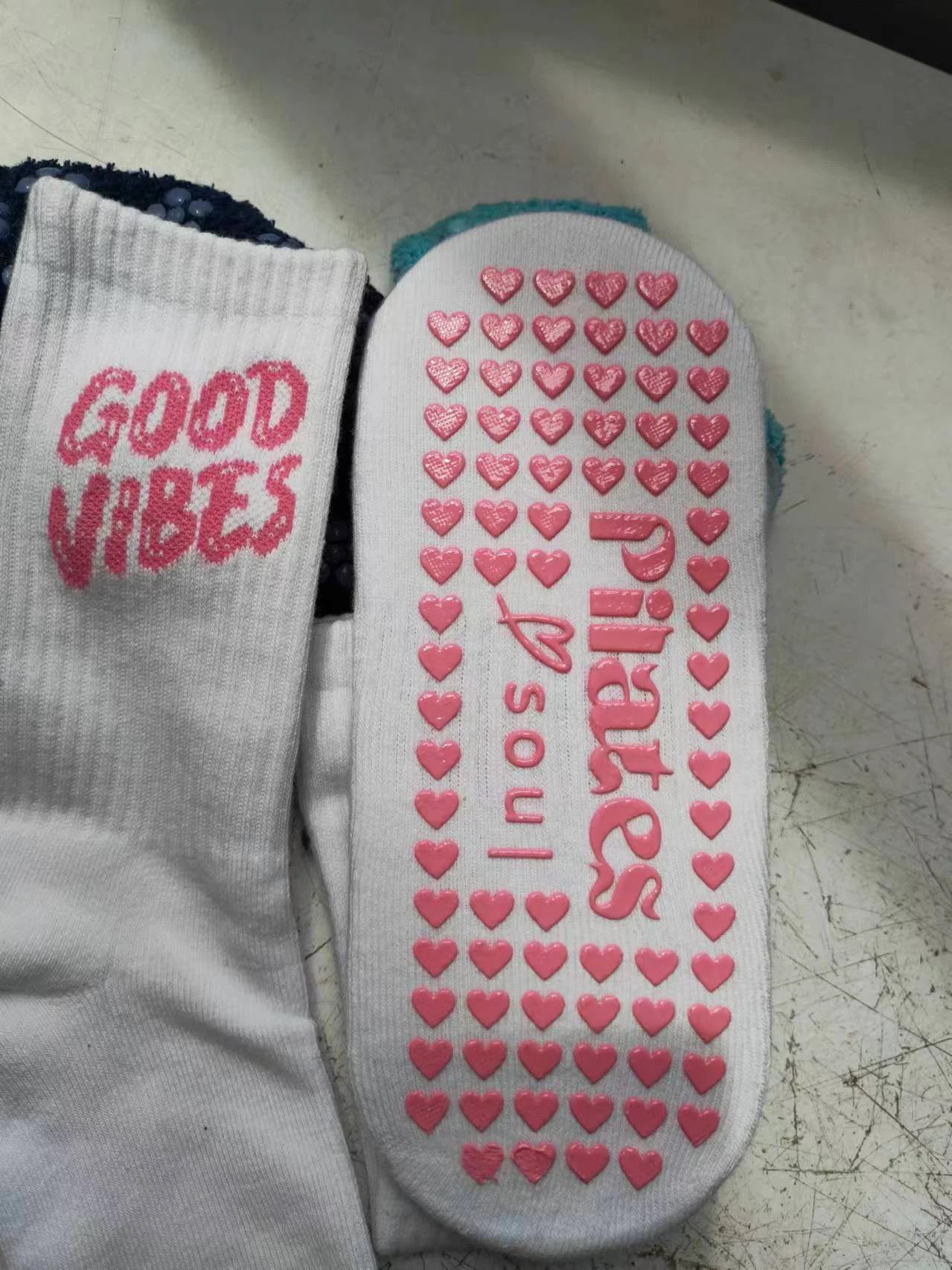
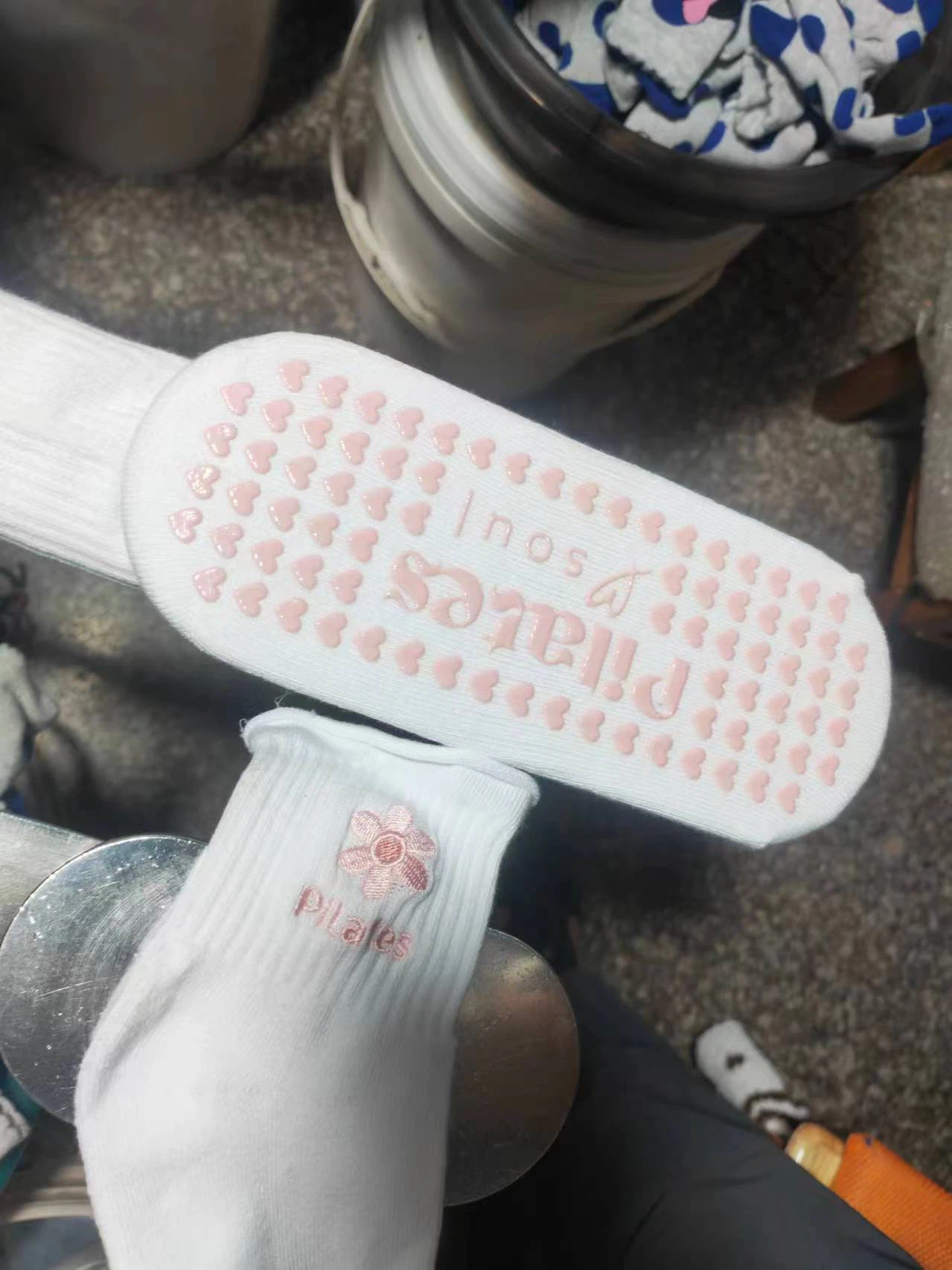
- Heart-shaped dots (10% of healthcare orders) — A popular decorative pattern that still provides excellent traction. Often used in pediatric, maternity, and premium care settings. Adds a touch of warmth and personality.
- Wave / zigzag pattern (10% of healthcare orders) — Continuous lines rather than dots. Provides good traction and is sometimes preferred for its smooth feel. Less common than dot patterns.
- Logo / custom pattern (10% of healthcare orders) — Your facility logo or a custom design can be used as the grip pattern itself. This is a premium option that reinforces branding while providing traction. Available for larger orders (500+ pairs).
Color Options and Color-Coding Systems
Color is an important consideration for healthcare facilities — both for branding and for fall risk color-coding systems:
- Standard hospital colors — Navy, gray, black, white, and beige are the most common. Neutral, professional, and match any facility decor.
- Fall risk color-coding — Many facilities use a standardized color system: Yellow (high fall risk), Red (alert/at-risk), Blue (standard risk), Green (low risk/independent). If your facility uses or plans to implement a color-coded system, make sure to order the appropriate colors. About 60% of our healthcare clients use a color-coded fall risk system.
- Facility branding colors — Custom colors matching your facility’s brand are available for larger orders. This reinforces brand identity and creates a cohesive patient experience.
- Pediatric / maternity colors — Bright colors, pastels, and fun patterns are popular for pediatric wards and labor & delivery units. Pink, blue, mint, lavender, and yellow are common choices.
We have 50+ standard stock colors available at no extra cost. Custom dyeing is available for a small setup fee ($30-$80 per color) for orders of 500+ pairs.
Disposable vs. Reusable: Which Is Right for Your Facility?
One of the most important procurement decisions is whether to use disposable (single-use) or reusable grip socks. Here is a comparison, based on our experience with healthcare facilities:
| Factor | Disposable / Single-Use | Reusable / Washable |
|---|---|---|
| Cost per pair | $0.80 – $2.00 | $1.50 – $4.00 |
| Cost per use | $0.80 – $2.00 (one use) | $0.03 – $0.20 (50-100 uses) |
| Infection control | Excellent — new pair for each patient | Good — requires proper laundering |
| Environmental impact | Higher — more waste | Lower — reusable for months |
| Inventory management | Simple — discard after use, restock as needed | More complex — track, collect, launder, redistribute |
| Best for | Acute care hospitals, short-stay facilities, high infection control areas (ICU, ER, OR) | Long-term care, assisted living, rehabilitation, home care, low infection risk areas |
| Healthcare Popularity | 55% of healthcare orders | 45% of healthcare orders |
Many facilities use a hybrid approach: disposable socks for acute care, ER, ICU, and short-stay patients; reusable socks for long-term care residents and rehabilitation patients. This balances infection control, cost, and environmental considerations. As the case study above shows, a 120-bed nursing home switched from disposable to reusable socks and saved 33% on annual sock costs while reducing fall rates by 32% — demonstrating that reusable socks can be both more cost-effective and more effective for long-term care facilities.
The Healthcare Grip Sock Ordering Process
Understanding the process helps you plan procurement timelines and budget cycles. Here is the step-by-step process from initial inquiry to delivery, based on our standard healthcare order workflow:
Step 1: Requirements Assessment and Quote (2-3 days)
Provide your facility’s requirements: estimated annual quantity, sock length, material, grip type (PVC/silicone), colors (including color-coding system), custom branding needs (facility logo on sock or packaging), and any special requirements (latex-free, hypoallergenic, behavioral health safety). We will provide a detailed quote including unit cost, setup fees, custom branding costs, packaging, and shipping. For facilities with annual procurement cycles, we can provide volume-based annual pricing and scheduled deliveries.
Step 2: Sample Evaluation (3-7 days)
Before placing a bulk order, we strongly recommend evaluating physical samples. This allows your clinical team (nurses, therapists, infection control) to test the socks for fit, comfort, grip effectiveness, and durability — on your facility’s actual flooring. Sample cost is typically $30-$80 (including shipping), and is credited toward your bulk order. For facilities implementing a new grip sock program, we recommend having your fall prevention committee or clinical governance team evaluate and approve the samples before procurement. We recommend having your clinical team test the samples for at least 1-2 weeks before making a decision.
Step 3: Bulk Production (10-20 days)
After you approve the samples and place your order, bulk production begins. For standard colors and specifications, production takes 10-15 business days. Custom colors, custom logo grips, or special materials may add 5-10 days. For large annual orders (5,000+ pairs), production may take 15-25 days. Procurement tip: Plan your orders well in advance of budget cycle deadlines and peak demand periods (flu season, winter months when falls are more common). We also offer scheduled deliveries for facilities with annual contracts — you can place one large order and have it delivered in monthly or quarterly shipments to manage inventory and cash flow.
Step 4: Quality Inspection and Packaging (2-3 days)
Every pair is inspected for grip quality, color accuracy, sizing, and construction defects. Socks are then packaged according to your specifications — individual poly bags, bulk packs, or custom retail packaging. For facilities with color-coded systems, we verify that each color is correctly packaged and labeled to prevent distribution errors. We inspect 100% of pairs — no sampling. Our quality control team has over 10 years of experience in sock production, and they catch defects that other factories miss.
Step 5: Shipping (5-10 days)
For large healthcare orders, we offer multiple shipping options: express air freight (5-7 days), standard air freight (7-10 days), and sea freight (25-35 days) for very large orders. Most facilities choose air freight for reliability and tracking. We can ship directly to your facility, to a central distribution warehouse, or to multiple facility locations. Total timeline from order to delivery: Approximately 3-5 weeks for standard orders. Plan accordingly and order early to avoid last-minute rushes.
Budget Planning: Healthcare Grip Sock Cost Analysis
The total cost depends on quantity, specifications, and whether you choose disposable or reusable. Here is a realistic budget breakdown, based on our actual 2026 factory-direct pricing:
Sample Cost Breakdown (1,000 pairs, ankle length, polyester blend, PVC grip, standard colors, disposable)
| Cost Item | Amount | Notes |
|---|---|---|
| Sock unit cost | $0.80 – $1.50/pair | Depends on quantity and material |
| Custom facility logo | $0.10 – $0.30/pair | Only if you add logo to sock or packaging |
| Individual packaging | $0.05 – $0.15/pair | Individual poly bag; bulk packaging is free |
| Sample fee | $30 – $80 (one-time) | Credited toward bulk order |
| Shipping (air freight) | $0.20 – $0.50/pair | Depends on total weight and destination |
| Total landed cost (standard) | $1.10 – $2.30/pair | All costs included, delivered to your facility |
| Total landed cost (with logo + packaging) | $1.30 – $2.80/pair | Includes custom logo and individual packaging |
Quantity Discount Tiers (Disposable PVC Grip Socks)
| Order Quantity | Estimated Unit Cost (sock only) | Best For |
|---|---|---|
| 100 – 499 pairs | $1.50 – $2.50 | Small facilities, pilot programs, sample orders |
| 500 – 999 pairs | $1.00 – $1.80 | Medium facilities, single department |
| 1,000 – 2,999 pairs | $0.80 – $1.40 | Most common hospital order size |
| 3,000 – 4,999 pairs | $0.70 – $1.20 | Large hospitals, multi-facility systems |
| 5,000 – 9,999 pairs | $0.60 – $1.00 | Hospital networks, annual contracts |
| 10,000+ pairs | $0.50 – $0.85 | Large healthcare systems, group purchasing organizations |
Budget tip: For facilities with predictable annual demand, placing one large annual order (rather than multiple smaller orders throughout the year) can reduce per-unit costs by 30-50%. Many facilities coordinate their grip sock procurement with their annual budget cycle and place one large order to maximize volume discounts. We also offer annual contract pricing for facilities with consistent demand — contact us to discuss volume-based annual pricing and scheduled deliveries. As the case study above shows, a 120-bed nursing home saved 33% on annual sock costs by switching to a reusable program with bulk ordering.
Quality Standards and Compliance for Healthcare Grip Socks
When procuring socks for healthcare use, quality and compliance are critical. Here is what to look for and inspect — these are the same quality standards we enforce on our factory floor:
- Grip effectiveness — The PVC/silicone grip should provide consistent traction on smooth hospital floors (tile, linoleum, polished concrete). Test samples on your facility’s actual flooring before bulk ordering. The grip should not be slippery when slightly damp (e.g., from spilled water or sanitizer). We perform a coefficient of friction (COF) test on every batch — COF should be 0.5 or higher on smooth surfaces.
- Grip durability — For reusable socks, the grip should remain effective after multiple washings. PVC grips typically last 20-50 washes; silicone grips last 50+ washes. Test samples by washing them 10-20 times and re-testing grip effectiveness. We perform a wash durability test on every batch — grip should remain effective after the rated number of washes.
- Latex-free certification — Most healthcare facilities require latex-free products due to latex allergy concerns. All our grip socks are latex-free. Request a latex-free declaration with your order. We can provide a latex-free declaration certificate for your facility’s compliance records.
- Material safety — Socks should be made from materials that meet textile safety standards (OEKO-TEX Standard 100 or equivalent). No harmful dyes, chemicals, or heavy metals. This is especially important for patients with sensitive skin or compromised immune systems. All our materials meet OEKO-TEX Standard 100 requirements.
- Construction quality — Check the toe seam (should be smooth to prevent pressure points and blisters), heel (well-formed), and cuff (good elasticity but not too tight — tight cuffs can restrict circulation, especially in patients with edema or diabetes). We use hand-linked toes for premium orders and machine-linked toes for standard orders.
- Size consistency — All pairs in the same size should fit consistently. For facilities with bariatric patients or patients with edema, consider ordering extra-wide or bariatric sizes. We recommend ordering 10-15% of your inventory in X-Large or Bariatric/Extra-Wide sizes.
- Color accuracy — If using a color-coded fall risk system, verify that colors are consistent across batches and match your facility’s color-coding standard. Color variations could cause confusion in clinical settings. We maintain an inventory of 500+ thread colors and can match virtually any color within ΔE < 2.0.
- Packaging and labeling — Individual packaging should be clean and properly labeled with size, color, and any relevant information (e.g., “Latex-Free”, “Fall Risk — Yellow”). For color-coded systems, clear labeling is essential to prevent distribution errors. We verify every package before shipping.
Related Guides
Frequently Asked Questions
Are your grip socks latex-free?
Yes — all our grip socks are 100% latex-free. The anti-slip grip is made from PVC or silicone (your choice), and the elastic in the cuff is made from spandex/elastane — no natural rubber latex is used in any component. We can provide a latex-free declaration certificate with your order for your facility’s compliance records. This is important for healthcare facilities where latex allergies are a significant patient safety concern. About 1-6% of the general population and 8-17% of healthcare workers have latex allergies, so latex-free products are essential in healthcare settings.
Can grip socks be washed and reused?
Yes — our grip socks are designed to be washable and reusable. PVC grips typically remain effective for 20-50 washes, and silicone grips for 50+ washes. To maximize lifespan: wash in warm water (40°C / 105°F max), avoid bleach and fabric softener, and tumble dry on low heat or air dry. Do not iron. For infection control in healthcare settings, follow your facility’s standard laundering protocols — grip socks can be laundered with regular linen using standard hospital washing procedures. For disposable programs, socks are discarded after each patient discharge or as per your facility’s policy. As the case study above shows, a 120-bed nursing home switched from disposable to reusable socks and saved 33% on annual sock costs while reducing fall rates by 32%.
What sizes are available for healthcare facilities?
We offer a range of sizes to accommodate all patient populations: Small (Women’s 4-6 / Youth), Medium (Women’s 6-10 / Men’s 5-8), Large (Men’s 8-12), X-Large (Men’s 12-15), and Bariatric / Extra-Wide (for patients with edema, lymphedema, or larger feet). For facilities that want to simplify inventory management, we also offer “one-size-fits-most” options that fit US women’s 5-11 and men’s 6-12. We recommend ordering a size mix based on your patient population — most facilities order 20% Small, 40% Medium, 30% Large, and 10% X-Large/Bariatric. About 30% of our healthcare clients order Bariatric/Extra-Wide sizes for patients with edema or larger feet.
Can you print our facility logo on the socks or packaging?
Yes — we offer several branding options for healthcare facilities: (1) Facility logo woven or printed on the sock cuff (available for orders of 500+ pairs), (2) Custom grip pattern using your facility logo (available for orders of 1,000+ pairs — the logo itself becomes the anti-slip grip), (3) Custom printed packaging with your facility name and logo, (4) Custom labels and tags with facility branding. Custom branding reinforces your facility’s identity and creates a more professional patient experience. Setup fees apply for custom branding, but per-unit costs are low — typically $0.10-$0.50 per pair depending on the branding option. About 25% of our healthcare clients add custom branding to their socks or packaging.
Do you offer color-coded fall risk systems?
Yes — we can produce grip socks in any color to match your facility’s fall risk color-coding system. Common systems include: Yellow (high fall risk), Red (alert/at-risk), Blue (standard risk), Green (low risk/independent), and Purple (bariatric/extra-wide). We can also print text labels on the sock or packaging (e.g., “FALL RISK”, “HIGH RISK”, “YELLOW — FALL PRECAUTIONS”) to reinforce the color-coding system. If your facility is implementing a new color-coded system, we can provide samples in all required colors for your clinical team to evaluate before procurement. There is no extra charge for standard colors — custom dyeing is only needed for very specific non-standard colors. About 60% of our healthcare clients use a color-coded fall risk system, and they report that it improves staff awareness and reduces fall rates.
What is the minimum order for healthcare grip socks?
Our factory minimum is 100 pairs per color/design for standard healthcare grip socks. This is lower than many medical supply companies, making it accessible for small facilities, pilot programs, or single departments. For custom branding (logo on sock or custom grip pattern), the minimum is 500-1,000 pairs depending on the customization level. For most facilities, order quantities range from 500 to 5,000 pairs per order. We also offer annual contract pricing for facilities with consistent demand — contact us to discuss volume-based annual pricing and scheduled deliveries. About 40% of our healthcare clients place annual orders with scheduled monthly or quarterly deliveries.
Can you provide samples for our clinical team to evaluate?
Yes — we strongly recommend clinical evaluation before bulk procurement. We can provide sample packs with multiple sizes, colors, materials, and grip types (PVC vs. silicone) for your nursing staff, physical therapists, infection control team, and fall prevention committee to evaluate. Sample cost is $30-$80 (including express shipping), and is typically credited toward your bulk order. We recommend having your clinical team test the samples for at least 1-2 weeks — evaluating fit, comfort, grip effectiveness on your facility’s actual flooring, durability after washing, and patient feedback. This ensures you select the best product for your specific facility needs before committing to a large order. A $50 sample pack is the best insurance policy you can buy — it can prevent increased fall rates and liability claims from choosing the wrong socks.
Can I combine healthcare grip socks with other custom sock types in one order?
Yes — we produce a wide range of custom socks, including jacquard socks, embroidered socks, crew socks, ankle socks, compression socks, and dress socks. If your healthcare facility or system wants to offer multiple sock types (e.g., grip socks for patients, embroidered dress socks for staff, jacquard crew socks for fundraising), we can combine everything into one order with unified branding and consistent quality. This also saves on shipping costs — you only pay shipping once for the combined order. Many of our healthcare system clients start with patient grip socks and then expand to staff appreciation socks and fundraising merchandise. Let us know what you need and we will create a custom quote for your entire order.
Ready to Procure Non-Slip Grip Socks for Your Facility?
Whether you manage a small assisted living facility or a large hospital network, our factory makes procuring high-quality non-slip grip socks simple and cost-effective. With latex-free materials, PVC and silicone grip options, 50+ standard colors, custom branding, color-coded fall risk systems, competitive factory-direct pricing, and comprehensive quality control, we help healthcare facilities of all sizes improve patient safety and reduce fall risk.
We have produced non-slip grip socks for over 80 healthcare facilities across the US, Canada, UK, and Australia — from small assisted living facilities with 20 beds to large hospital networks with 5,000+ beds. No matter the size of your facility or your budget, you get the same factory-direct quality, responsive communication, and attention to detail. We also produce custom jacquard socks and custom embroidered socks — if your healthcare system wants to expand beyond patient grip socks to staff appreciation or fundraising merchandise, we can handle everything in one order.
Contact us on WhatsApp for a free consultation and quote. Provide your facility type, estimated quantity, preferred specifications (sock length, material, grip type, colors, custom branding), and any special requirements — we will respond within 24 hours with detailed pricing and sample options. Not sure which specifications are right for your facility? We will send you a free sample pack with multiple options so your clinical team can evaluate them on your facility’s actual flooring before making a decision.