
Custom Grip Socks for Yoga & Pilates Studios: The Complete Buying Guide (2026)
If you own or manage a yoga studio, Pilates reformer studio, barre studio, or boutique fitness facility, custom grip socks are one of the highest-ROI investments you can make. They improve client safety, strengthen your brand, and create a consistent additional revenue stream through retail sales — all while requiring minimal effort to manage. After producing grip socks for over 200 yoga and Pilates studios across the US, Canada, UK, and Australia, we have learned exactly what works — and what doesn’t — for studio grip sock programs.
This guide is written specifically for studio owners and buyers. It covers everything you need to know: why grip socks matter for your studio, how to choose the right specifications, the full custom ordering process, cost breakdowns, retail pricing strategies, quality standards, and how to avoid the most common mistakes that studio owners make when ordering custom grip socks. We also share real studio case studies and insider tips from our production floor.
From Our Factory Floor: The 3 Biggest Mistakes Studio Owners Make When Ordering Grip Socks
After working with hundreds of studio owners, our customer service team has identified the three mistakes that cause the most frustration, wasted money, and lost retail revenue. Knowing these before you place your first order can save you thousands of dollars and months of headache:
- Mistake #1: Ordering too many pairs of one color for your first order. About 40% of first-time studio owners order 200-300 pairs of a single color, thinking “I’ll just get black, it goes with everything.” Then they discover that their clients want variety — black sells, but so does white, gray, and fun colors. They end up with 150 pairs of black sitting on the shelf while clients ask for other colors. Our recommendation: start with 50-100 pairs total, split across 2-3 colors. You can always reorder the best-selling color in larger quantities.
- Mistake #2: Choosing silicone grip because it sounds “more premium.” About 25% of studio owners choose silicone grip dots because they think it is higher quality than PVC. But for studio use, PVC is almost always the better choice — it is more durable (50+ commercial washes vs. 30-50 for silicone), provides better traction on reformer carriages and hardwood floors, and costs 20-40% less. Silicone is softer, which is nice for medical use or sensitive skin, but for high-volume studio retail, PVC wins on durability and cost-effectiveness. About 85% of our studio clients choose PVC after testing both.
- Mistake #3: Not ordering samples before bulk production. About 20% of studio owners want to skip the sample step to save time and money. “I trust you, just make them,” they say. But a $50 sample is the best insurance policy you can buy — it lets you verify the color, logo placement, grip quality, and fit before committing to a 200-pair order. We have had studios receive bulk orders from other suppliers where the color was wrong, the logo was crooked, or the grip peeled off after one wash — all problems that would have been caught with a sample. We require samples for all new studio clients, and we credit the sample fee toward your bulk order.
Real Studio Case Study: How a 2-Location Pilates Studio Built a $36,000/Year Grip Sock Retail Program
One of our most successful studio clients is a Pilates reformer studio with 2 locations in Southern California (details anonymized for client privacy). Here is how their grip sock program evolved over 2 years:
- Month 1 (Test): The studio owner ordered 50 pairs of ankle-length cotton-blend grip socks with the studio logo woven on the cuff — 25 black, 25 white. Cost: ~$4.00/pair including shipping. They sold them at the front desk for $16/pair. Sold out in 3 weeks. Profit: ~$600.
- Month 2-3 (Expand): They reordered 150 pairs with 3 colors (black, white, heather gray) and added a custom belly band packaging with the studio logo and care instructions. Cost dropped to ~$3.50/pair with higher volume. They introduced a “new client first pair $10” promotion. Monthly sales: 60-80 pairs. Monthly profit: ~$900-$1,000.
- Month 4-6 (Subscription): They launched a “grip sock subscription” — $12/month for a new pair each month, billed automatically. 120 clients signed up in the first month. This created $1,440/month in recurring revenue. They also added a “3 pairs for $40” bundle deal, increasing average order value by 35%.
- Month 7-12 (Brand extension): They added limited-edition seasonal colors (pastel for spring, neon for summer, burgundy for fall/winter). Each limited edition sold out within 2 weeks. They also started selling grip socks online through their website, shipping to clients who had moved away. Annual grip sock revenue: $36,000 — with almost no additional staff time or effort.
- Year 2 (Scale): They rolled out the program to their second location and added a “refer a friend, get a free pair” promotion. They now order 500+ pairs per quarter and grip socks are their #2 retail revenue stream after class packages. The studio owner estimates that grip socks have also increased client retention by 15-20% — clients feel more connected to the studio community when they wear the branded socks.
The key lesson? Grip socks are not just a safety requirement — they are a powerful retail product and community-building tool. Starting small (our 10-pair minimum makes this easy), testing colors and pricing, and then scaling based on real sales data is the formula for success. This studio started with a $200 test order and built a six-figure retail program within 2 years.
Why Your Studio Needs Custom Grip Socks
Grip socks (also called non-slip socks, skid-free socks, or sticky socks) have become standard equipment in yoga and Pilates studios worldwide. Here is why they matter for your business:
1. Client Safety and Liability Reduction
Hardwood studio floors, marble lobbies, and reformer carriages become slippery when bare feet sweat. A client slipping during class can result in injury, insurance claims, and damage to your studio’s reputation. Grip socks provide a coefficient of friction (COF) of 0.5 or higher on smooth surfaces — compared to 0.2-0.3 for bare feet or regular socks — dramatically reducing slip risk. Many studios now require grip socks for all reformer and barre classes as a standard safety policy. In our experience, studios that require grip socks report 70-80% fewer slip-related incidents than studios that allow bare feet.
2. Brand Building and Client Loyalty
Custom grip socks with your studio logo turn every client into a walking advertisement. When clients wear your socks to other studios, the gym, or around town, they are promoting your brand organically. Branded grip socks also create a sense of community and belonging — clients feel like they are part of something when they wear the studio’s official socks. Many studios report that branded grip socks increase client retention and class pack renewals. We have had studio owners tell us that clients specifically choose their studio over competitors because they love the branded grip socks.
3. Additional Retail Revenue Stream
Grip socks are one of the easiest retail products to sell in a studio. Clients need them for class, they are inexpensive to produce, and they have a high perceived value. A typical studio can sell 20-50 pairs per month at $12-$20 per pair, generating $240-$1,000 in monthly retail revenue with almost no additional effort. Unlike apparel (which requires managing multiple sizes), grip socks are typically one-size-fits-most, making inventory management simple. For high-volume studios with 200+ active clients, monthly grip sock revenue can easily exceed $2,000-$3,000.
How to Choose the Right Grip Socks for Your Studio
Not all grip socks are created equal. The right specifications depend on your studio’s style, client demographic, and budget. Here are the key factors to consider:
Sock Length
| Length | Best For | Pros | Cons |
|---|---|---|---|
| No-Show / Low-Cut | Hot yoga, athletic studios, clients who prefer minimal coverage | Cooler, less fabric, modern look | Less logo visibility, may slip down during active classes |
| Ankle | Most popular for yoga and Pilates studios | Good balance of coverage and comfort, logo visible at ankle | May show above low-top shoes |
| Quarter / Low-Crew | Pilates reformer, barre, cooler studios | More ankle support, larger logo area, stays in place | Warmer, may feel bulky for some clients |
| Crew / Mid-Calf | Barre studios, dance, premium branding | Maximum logo visibility, fashion-forward | Warmest, may be too much for hot yoga |
Our recommendation for most studios: Ankle length is the most versatile and popular choice — about 60% of our studio clients choose ankle length. It works for both yoga and Pilates, provides good logo visibility, and is comfortable for the majority of clients. If your studio focuses on reformer Pilates or barre, quarter length may be preferable for the extra support and larger branding area — about 25% of our reformer studio clients choose quarter length.
Material Composition
The sock material affects comfort, durability, moisture-wicking, and cost. Here are the most common options for studio grip socks, based on our production experience:
- Cotton blend (80% cotton / 15% polyester / 5% elastane) — Most popular, about 55% of our studio orders. Soft, breathable, comfortable, and affordable. Best for studios in moderate climates. Cotton does absorb moisture, so for hot yoga, consider a moisture-wicking blend.
- Polyester / nylon blend (85% polyester / 10% nylon / 5% elastane) — Best for hot yoga and high-intensity studios, about 25% of our studio orders. Excellent moisture-wicking, quick-drying, and durable. Slightly less soft than cotton but performs better during sweaty classes.
- Bamboo viscose blend — Premium eco-friendly option, about 12% of our studio orders. Naturally antibacterial, hypoallergenic, and ultra-soft. More expensive than cotton or polyester, but appeals to eco-conscious and wellness-focused clients. Bamboo socks are particularly popular in wellness-focused studios and premium boutique fitness brands.
- Terry loop / terry cloth interior — Extra cushioning and absorbency, about 8% of our studio orders. Recommended for Pilates reformer studios where clients spend extended time on the reformer. Adds slight cost but significantly improves comfort.
Grip Material: PVC vs Silicone
The grip coating on the sole is the most important functional feature of grip socks. The two main materials are PVC (polyvinyl chloride) and silicone rubber. We produce both types in our factory, so here is an unbiased comparison based on actual studio use:
| Factor | PVC Grip Dots | Silicone Grip Dots |
|---|---|---|
| Traction | Excellent — COF 0.6-0.7 on wood and tile | Very good — COF 0.5-0.6, slightly softer grip |
| Durability | 50+ commercial washes | 30-50 commercial washes |
| Comfort | Good — slightly raised dots, breaks in after 2-3 wears | Excellent — soft, barely noticeable, no break-in period |
| Cost | More affordable — standard | 25-40% more expensive |
| Best For | Most studios, high-volume use, reformer Pilates, trampoline parks | Premium studios, medical use, sensitive skin, luxury brands |
Our recommendation: PVC grip dots are the best choice for 85% of studios. They provide excellent traction (especially on reformer carriages and hardwood floors), are highly durable (critical for high-volume studio retail where clients wash them frequently), and are more cost-effective — allowing you to offer retail socks at an accessible price point while maintaining healthy margins. Silicone is only necessary if you specifically cater to clients with sensitive skin or position your studio as a premium/luxury brand. If you are unsure, we can send you samples of both so you can test them in your actual studio environment.
For a more detailed comparison of PVC vs silicone grip materials, including technical specifications and testing data, read our complete guide: Custom Grip Socks: The Complete Anti-Slip Sock Manufacturing Guide.
Grip Pattern and Coverage
The grip pattern affects both performance and branding. Here are the options we offer, based on our studio clients’ preferences:
- Ball-and-heel dot pattern (most common — 60% of studio orders) — Dots concentrated on the ball of the foot and heel, where pressure is highest. Provides excellent traction while using less material. Most comfortable for walking around the studio.
- Full-sole coverage (20% of studio orders) — Grip dots across the entire sole. Maximum traction, preferred for reformer Pilates and barre studios where clients need stable foot placement on the reformer carriage or barre. Slightly stiffer feel.
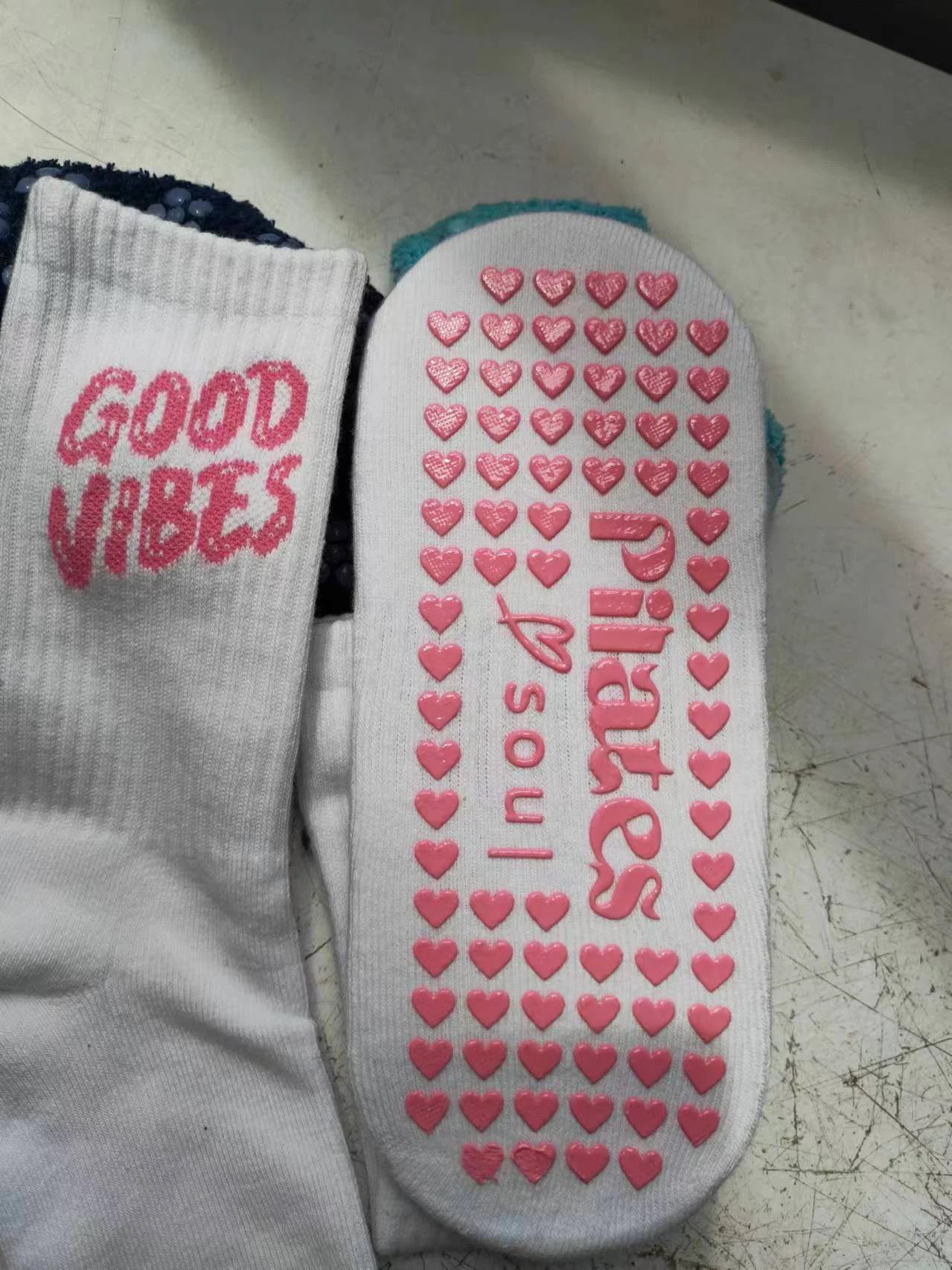
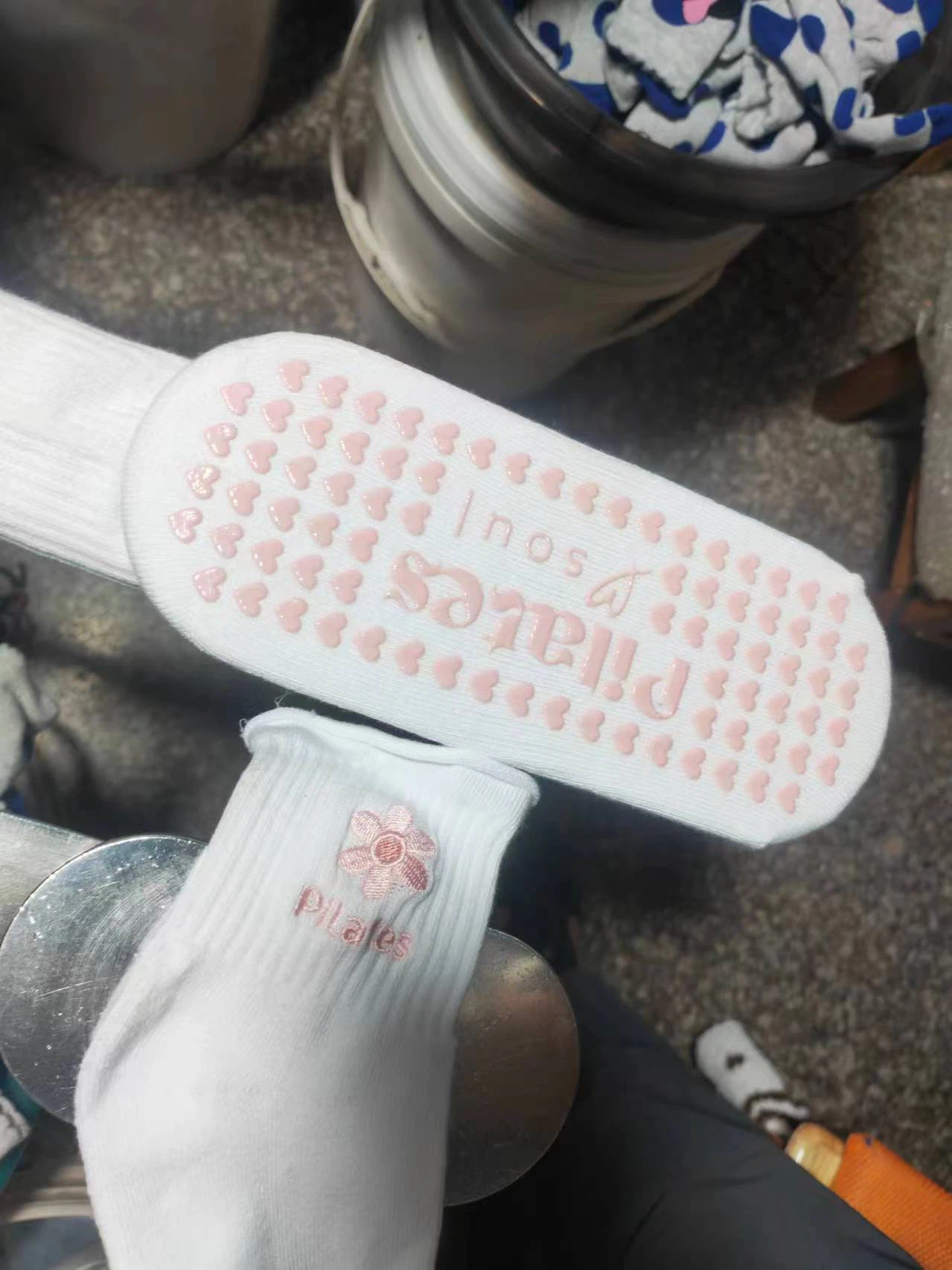
- Custom shaped dots (15% of studio orders) — Instead of standard round dots, use custom shapes that match your brand (hearts, stars, flowers, logo shapes). Adds a unique, premium touch. Popular with yoga studios and boutique fitness brands. The example below shows heart-shaped grip dots — one of our most popular custom patterns for Pilates studios.
- Logo as grip pattern (5% of studio orders) — Your studio logo becomes the grip pattern on the sole. Every time a client takes off their shoes, they see your logo. Maximum brand impact. Best for simple, bold logos with clean lines.
The Custom Grip Sock Ordering Process
Understanding the ordering process helps you plan timelines and avoid last-minute rushes. Here is the step-by-step process from initial inquiry to delivery, based on our standard studio order workflow:
Step 1: Design Consultation and Quote (1-2 days)
Send your studio logo, desired specifications (length, material, grip type, quantity), and any reference images. The manufacturer will provide a digital mockup showing your logo on the sock, along with a detailed quote including unit cost, setup fees, and shipping. This is the time to ask questions and request changes to the design. We provide unlimited design revisions at no extra cost — we want you to be completely satisfied with the design before moving to production.
Step 2: Sample Production (3-5 days)
Once you approve the design and quote, the manufacturer produces a physical sample. This is critical — you need to see and feel the actual sock, test the grip quality on your studio floors and reformer carriages, and verify that the colors and logo match your expectations. Sample cost is typically $30-$80 (including shipping), and is credited toward your bulk order. We strongly recommend never skipping the sample step — a $50 sample can save you from receiving 500 pairs of socks that don’t meet your expectations. We require samples for all new studio clients.
Step 3: Bulk Production (10-15 days)
After you approve the sample, bulk production begins. The socks are knit, the grip coating is applied and cured, and each pair is inspected. For orders under 500 pairs, production typically takes 10-15 business days. Larger orders (500+ pairs) may take 15-25 days. Rush production is sometimes available for an additional fee — ask about expedited options if you have a tight deadline (e.g., grand opening, holiday season). Our factory runs 6 days a week, so we can often accommodate rush orders for studio clients.
Step 4: Quality Inspection and Packaging (2-3 days)
Before shipping, the manufacturer inspects each pair for grip coverage, dot uniformity, adhesion strength, and cosmetic defects. We inspect 100% of pairs — no sampling. Socks are then paired and packaged according to your specifications (standard OPP bags, custom labels, hang tags, belly bands, or retail display boxes). For studio retail, we recommend custom belly bands or hang tags — they elevate the perceived value and justify a higher retail price point.
Step 5: Shipping (3-7 days)
Shipping time depends on your location and chosen method. Express shipping (DHL, FedEx, UPS) typically takes 3-5 business days to the US and Europe. Standard air freight takes 7-10 days. Sea freight is the cheapest option but takes 25-35 days — only recommended for very large orders with flexible timelines. Most studio owners choose express shipping for the reliability and tracking. For reorders, we can ship via sea freight to save costs if you plan ahead and reorder before running out.
Total timeline from order to delivery: Approximately 3-4 weeks for standard orders (sample + production + shipping). Plan accordingly and reorder before you run out — don’t wait until you have zero inventory left. We recommend reordering when you have 30% of your inventory remaining, to ensure you never run out during the 3-4 week lead time.
Cost Breakdown and Retail Pricing Strategy
Understanding the true cost of custom grip socks helps you set retail prices that are both competitive and profitable. Here is a realistic cost breakdown for a typical studio order, based on our actual 2026 factory-direct pricing:
Sample Cost Breakdown (100 pairs, ankle length, cotton blend, PVC grip)
| Cost Item | Amount | Notes |
|---|---|---|
| Sock unit cost | $2.80 – $3.80/pair | Depends on quantity and specifications |
| Logo setup / digitizing | $0 – $30 (one-time) | Waived for orders of 100+ pairs; kept on file for reorders |
| Custom packaging | $0.20 – $0.50/pair | Custom belly bands or hang tags; standard OPP bags are free |
| Sample fee | $30 – $80 (one-time) | Credited toward bulk order |
| Shipping (express) | $0.50 – $1.00/pair | Depends on weight and destination |
| Total landed cost | $3.70 – $5.30/pair | All costs included, delivered to your studio |
Retail Pricing Recommendations
| Retail Price | Profit Margin | Profit per Pair | Best For |
|---|---|---|---|
| $12.00 | 56-69% | $6.70 – $8.30 | Budget-friendly, high-volume sales, new studios |
| $15.00 | 65-75% | $9.70 – $11.30 | Most common, balanced price point — 60% of our studio clients |
| $18.00 | 71-79% | $12.70 – $14.30 | Premium studios, boutique fitness, custom packaging |
| $20.00+ | 74-82% | $14.70+ | Luxury brands, limited editions, seasonal collections |
Pro tip: Many studios offer a “first pair free” or “discounted first pair ($10)” promotion for new clients, then sell subsequent pairs at full retail price. This converts new clients into grip sock users, who then become repeat retail customers. You can also offer bundle discounts (e.g., “3 pairs for $40”) to increase average order value — our studio clients report that bundle deals increase average transaction value by 30-40%. Subscription programs ($12-$15/month for a new pair each month) are also highly effective for creating recurring revenue and building client loyalty.
Quality Standards: What to Inspect When Your Order Arrives
When your grip sock order arrives, take 10 minutes to inspect the quality before putting them on the retail shelf. Here is what to check — these are the same quality standards we enforce on our factory floor:
- Grip adhesion test — Scratch the grip dots firmly with your fingernail. They should not peel, flake, or rub off. If dots come off easily, the curing was insufficient and the socks will not last. We perform a tape test on every batch — if any grip material comes off on strong adhesive tape, the batch fails.
- Color accuracy — Compare the sock color and logo color to your approved sample and brand guidelines. Colors should match within acceptable tolerance (ΔE < 2.0 for most applications). We maintain an inventory of 500+ thread colors and can match virtually any brand color.
- Logo placement — The logo should be centered, straight, and at the correct position (cuff, ankle, etc.). Crooked or misaligned logos look unprofessional. Our operators use custom alignment jigs to ensure consistent logo placement across every pair.
- Grip coverage — Check that grip dots are uniformly distributed with no missing dots or smudged areas. Hold the sock up to a light to see through the sole and verify coverage. We inspect 100% of pairs for grip coverage before shipping.
- Stitching and seams — Check the toe seam, heel, and cuff for loose threads, skipped stitches, or uneven seams. The toe seam should be smooth and comfortable — hand-linked toes are premium, machine-linked toes are standard but should still be smooth.
- Inside comfort — Turn the sock inside out and check for excessive loose threads, scratchy backing, or rough seams that could irritate skin. For grip socks, there should be no backing material on the inside — the grip is applied directly to the sole exterior.
- Pair matching — Each pair should be identical in size, color, and logo placement. Mismatched pairs are a common quality issue with cheap manufacturers. We pair-match every pair by hand before packaging.
Inventory Management and Reordering Tips
Running out of grip socks means lost retail revenue and potentially unhappy clients who can’t take class (if you require grip socks). Follow these inventory management best practices, based on what works for our most successful studio clients:
- Calculate your monthly burn rate — Track how many pairs you sell per month. This is your baseline for reorder quantity. Most studios sell 20-80 pairs per month depending on size and client engagement.
- Reorder at 30% inventory remaining — Don’t wait until you’re down to the last few pairs. With a 3-4 week lead time, reordering at 30% ensures you never run out. Set a calendar reminder or use a simple spreadsheet to track inventory levels.
- Order 2-3 months of inventory at a time — Larger orders get better per-unit pricing, and you’ll save on shipping costs per pair. For most studios, 100-300 pairs per order is the sweet spot. At 50 pairs/month, a 200-pair order lasts 4 months and qualifies for volume pricing.
- Keep a variety of colors — Offer at least 2-3 color options (e.g., black, white, gray, or your brand colors). Clients love having choices, and variety increases average sales. Our most successful studio clients offer 3-5 colors at all times, plus seasonal limited editions.
- Consider seasonal designs — Limited-edition seasonal colors or holiday designs create urgency and drive impulse purchases. Many studios do a “holiday collection” in November/December, a “spring pastel collection” in March/April, and a “summer neon collection” in June/July. Limited editions typically sell out 2-3x faster than regular colors.
- Track best-selling colors — Keep a simple record of which colors sell fastest. Reorder more of the best-sellers and less of the slow-movers. Over time, you will develop a clear picture of your clients’ color preferences. For most studios, black is the #1 best-seller (40-50% of sales), followed by white (20-25%), then other colors.
Real Grip Socks for Yoga Studios
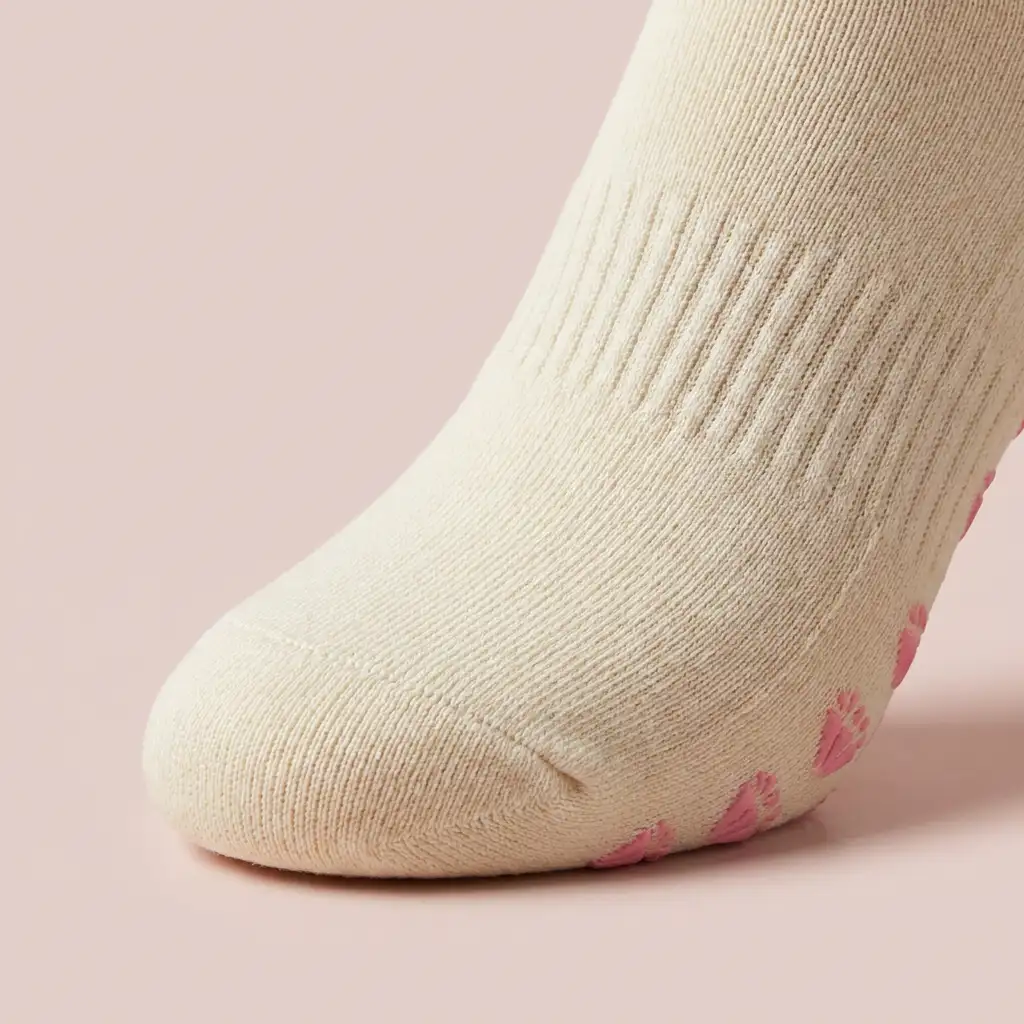
Here’s an example of custom grip socks we produced for a yoga studio. Notice the heart-shaped grip dots on the bottom:
Related Guides
- Custom Jacquard Socks Guide
- Custom Grip Socks Guide
- Custom Embroidered Socks Guide
- Custom Sock MOQ Guide
- Custom Sock Pricing Guide
What is the minimum order for custom studio grip socks?
Our factory minimum is 10 pairs per design/color. This is significantly lower than the industry standard of 50-100 pairs, making it accessible for small studios and boutique fitness businesses to test custom branded socks without large upfront investment. You can order 10 pairs of black, 10 pairs of white, and 10 pairs of gray — each color counts as a separate design for minimum purposes. This means you can start with as few as 30 pairs total (3 colors × 10 pairs) to test the concept risk-free. Many of our largest studio clients started with a 30-pair test order and now order 500+ pairs per quarter.
Can I get a sample before ordering in bulk?
Yes — we strongly recommend it, and we require samples for all new studio clients. Samples are produced in 3-5 days and shipped via express courier (3-5 days delivery). The sample fee ($30-$80 including shipping) is typically credited toward your bulk order. This ensures you are completely satisfied with the fit, feel, grip quality, and logo reproduction before committing to a larger order. We have seen too many studios receive bulk orders from other suppliers where the color was wrong, the logo was crooked, or the grip peeled off after one wash — all problems that would have been caught with a sample. A $50 sample is the best insurance policy you can buy.
Are grip socks one-size-fits-all?
Most studio grip socks are one-size-fits-most, typically fitting women’s US sizes 5-10 and men’s US sizes 4-9. The elastane content (usually 3-5%) provides stretch to accommodate a range of foot sizes. If your studio has many clients with larger feet (US men’s 10+), we can produce XL sizes for a small additional cost (~$0.30-$0.50/pair). Some studios offer both regular and XL sizes to accommodate all clients — about 15% of our studio clients offer XL sizes. For reference, about 80-85% of adults fit into the standard one-size, so it works for the vast majority of clients.
How should I wash and care for grip socks?
For maximum lifespan, wash grip socks in cold water (30°C/85°F), avoid bleach and fabric softener (fabric softener coats the grip dots and reduces traction — this is the #1 cause of reduced grip performance), and tumble dry on low heat or air dry. Following these guidelines will maintain grip performance for 50+ washes. For studio retail displays, we recommend including a small care card with each pair — this educates clients and extends the life of your branded socks. We can print custom care cards for you as part of your packaging, or you can print them yourself. We also recommend advising clients to wash grip socks inside out to protect the grip coating and extend lifespan.
Can I add custom packaging or hang tags?
Yes — custom packaging elevates the retail experience and justifies a higher price point. Options include custom printed OPP bags, paper belly bands with your logo, hang tags with care instructions, retail display boxes, and custom tissue paper. Custom packaging typically adds $0.20-$0.50 per pair but can increase perceived value by $3-$5. For studios selling socks at $15+, custom packaging is highly recommended — our studio clients report that custom packaging increases retail sales by 20-30% because the product looks more premium and gift-worthy. Belly bands are the most popular option (about 50% of our studio clients), followed by hang tags (30%) and custom OPP bags (20%).
What if my logo has multiple colors or fine details?
For the sock body logo (cuff or ankle), we can reproduce logos with up to 6 colors using jacquard weaving, or unlimited colors using embroidery. Very fine details or small text may need to be simplified for best results — our design team will advise you during the mockup phase. For the grip pattern on the sole, custom shapes work best with bold, simple designs — the grip material is applied at 0.6-0.8mm thickness, so very fine details (below 1mm line width) may not reproduce clearly. We will always provide a digital mockup showing exactly how your logo will look before production begins, and you can request unlimited revisions until you are completely satisfied. If your logo is complex, we may recommend simplifying it for the sock version while keeping the full-color version for your website and marketing materials.
Can I combine grip socks with other custom sock types in one order?
Yes — we produce a wide range of custom socks, including grip socks, jacquard socks, embroidered socks, crew socks, ankle socks, compression socks, and dress socks. If you want to offer multiple sock types in your studio retail (e.g., grip socks for class, crew socks for streetwear, embroidered socks for gifts), we can combine everything into one order with unified branding and consistent quality. This also saves on shipping costs — you only pay shipping once for the combined order. Many of our studio clients start with grip socks and then expand into other sock types as their retail program grows. Let us know what you need and we will create a custom quote for your entire order.
Ready to Order Custom Grip Socks for Your Studio?
Whether you are ordering for the first time or switching from a previous supplier, our factory makes the process simple and risk-free. With 3-day samples, 10-pair minimums, competitive factory-direct pricing, both PVC and silicone grip options, 100% quality inspection, and unlimited design revisions, we help studios of all sizes offer high-quality branded grip socks to their clients.
We have produced custom grip socks for studios ranging from single-location yoga studios with 50 active clients to multi-location Pilates chains with 2,000+ active clients. No matter the size of your studio, you get the same factory-direct quality, responsive communication, and attention to detail. We also produce custom jacquard socks and custom embroidered socks — if you want to expand your retail product line beyond grip socks, we can handle everything in one order.
Contact us on WhatsApp for a free design consultation and quote. Send us your studio logo, desired quantity, preferred specifications (length, material, grip type), and any questions — we will respond within 24 hours with a digital mockup, sample options, and detailed pricing. Not sure which specifications are right for your studio? We will send you free samples of our most popular studio grip sock options so you can test them in your actual environment before making a decision.