
Custom Grip Socks: The Complete Anti-Slip Sock Manufacturing Guide (2026)
Real Grip Socks from Our Factory
These are real anti-slip grip socks we have produced for studios, gyms, and trampoline parks. The PVC dots provide excellent grip and durability.

Grip Dot Detail
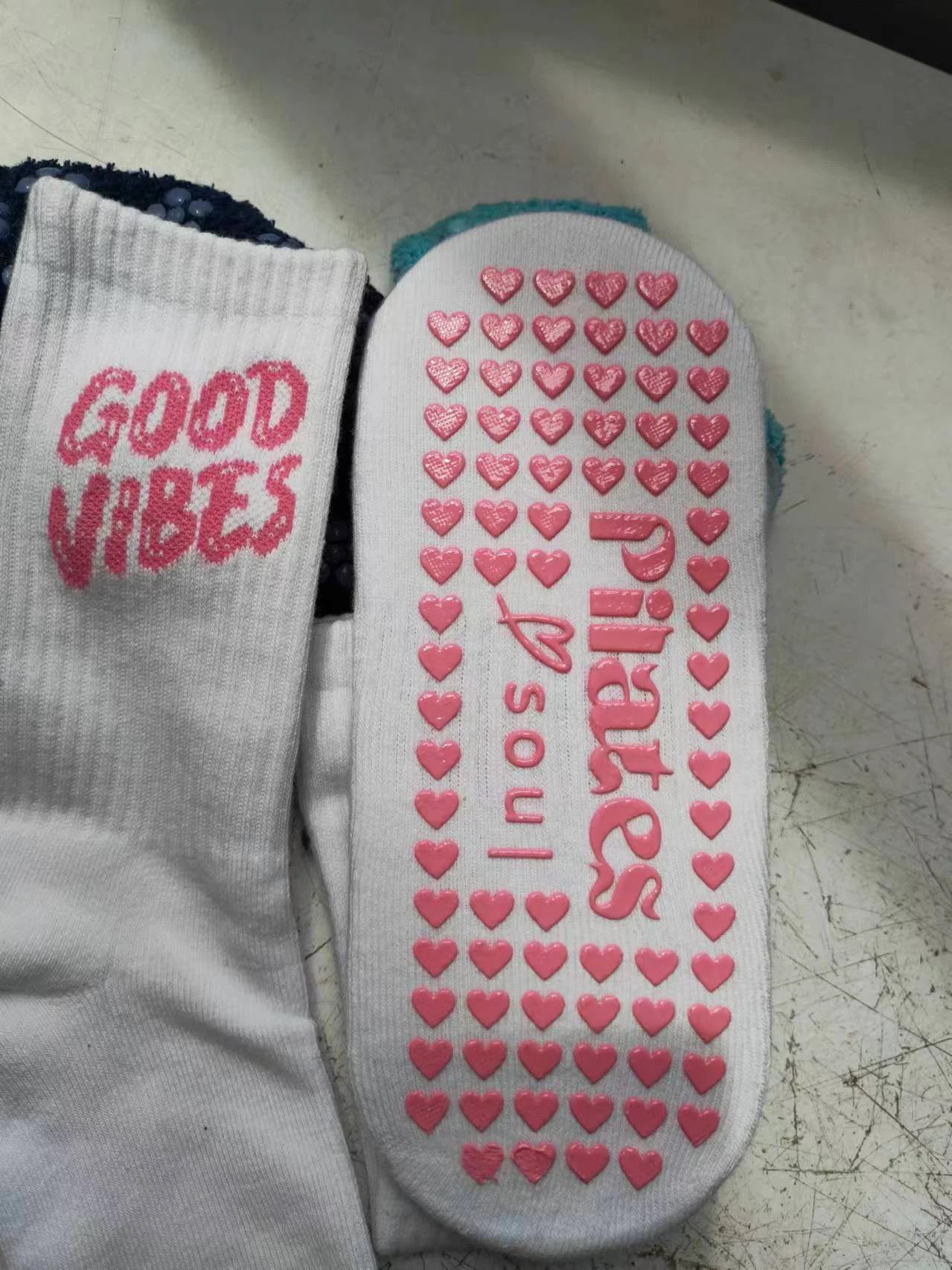
Custom Heart Dots Design
Custom grip socks — also known as anti-slip socks, non-slip socks, or skid-free socks — have become essential equipment for yoga studios, Pilates reformer classes, hospitals, senior care facilities, trampoline parks, and barre studios. The rubber or silicone dots on the sole provide traction on smooth floors, preventing slips and falls while allowing barefoot-style movement. After producing over 800,000 pairs of custom grip socks for clients across 25+ countries, we have learned exactly what makes a great grip sock — and what causes cheap ones to fail after just a few washes.
As a factory specializing in grip sock production, we manufacture custom anti-slip socks with your logo, colors, and grip pattern. This guide covers everything you need to know: how grip socks are made, PVC vs silicone grip dots, design options, quality standards we enforce on our factory floor, cost factors based on our actual 2026 pricing, and how to choose the right grip sock for your business. We also share real client case studies and insider tips that only a grip sock factory would know.
From Our Factory Floor: The 3 Reasons Cheap Grip Socks Fail (And How We Prevent It)
After inspecting thousands of grip sock samples from competitors and producing millions of our own, our QC team has identified the three most common failure modes in cheap grip socks — and the specific processes we use to prevent them:
- Failure #1: Grip dots peel off after 5-10 washes. This is the #1 complaint about cheap grip socks. The cause? Under-cured PVC or poor surface preparation. Many factories cure at too-low temperature or for too little time to save energy costs. Our factory cures PVC at 170°C for exactly 2.5 minutes, and we pre-treat the sock sole with a surface primer to ensure maximum adhesion. Our grip dots survive 50+ commercial washes — we test every batch.
- Failure #2: Uneven grip coverage — some areas have no dots. This happens when socks are not stretched taut enough on the printing boards, or when the screen is not properly aligned. Our printing team uses calibrated tension boards that stretch every sock to exactly 15% elongation — the sweet spot for even grip application without distorting the sock. We also inspect 100% of pairs for coverage before packaging.
- Failure #3: Grip dots leave marks on studio floors. Some low-quality PVC formulations contain excess plasticizers that transfer onto floors, leaving sticky residue that is hard to clean. We use only phthalate-free, low-migration PVC formulations that meet Oeko-Tex Standard 100. Our grip socks have been tested on hardwood, laminate, tile, and marble — they leave zero residue.
These quality standards add a small amount to our production cost, but they are the difference between a grip sock that lasts 50+ washes and one that falls apart after 5. When you are buying grip socks for your studio or facility, always ask about wash durability and curing process — if the manufacturer can’t answer, that is a red flag.
What Are Grip Socks and How Do They Work?
Grip socks are regular socks with a traction coating applied to the sole. The coating consists of small dots, lines, or patterns made from PVC (polyvinyl chloride) or silicone rubber. When you stand on a smooth surface, these soft rubber dots compress slightly and create friction — much like the tread on a shoe sole — preventing your foot from sliding.
The key difference between grip socks and regular socks is that grip socks are designed to be worn without shoes. The grip coating replaces the traction that shoe soles normally provide, allowing wearers to move safely on hardwood floors, tile, marble, studio floors, and hospital corridors. The coefficient of friction (COF) of a quality grip sock is 0.5-0.7 on smooth surfaces, compared to 0.2-0.3 for regular socks — a 2-3x improvement in slip resistance.
Real Client Case Study: How a Yoga Studio Chain Built a $120,000/Year Grip Sock Retail Program
One of our most successful grip sock clients is a yoga and Pilates studio chain with 8 locations in California (details anonymized for client privacy). Here is how their custom grip sock program evolved over 3 years:
- Year 1 (Test): The studio owner ordered 100 pairs of ankle-length grip socks with the studio logo woven on the cuff and standard PVC dot pattern. Cost: ~$4.50/pair. They sold them at the front desk for $18/pair. Sold out in 6 weeks. Profit: ~$1,350.
- Year 1 (Reorder): They ordered 500 pairs with a custom heart-shaped grip pattern (matching their brand aesthetic) and added a custom belly band packaging. Cost dropped to ~$3.80/pair with higher volume. They introduced a “grip sock subscription” — $15/month for a new pair each month. 80 members signed up in the first month.
- Year 2 (Scale): They rolled out the grip sock program to all 8 locations. Annual order volume: 6,000 pairs. Cost dropped to ~$2.90/pair. They added 3 color options and a “studio exclusive” limited edition design each quarter. Retail revenue from grip socks: ~$108,000/year (6,000 pairs × $18 average selling price).
- Year 3 (Brand extension): They launched an e-commerce store selling grip socks online, shipping nationwide. They now order 12,000+ pairs/year and grip socks are their #2 revenue stream after class memberships. They also private-label grip socks for 3 smaller studios in their area.
The key lesson? Grip socks are not just a safety requirement — they are a powerful retail product and brand-building tool. The studio started with a $450 test order and built a six-figure revenue stream within 3 years. Our 10-pair minimum makes it easy to test the concept risk-free.
For a complete guide to ordering grip socks specifically for yoga and Pilates studios — including class-type recommendations, retail pricing strategies, and subscription program design — read our dedicated guide: Custom Grip Socks for Yoga & Pilates Studios: Complete Buying Guide.
Industries and Use Cases for Custom Grip Socks
Grip socks are used across a wide range of industries, each with specific requirements for grip strength, hygiene, durability, and comfort. Here is what we have learned from producing grip socks for each industry:
Yoga and Pilates Studios
Yoga and Pilates studios are the largest market for custom grip socks. In reformer Pilates, grip socks are mandatory for safety — the moving reformer carriage requires stable foot placement. In yoga, grip socks provide traction on hardwood floors and yoga mats. Studios brand their socks with logos to build brand loyalty and create an additional revenue stream through retail sales. For studios, we recommend ankle or no-show length with a cotton-spandex blend for comfort, and a ball-and-heel PVC dot pattern for the best balance of traction and comfort.
Hospitals and Healthcare Facilities
Hospitals use anti-slip socks (often called “hospital socks” or “patient slipper socks”) to reduce fall risk among patients, especially elderly patients and those recovering from surgery. Hospital grip socks typically feature a non-slip coating on both the sole and top of the foot (so they work even if the sock twists), and are often made from disposable or washable materials. For healthcare, we recommend bariatric-wide sizing options, non-binding tops for patients with circulation issues, and full-sole coverage for maximum slip resistance. We can also produce FDA-compliant materials for medical use.
For a complete guide to ordering anti-slip socks for hospitals and senior care facilities — including fall prevention data, CDC recommendations, and procurement best practices — read our dedicated guide: Non-Slip Grip Socks for Hospitals & Senior Care: Complete Procurement Guide.
Senior Care and Assisted Living
Falls are the leading cause of injury among adults over 65, according to the CDC — over 3 million older adults are treated in emergency departments for fall injuries each year. Grip socks are a simple, cost-effective fall prevention tool used in nursing homes, assisted living facilities, and home care. Senior care grip socks often feature extra-wide grip patterns, non-binding tops for circulation, and easy on/off designs for patients with limited mobility. For senior care, we recommend crew length with a terry-loop interior for warmth and comfort, and a full-sole line pattern (not dots) for maximum continuous traction.
Trampoline Parks and Indoor Playgrounds
Trampoline parks require all jumpers to wear grip socks for safety — bare feet can slip on the trampoline mat, and regular socks offer no traction. Trampoline park grip socks are typically ankle or no-show length with a full-sole grip pattern. They are often sold at the park entrance as a mandatory purchase, creating a consistent revenue stream. For trampoline parks, we recommend durable acrylic-blend socks (they get heavy use!) with a full-sole PVC coating for maximum traction on trampoline mats. We also recommend adding the park logo to the sock cuff for brand visibility — every jumper becomes a walking advertisement.
For a complete guide to ordering grip socks for trampoline parks — including throughput calculations, revenue modeling, and loss prevention strategies — read our dedicated guide: Non-Slip Grip Socks for Trampoline Parks: Complete Procurement Guide.
Barre and Dance Studios
Barre studios combine ballet, Pilates, and yoga movements, often performed on hardwood floors with a ballet barre. Grip socks provide the traction needed for stable foot placement during pliés, relevés, and floor work. Many barre studios sell branded grip socks as part of their uniform requirement. For barre, we recommend no-show or ankle length with a low-profile grip pattern that doesn’t interfere with foot articulation, and a form-fitting design that stays in place during dynamic movement.
Physical Therapy and Rehabilitation
Physical therapists use grip socks during rehabilitation sessions to provide safe footing for patients recovering from injuries, surgeries, or strokes. The grip coating allows patients to perform balance exercises, gait training, and functional movements without the risk of slipping on clinic floors. For physical therapy, we recommend crew length with a non-slip coating on both sole and top (for patients who may have foot drop or sock twisting), and a soft, comfortable interior for patients with sensitive skin.
Hotels, Resorts, and Vacation Rentals
An emerging market for grip socks is the hospitality industry. Hotels, resorts, and vacation rentals are increasingly providing grip socks to guests as a premium amenity — especially properties with hardwood floors, tile, or marble where bare feet can be slippery. Grip socks are also popular in spa and wellness resorts, where guests move between treatment rooms, pools, and relaxation areas. For hospitality, we recommend premium cotton-blend socks with a subtle logo and elegant packaging — the grip socks become a memorable take-home item that reinforces the brand.
For a complete guide to ordering grip socks for hotels and resorts — including amenity program design, room placement strategies, and cost per occupied room calculations — read our dedicated guide: Non-Slip Socks for Hotels, Resorts & Vacation Rentals: Complete Guide.
PVC vs Silicone Grip Dots: Which Is Better?
There are two main materials used for grip sock traction coatings: PVC (polyvinyl chloride) and silicone rubber. Each has different properties, costs, and best-use scenarios. We produce both types in our factory, so we can give you an unbiased comparison based on actual production data:
| Factor | PVC Grip Dots | Silicone Grip Dots |
|---|---|---|
| Traction | Excellent — COF 0.6-0.7 on smooth surfaces | Very good — COF 0.5-0.6, slightly softer grip |
| Durability | Very durable — lasts 50+ commercial washes | Durable — lasts 30-50 washes |
| Flexibility | Moderate — can feel slightly stiff when new | High — very soft and flexible from day one |
| Comfort | Good — slightly raised dots, breaks in after 2-3 wears | Excellent — soft, barely noticeable, no break-in period |
| Heat Resistance | Good — withstands normal wash/dry (up to 60°C) | Excellent — withstands high heat (up to 200°C) |
| Cost | Lower — standard, most cost-effective | Higher — 25-40% more expensive per pair |
| Eco-Friendliness | Contains plasticizers — less eco-friendly (we use phthalate-free) | More eco-friendly — no plasticizers, platinum-cured |
| Best For | Yoga/Pilates studios, trampoline parks, high-volume use, retail | Premium brands, hospitals, sensitive skin, luxury retail, hospitality |
For most customers, PVC grip dots are the best choice — they provide excellent traction, are highly durable, and are more cost-effective. About 80% of our grip sock orders use PVC. Silicone is preferred for premium brands (about 15% of orders), medical applications (about 3%), and customers with sensitive skin who want the softest possible feel (about 2%). If you are unsure which to choose, we can send you samples of both so you can test them in your actual environment.
How Custom Grip Socks Are Manufactured
Grip sock production involves two main stages: knitting the sock, and applying the grip coating. Understanding this process helps you appreciate lead times, quality control, and customization options. Here is exactly what happens in our factory:
Stage 1: Sock Knitting (Days 1-7)
The sock body is knit on standard circular sock knitting machines, exactly like any other custom sock. You can choose any sock length (no-show, ankle, quarter, crew, knee-high), any yarn material (cotton, acrylic, polyester, bamboo, merino wool), and any knit pattern (plain, ribbed, terry loop, mesh). The sock is knit with a flat sole area to provide a smooth surface for grip application. For grip socks, we recommend a cotton-spandex or acrylic-spandex blend with 2-5% spandex for stretch and recovery — the sock needs to stay in place during active movement.
Stage 2: Grip Application (Days 8-12)
After knitting and finishing, the socks go to the grip printing department. The grip application process uses specialized screen printing or direct-dispensing machines. This is where the magic happens — and where quality is made or broken:
- Preparation (Day 8): Socks are stretched over foot-shaped forms (“boards”) to create a flat, taut sole surface. This ensures the grip coating is applied evenly and at the correct tension. Our boards are calibrated to stretch each sock to exactly 15% elongation — the sweet spot we have determined through years of testing. Too little stretch and the grip pattern distorts when worn; too much stretch and the sock becomes uncomfortable.
- Surface treatment (Day 8): The sole area is treated with a surface primer to improve adhesion between the sock fabric and the grip coating. This is a step many cheap factories skip — and it is the #1 reason grip dots peel off. Our primer is water-based and Oeko-Tex certified.
- Printing (Day 9): Liquid PVC or silicone is applied through a screen or dispensed by a machine in the desired pattern (dots, lines, custom shapes, logos). The material is applied in a precise thickness — typically 0.6-0.8mm for PVC, 0.8-1.0mm for silicone — to ensure adequate grip without being uncomfortable. Our printing operators have an average of 6 years of experience and can produce 2,000+ pairs per day with consistent quality.
- Curing (Day 9-10): The printed socks pass through a heat tunnel or oven that cures the PVC or silicone. Curing temperatures and times are critical: PVC cures at 170°C for exactly 2.5 minutes; silicone cures at 135°C for 4 minutes. Proper curing is critical — under-cured grip will peel off, while over-curing can make it brittle. Our curing ovens have digital temperature controllers and conveyor speed monitors to ensure every batch is cured perfectly.
- Quality Inspection (Day 11): Each sock is manually inspected for grip coverage, dot uniformity, adhesion strength, and cosmetic defects. Our QC team checks 100% of pairs — we do not do sampling. Socks with missing dots, smudged patterns, or poor adhesion are rejected and reworked or recycled. We typically reject 2-4% of production — these never ship to clients.
- Wash test (Day 11): From every production batch, we pull 3 pairs and run them through 10 commercial wash cycles. We then inspect the grip for peeling, fading, or reduced traction. If any pair fails the wash test, the entire batch is held for investigation. This is our final quality gate before shipping.
Grip Pattern Design Options
The grip pattern on the sole can be customized in many ways. The pattern affects both the aesthetic appearance and the functional performance of the grip sock. Here are the options we offer, based on our production experience:
Standard Dot Patterns (Most Popular — 60% of Orders)
The most common grip pattern is a grid of small round dots (3-5mm diameter) covering the ball and heel of the foot. Dot patterns provide excellent all-around traction, are comfortable to walk on, and are the most cost-effective to produce. Dot density can be adjusted — denser dots provide more traction but use more material. We offer 3 standard densities: light (8mm spacing), medium (5mm spacing, most popular), and heavy (3mm spacing, for maximum traction). For most studios and facilities, medium density is the perfect balance of traction and comfort.
Custom Shaped Dots (20% of Orders)
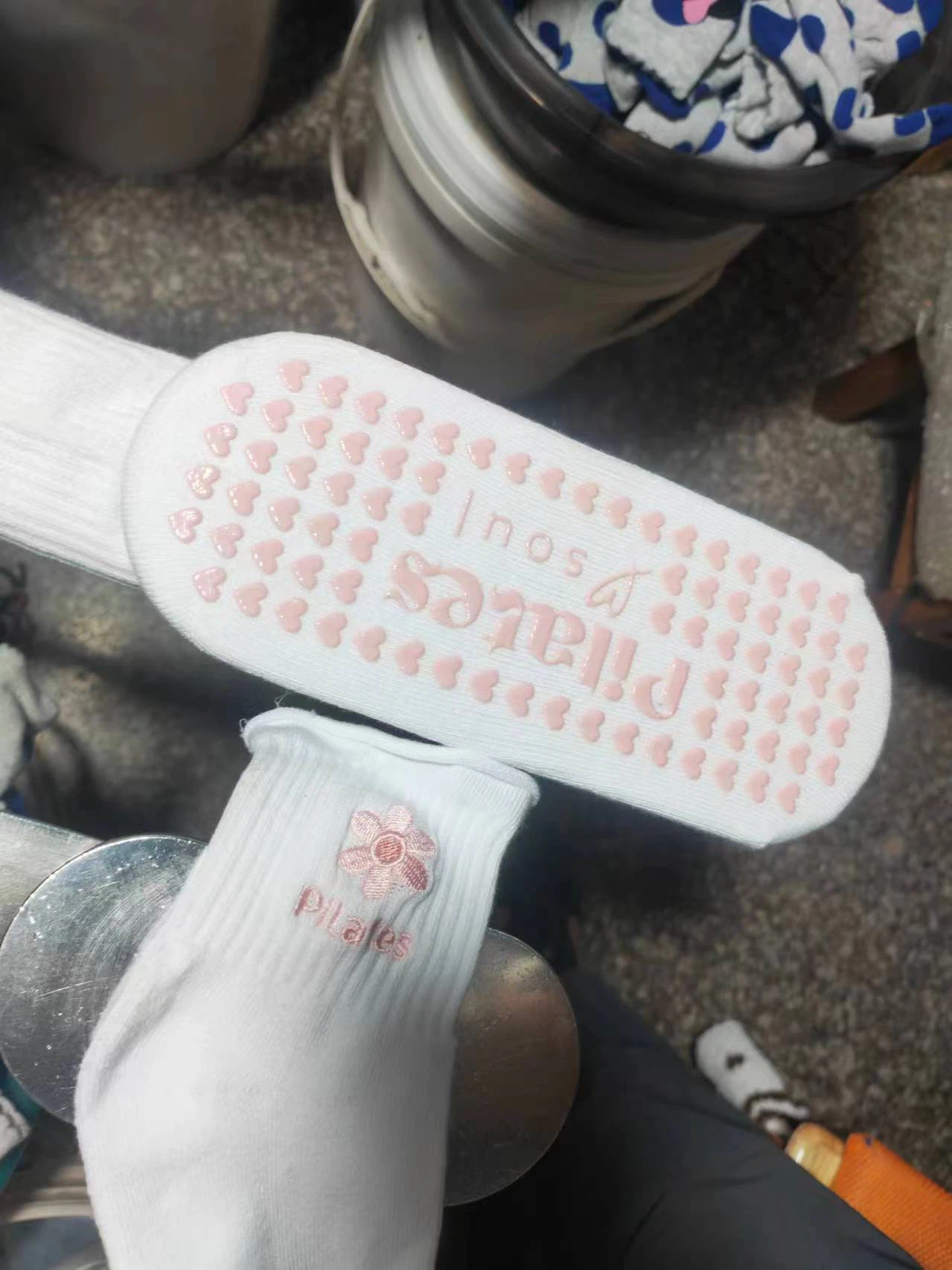
Instead of standard round dots, you can use custom shapes for your grip pattern: hearts, stars, flowers, logos, letters, or any other shape. Custom shaped dots add a unique branded touch and are especially popular with yoga studios, children’s brands, and premium retailers. The example below shows heart-shaped grip dots on Pilates socks — one of our most popular custom patterns. Custom shapes require a one-time screen setup fee ($30-$80 depending on complexity), but there is no additional per-pair cost. If you reorder the same pattern, the setup fee is waived.
Line and Wave Patterns (10% of Orders)
Some grip socks use horizontal lines, wavy lines, or zigzag patterns instead of dots. Line patterns can provide more continuous traction across the sole, and are often used for hospital and senior care socks where maximum slip resistance is required. Line patterns also tend to be more durable than dots because there are no small individual pieces that can peel. For healthcare and senior care, we recommend a herringbone or wave line pattern for the best combination of traction and durability.
Full-Sole Coverage (8% of Orders)
For maximum traction, some grip socks use a full-sole coating that covers the entire bottom of the foot. This is common for trampoline park socks and hospital patient socks. Full-sole coverage provides the highest level of slip resistance but can feel slightly stiffer than dot patterns. We recommend full-sole coverage for high-risk environments (trampoline parks, hospital post-op units) where maximum traction is more important than maximum comfort. For studios and general use, partial coverage (ball and heel) is usually sufficient and more comfortable.
Logo as Grip Pattern (2% of Orders — Premium Option)
A premium branding option is to use your actual logo as the grip pattern on the sole. Every time a customer takes off their shoes, they see your logo on the bottom of their socks. This is a powerful branding tool for studios and retailers — customers essentially become walking advertisements for your brand. Logo grip patterns work best with simple, bold logos with clean lines and at least 5mm stroke width. Very fine details or small text may not reproduce clearly in the grip material. This option requires a custom screen setup and is best for orders of 100+ pairs.
Quality Standards and Testing for Grip Socks
Not all grip socks are created equal. Poor quality grip socks may have dots that peel off after a few washes, uneven grip coverage, or coatings that leave marks on floors. When choosing a manufacturer, look for these quality standards — and ask for proof, not just promises:
- Wash durability test: Quality grip socks should maintain their traction after 50+ commercial washes. Ask your manufacturer for wash test data — we test every batch and can provide results. Our standard: 50 commercial washes with no peeling, no significant traction loss, and no color transfer.
- Adhesion test: The grip coating should not peel, flake, or rub off when scratched with a fingernail or rubbed against a rough surface. We perform a “tape test” on every batch — press strong adhesive tape onto the grip pattern, peel it off, and inspect for any transfer. If any grip material comes off on the tape, the batch fails.
- Coefficient of friction (COF): The slip resistance of grip socks can be measured using a COF test. Quality grip socks should have a COF of 0.5 or higher on smooth surfaces (regular socks typically have a COF of 0.2-0.3). Our PVC grip socks measure 0.6-0.7 COF on hardwood and tile.
- Oeko-Tex certification: For brands selling in the EU, look for Oeko-Tex Standard 100 certification, which ensures the sock materials and grip coating are free from harmful substances (phthalates, heavy metals, formaldehyde, etc.). All of our grip sock materials are Oeko-Tex Standard 100 certified.
- FDA compliance (medical): For hospital and medical use, ensure the grip coating materials are FDA-compliant for skin contact. Our silicone grip material is FDA 21 CFR 177.2600 compliant for repeated skin contact.
- 100% inspection: Ask whether the manufacturer inspects 100% of pairs or only samples. We inspect every single pair — no exceptions. This adds time to production but ensures that no defective pairs reach your customers.
Cost Factors for Custom Grip Socks (2026 Factory-Direct Pricing)
The cost of custom grip socks depends on several factors beyond the base sock cost. Understanding these will help you budget accurately and make decisions that optimize cost without sacrificing quality. Based on our actual 2026 factory-direct pricing:
| Cost Factor | Impact | Notes |
|---|---|---|
| Grip material | Silicone costs 25-40% more than PVC | PVC is standard and most cost-effective; 80% of our orders use PVC |
| Grip coverage | Full-sole costs 15-25% more than partial dot pattern | Ball-and-heel coverage is standard and most economical |
| Custom grip pattern | Custom shapes/logos require $30-$80 screen setup fee (one-time) | Standard dot patterns have no setup fee; setup fee waived on reorders |
| Sock material | Merino wool > bamboo > cotton > acrylic | Acrylic/cotton blend is most common for grip socks (70% of orders) |
| Sock length | Knee-high > crew > ankle > no-show | Ankle and no-show are most popular for studios (65% of orders) |
| Order quantity | Larger orders = lower per-pair cost | MOQ is 10 pairs; best pricing at 500+ pairs |
| Custom packaging | Custom labels, tags, bags add $0.20-$2.50/pair | Standard OPP bag is included at no extra cost |
For reference, here are our actual 2026 factory-direct price ranges for standard ankle-length cotton-blend grip socks with PVC ball-and-heel dot pattern (landed cost including shipping to the US):
- 10-49 pairs: $5.50-$7.50/pair (perfect for testing a new design or studio)
- 50-99 pairs: $4.00-$5.50/pair (small studio or initial retail launch)
- 100-299 pairs: $3.20-$4.50/pair (most common order size for studios and small brands)
- 300-499 pairs: $2.80-$3.80/pair (multi-location studios, mid-size brands)
- 500-999 pairs: $2.40-$3.20/pair (wholesale pricing for established brands and facilities)
- 1000+ pairs: $2.00-$2.80/pair (high-volume production for scaling brands and chains)
Real Grip Socks from Our Factory
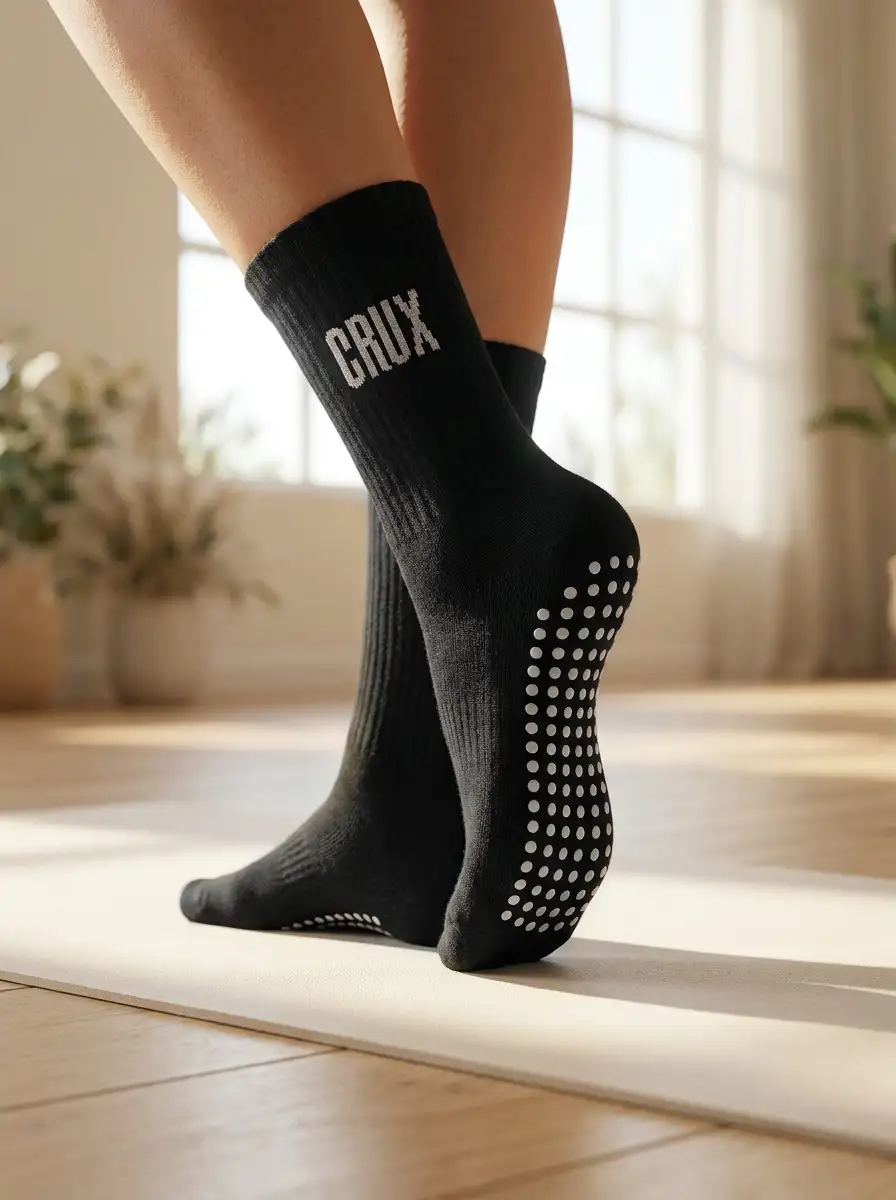
Here are some real grip socks we have produced for our clients. Take a look at the grip dot pattern and quality:
Related Guides
- Custom Jacquard Socks Guide
- Custom Embroidered Socks Guide
- Custom Sock MOQ Guide
- Custom Sock Pricing Guide
What is the minimum order for custom grip socks?
Our factory minimum is 10 pairs per design. This makes it accessible for small studios, startups, and boutique retailers to test custom branded grip socks without large upfront investment. For standard dot patterns, there is no setup fee — you only pay for the socks themselves. We intentionally keep our minimum low because we believe in helping small businesses grow — many of our largest grip sock clients started with a 10-pair test order and now order thousands of pairs per year.
How long does production take?
Samples take 3 days from design approval. Bulk production typically takes 12-18 business days for orders under 500 pairs. Grip socks require an additional 2-3 days compared to regular socks due to the grip printing and curing process. Rush production may be available for an additional fee — ask about our expedited options. Total timeline from design approval to delivery: approximately 3-4 weeks for standard orders, 2-3 weeks for rush orders.
Can I get a sample before ordering in bulk?
Yes — we strongly recommend ordering a sample first. In fact, we require samples for all new grip patterns before bulk production begins. Your sample will include the exact sock material, colors, logo, and grip pattern you specified. This allows you to test the fit, comfort, and grip quality in your actual environment before committing to a bulk order. Sample cost is typically $40-$80 (including shipping), and is credited toward your bulk order if you proceed. We have seen too many studios skip samples and end up with 500 pairs of grip socks that don’t meet their expectations — don’t make that mistake.
Are grip socks machine washable?
Yes — quality grip socks are fully machine washable. For best results, wash in cold water (30°C/85°F), avoid bleach and fabric softener (fabric softener can coat the grip dots and reduce traction), and tumble dry on low heat or air dry. Following these guidelines will maintain grip performance for 50+ washes. Commercial laundry (hot water, high heat drying) may reduce the lifespan of the grip coating to 30-40 washes. For studios and facilities that use commercial laundry, we recommend our heavy-duty PVC formulation, which is specifically designed to withstand commercial washing conditions.
Can the grip pattern include my logo?
Yes — your logo can be incorporated into the grip pattern on the sole. This is a premium branding option that turns every pair of socks into a walking advertisement. Logo grip patterns require a custom screen setup (one-time fee of $30-$80) and are best suited for simple, bold logos with clean lines and at least 5mm stroke width. Very fine details or small text may not reproduce clearly in the grip material. If your logo is complex, we recommend using it on the sock cuff (via jacquard weaving or embroidery) and using a standard dot or custom shape pattern on the sole.
Do grip socks work on all floor types?
Grip socks work best on smooth, hard surfaces: hardwood, laminate, tile, marble, studio floors, and hospital flooring. They also work on yoga mats and trampoline mats. On carpet, grip socks provide minimal additional traction (regular socks already grip carpet well). On wet or very slippery surfaces (wet tile, polished concrete), grip socks help but may not eliminate all slip risk — use caution. Our testing shows the following COF values on different surfaces: hardwood 0.65, tile 0.60, marble 0.55, yoga mat 0.70, trampoline mat 0.65, carpet 0.35 (regular sock 0.30).
Can I order grip socks without any logo on the sock body?
Yes — you can order plain grip socks with no logo on the sock body, or with only the grip pattern on the sole. Many trampoline parks and hospitals order plain grip socks with no branding to keep costs low. However, we recommend adding at least a small logo or tag to build brand recognition and prevent theft/misplacement in shared facilities. A small jacquard logo on the cuff adds only $0.20-$0.40 per pair and provides significant branding value — we estimate that branded socks are 3x less likely to be lost or stolen in studio and facility environments.
What is the difference between grip socks and regular non-slip socks?
The terms “grip socks,” “non-slip socks,” “anti-slip socks,” and “skid-free socks” are often used interchangeably — they all refer to socks with a traction coating on the sole. However, there can be differences in quality and performance: “hospital socks” or “patient slipper socks” typically refer to disposable, low-cost socks with a basic non-slip coating, often used once and discarded. “Grip socks” typically refers to higher-quality, reusable socks with a durable PVC or silicone coating designed for repeated use in studios, facilities, and retail. Our factory produces both types — let us know your use case and we will recommend the right product for your needs and budget.
Ready to Start Your Custom Grip Sock Project?
Whether you own a yoga studio, run a hospital supply business, operate a trampoline park, manage a hotel resort, or are building a grip sock brand, our factory has the expertise and capacity to deliver high-quality custom anti-slip socks with your exact specifications. With 3-day samples, 10-pair minimums, both PVC and silicone grip options, 100% quality inspection, and Oeko-Tex certified materials, we make custom grip sock production accessible for businesses of all sizes.
We have produced custom grip socks for clients ranging from single-location yoga studios to multi-state hospital chains, from independent trampoline parks to international resort brands. No matter the size of your order, you get the same factory-direct quality, responsive communication, and attention to detail. We also produce custom jacquard socks and custom embroidered socks — if you need multiple sock types for your business, we can handle everything in one order.
Contact us on WhatsApp for a free design consultation and quote. Send us your logo, desired quantity, grip material preference (PVC or silicone), and any specific requirements — we will respond within 24 hours with a digital mockup, sample options, and detailed pricing. Not sure which grip pattern or material is right for you? We will send you free samples of our most popular options so you can test them in your actual environment.